Man Collecting Beetles Near Stockholm Summer Cottage
Finds Copper Cauldron Filled with Over 20,000 Silver Coins
Rare Coins Depicting Swedish King and Bishops Also Discovered
A Swedish man has drawn attention after discovering 20,000 medieval silver coins while catching bugs on the outskirts of Stockholm. On October 11 (local time), the science news outlet Live Science reported, "The Stockholm County Administrative Board announced in a statement last month that an unusually large quantity of well-preserved silver artifacts had been found in its jurisdiction."
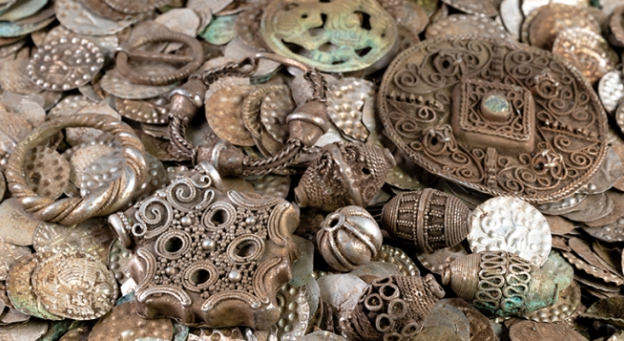 Silver coins and various treasures discovered on the outskirts of Stockholm, Sweden. Stockholm County Administrative Board
According to the report, the finder stated that he was digging near his summer cottage to collect ground beetles when he came across a copper cauldron, which contained various treasures. The total weight of the hoard was about 6 kilograms, most of which were silver coins, along with silver rings, pendants, and beads. It is estimated that there are more than 20,000 silver coins. Sofia Andersson, the antiquities officer at the Stockholm County Administrative Board, said, "Most of the artifacts were well preserved, but the copper cauldron that contained them was not in good condition."
The silver coins date back to the 12th century, when they were minted and circulated. Some coins are engraved with the Latin word 'KANUTUS,' meaning 'Knut,' which is believed to refer to Knut Eriksson, who was King of Sweden in the late 12th century. In medieval Europe, coins known as 'bishop coins' were also minted, specifically for the bishop, the head of the diocese. Several silver coins depict a bishop holding a staff in his right hand, which draws attention.
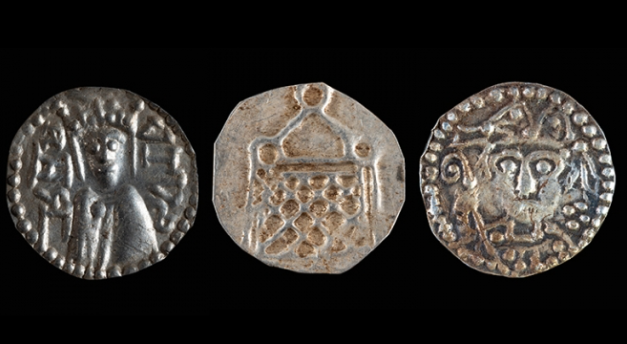 Silver coin depicting 12th-century Swedish king Knut Eriksson (left), Gotland coin engraved with a church building (center). The bishop coin (right) draws attention with the image of him holding a staff. Stockholm County Administrative Board
According to Lin Annerb?ck, director of the Stockholm Medieval Museum, Stockholm did not exist in the late 12th century, when these coins were in circulation. The city of Stockholm was founded in 1252 by a politician and grew to become Sweden's largest city by the end of the 13th century. Annerb?ck commented that the late 12th century is "completely unique. Moreover, the sheer scale makes this a truly fascinating discovery," adding, "It appears that many people at the time hid such treasures to protect their family wealth. The way the silver coins are mixed with pearls and other treasures looks like evidence that someone stashed away their fortune."
Currently, archaeologists are working to examine and document the discovered artifacts. The County Administrative Board will not disclose the exact location of the find until the investigation is complete. The artifacts will be reported to the Swedish National Heritage Board, which will decide whether the county government should reclaim the artifacts and whether the finder will receive a reward.
The Stockholm County Administrative Board stated, "The finder immediately contacted the local administrative board, which was the right thing to do," adding, "Anyone who discovers buried artifacts is required to report them to the authorities so that the state can pay a reward and recover them."
© The Asia Business Daily(www.asiae.co.kr). All rights reserved.


















