2025 Nobel Laureate in Economics Peter Howitt Holds Press Conference
Urges Korea: "Revitalize Innovation Dynamism with Antitrust Policies"
AI as a General-Purpose Technology Following Electricity and Steam Engines... Currently in a Big Shakeout
"The key to solving Korea's aging population problem is openness to external ideas. The country must remain open so that the inflow of new ideas and innovations is not restricted."
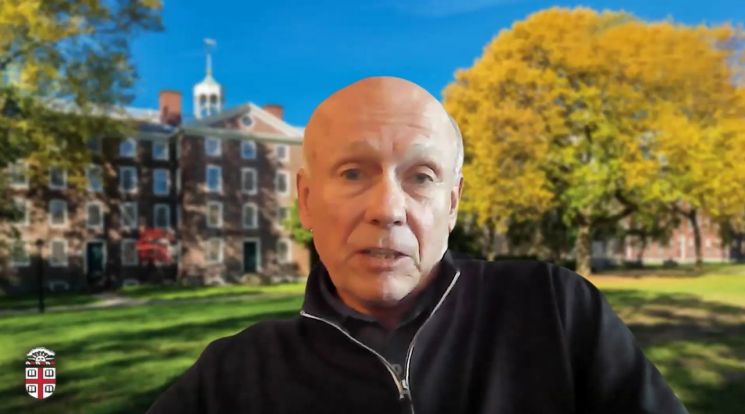 Peter Howitt, professor at Brown University in the United States and co-recipient of the 2025 Nobel Prize in Economic Sciences, held an online press conference on the 13th (local time).
Peter Howitt, professor at Brown University in the United States and recipient of the 2025 Nobel Prize in Economic Sciences, made this statement during a press conference held immediately after the award announcement on the 13th (local time), responding to questions from Korean reporters about the innovation limits faced by aging countries such as Korea.
He explained, "Innovation generally tends to be more active among younger generations, so aging can be disadvantageous to innovation overall. However, not all ideas in a country necessarily originate domestically. Ideas can flow across borders, and academia can serve as an important channel for this." Professor Howitt's remarks are interpreted as suggesting that innovation can be driven by international openness, including the inflow of foreign technology and research talent, as well as immigration.
Regarding ways to foster innovation in Korea's economy, which is centered on manufacturing and large corporations, he emphasized, "A strong antitrust policy is extremely important."
He pointed out that even in the United States, monopolistic power has grown in some industries, restricting innovation. "Joseph Schumpeter once argued that monopoly was the motivation for innovation, but our research has shown that escaping competition provides a stronger incentive for innovation," he explained. He continued, "The fiercer the competition, the greater the incentive for incumbent market leaders to continue innovating and stay ahead of the competition. This is what successful countries like Korea should focus on if they wish to sustain innovation going forward," he added.
Professor Howitt also stressed, "New technologies are often introduced by external innovators who disrupt the existing order, but once they succeed, they soon become the new vested interests. Institutions must be designed so as not to block this generational turnover."
He predicted that the recent artificial intelligence (AI) industry "could become another general-purpose technology, following electricity, the steam engine, and the information technology revolution of the 20th century." However, he diagnosed that we are currently in a "big shakeout period," where it is unclear who will take the lead and where the effects of creative destruction will be directed.
Professor Howitt noted that while AI is a technology with tremendous potential and possibilities, it also carries the risk of replacing or destroying many jobs. "This conflict can only be resolved through regulation. Relying solely on private incentives in an unregulated market makes it difficult to resolve this conflict in a way that is best for society," he said.
He also expressed concern about the impact of President Donald Trump's strengthening of protectionism on creative destruction.
Professor Howitt stated, "It is important to maintain openness in trade. While the impact of trade on economic growth is varied, if the trade environment changes drastically (becomes restricted), the biggest problem will be a reduction in market size." He continued, "If large-scale trade wars, tariff hikes, or trade restrictions shrink the market and countries are forced to trade only domestically due to increased border costs, the accessible market for R&D investors seeking to develop and sell new products will shrink, and the incentive for innovation will also weaken. It is important to avoid being caught up in trade wars and to maintain an open market by diversifying trading partners," he emphasized.
In particular, for countries like Korea that are highly dependent on exports, he noted, "Active trade allows you to learn more technologies from other countries. If some major trading partners try to reduce trade, you need to find other partners. There are countless other trading countries in the world besides those retreating from trade," he stressed.
On this day, the Royal Swedish Academy of Sciences Nobel Committee selected Joel Mokyr, professor of economics at Northwestern University in the United States; Philippe Aghion, professor of economics at the London School of Economics; and Professor Howitt as this year's Nobel laureates in economic sciences. Professor Howitt, together with Professor Aghion, who was a co-recipient of the 1992 Nobel Prize in Economic Sciences, established a mathematical model of Schumpeter's theory that 'creative destruction' driven by technological innovation leads to economic growth.
© The Asia Business Daily(www.asiae.co.kr). All rights reserved.
![User Who Sold Erroneously Deposited Bitcoins to Repay Debt and Fund Entertainment... What Did the Supreme Court Decide in 2021? [Legal Issue Check]](https://cwcontent.asiae.co.kr/asiaresize/183/2026020910431234020_1770601391.png)
















