Study by 160 Scientists from 23 Countries
80% of Coral Reefs Worldwide Experiencing 'Bleaching'
A new study has found that global warming has already pushed coral reefs worldwide beyond the threshold at which they can survive.
On October 13 (local time), according to AFP, dpa, and other news agencies, more than 160 scientists from 23 countries around the world warned in a report that the Earth has reached a critical threshold due to rising average temperatures, and that crossing this threshold would accelerate ecosystem collapse.
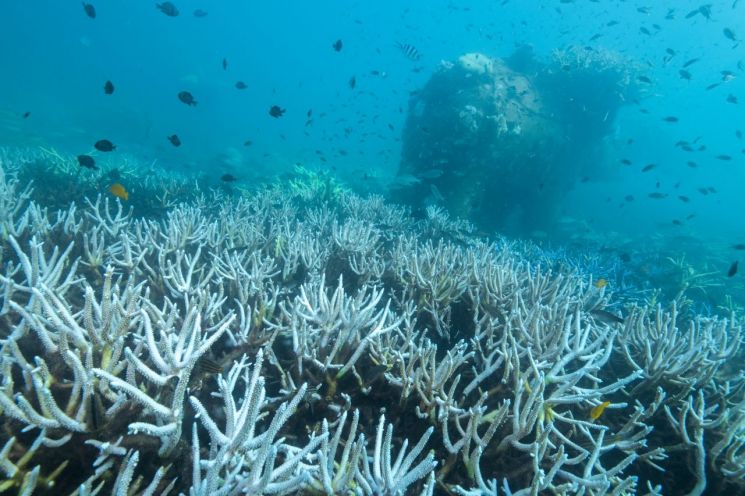
The first tipping point caused by climate change, as defined by the researchers, is the widespread die-off of coral reefs around the world. According to the report, large-scale coral mortality can begin to occur when the global average temperature rises by about 1.2°C above pre-industrial levels. However, the current level of warming is estimated to be around 1.3 to 1.4°C, meaning that the temperature has already surpassed the limit that coral reefs can endure.
"If temperatures rise 1.5°C above pre-industrial levels, coral reefs will become extinct"
The report pointed out that coral reefs worldwide are experiencing unprecedented die-offs. Over the past two years, more than 80% of the world's coral reefs have exhibited bleaching due to rising sea temperatures. Bleaching refers to the phenomenon where corals expose their white skeletons. Even when this occurs, corals can survive for a certain period, but if the bleaching persists, their growth slows, they become more susceptible to disease, and eventually die. Scientists believe that if the global average temperature rises 1.5°C above pre-industrial levels, coral reefs will become extinct.
Tim Lenton, a professor at the University of Exeter in the United Kingdom who led this research, warned that if the global average temperature exceeds 1.5°C, "the risk of additional destructive tipping points will accelerate." He added, "We can no longer say that tipping points are just a future risk." In other words, if greenhouse gas emissions are not drastically reduced, the 1.5°C threshold could be reached within the next decade.
However, Peter Mumby, a professor at the University of Queensland in Australia and a coral expert, expressed caution regarding the pessimistic interpretation of the report. He explained, "While it is necessary to improve management of coral reefs to cope with the onslaught of climate change, we should be careful not to interpret this report as a claim that coral reef habitats will completely collapse."
In addition, the report found that the Amazon rainforest could also be at risk of crossing its tipping point even before the global average temperature reaches the 2°C target set by the Paris Climate Agreement.
© The Asia Business Daily(www.asiae.co.kr). All rights reserved.

















