From 781,000 in 2017 to 2.78 Million Last Year
City Plans to Establish Next-Generation Integrated Transfer Center
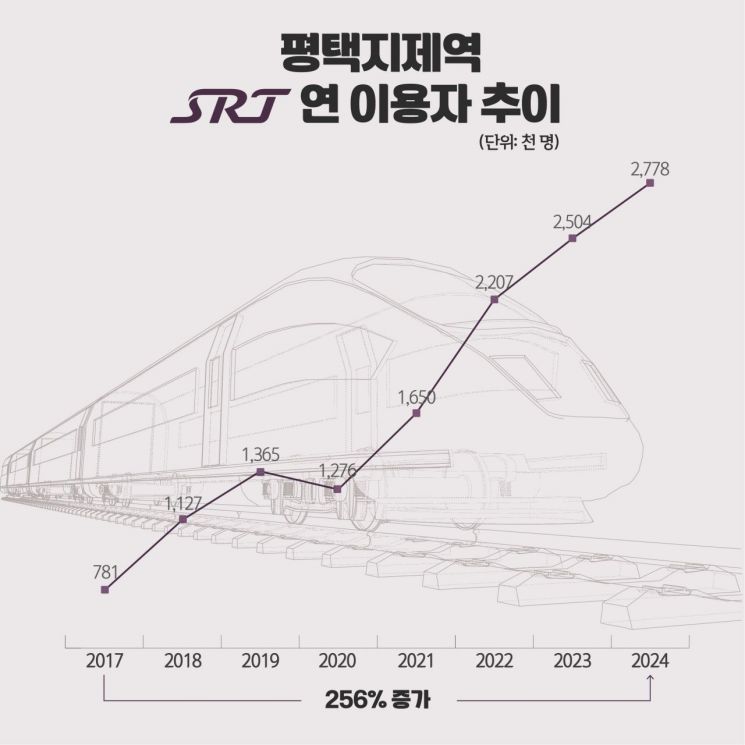
Due to the development of large-scale new towns and the impact of the Samsung Electronics Pyeongtaek Campus, the number of passengers using SRT Pyeongtaek Jije Station has nearly quadrupled over the past seven years.
According to Pyeongtaek City on October 13, the number of passengers at SRT Pyeongtaek Jije Station was 781,000 in the year following its opening, but last year it reached 2,778,000, marking a 256% increase. This growth rate is the highest among all 32 SRT stations.
SRT is a high-speed train service launched in December 2016 to alleviate rail congestion, connecting major cities nationwide with Seoul Suseo Station as its starting point. At the time of its opening, it operated at 17 stations, and it has since expanded to 32 stations.
The station's annual passenger ranking also rose from 11th to 7th during this period. In the early days after opening, it had fewer passengers than stations such as Singyeongju, Cheonan Asan, Osong, and Iksan, but last year it surpassed these stations.
Pyeongtaek City cited the development of new towns such as Godeok International New Town and the establishment of large corporations, including Samsung Electronics, as the main factors behind this increase.
The city expects the number of passengers at Pyeongtaek Jije Station to continue to grow. A city official stated, "With the ongoing development of Godeok International New Town and the addition of Brain City, the surrounding population is expected to reach 400,000."
In addition, the city anticipates a steady increase in passengers at Pyeongtaek Jije Station with the planned KTX stop in 2026, GTX-A operation in 2028, and GTX-C operation in 2030.
Accordingly, the city is planning to establish Pyeongtaek Jije Station as a next-generation transfer center. A next-generation transfer center refers to a transportation hub that not only connects rail and bus networks but also integrates future mobility options such as urban air mobility, autonomous vehicles, and electric and hydrogen vehicles. The city also plans to add multifunctional spaces to accommodate various business activities.
To this end, the city held an investment briefing for the construction of a "next-generation integrated transfer center" at the end of last month and plans to select an operator for the project next year.
© The Asia Business Daily(www.asiae.co.kr). All rights reserved.
![Clutching a Stolen Dior Bag, Saying "I Hate Being Poor but Real"... The Grotesque Con of a "Human Knockoff" [Slate]](https://cwcontent.asiae.co.kr/asiaresize/183/2026021902243444107_1771435474.jpg)
















