Establishing Korea’s First Carbon-Neutral Industrial Complex
Preparing for a Sustainable Future through Energy Transition with Renewables and Hydrogen
Bridging the Energy Gap and Enhancing Citizen Well-Being through Energy Welfare
Expanding a Stable Power Grid and Boosting Energy Self-Sufficiency
Strengthening Energy Conservation and Safety Management
Gumi City in North Gyeongsang Province is accelerating a large-scale project to transition toward a sustainable energy society, establishing itself as a hub of energy innovation.
The city is implementing a range of energy policies, from creating a carbon-neutral industrial complex to expanding energy welfare, in an effort to transform Gumi’s future.
Gumi was selected for the Ministry of Trade, Industry and Energy’s “Carbon-Neutral Industrial Complex Flagship Model Construction Project,” laying the foundation for Korea’s first carbon-neutral industrial complex. With this selection, the city secured a total project budget of 130.2 billion won, including 50 billion won in government funding, and is accelerating the establishment of a virtuous cycle for carbon neutrality within the Gumi National Industrial Complex.
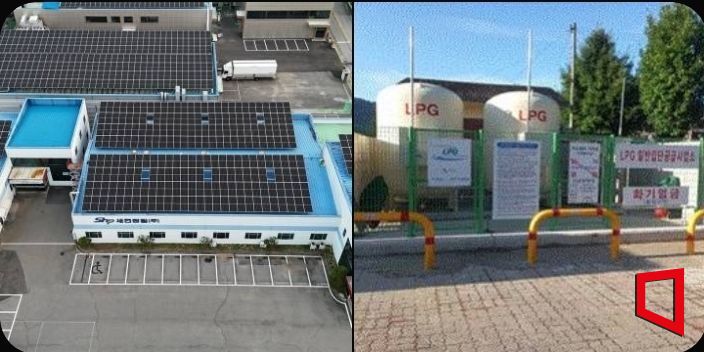 Left) Solar panel installation on the factory roof Right) Small storage tank installation / Photo by Kim Ihwan
The main initiatives include a 30MW-class solar power plant, the introduction of a 50MWh energy storage system and intelligent power trading system, the creation of an ecosystem for battery recycling, and customized consulting and eco-friendly facility support for companies. These efforts will enable local businesses to respond to global carbon regulations such as RE100 and the Carbon Border Adjustment Mechanism, thereby enhancing the price competitiveness of their exports.
Last year, Gumi enacted the “Gumi City Basic Energy Ordinance,” and in April this year, officially launched the “Gumi City Energy Committee.” The city is currently conducting a regional energy strategy planning study, which will be completed within the year to kick off full-scale energy industry promotion and energy welfare projects. In addition, Gumi is implementing practical projects to expand the adoption of renewable energy.
Through the “Renewable Energy Supply Project,” the city invested approximately 6 billion won by 2024, supplying renewable energy to 811 locations. In 2025, Gumi plans to supply renewable energy to 141 locations with a budget of about 1 billion won.
In the hydrogen economy sector, the “Preliminary Hydrogen Specialized Enterprise Fostering Support Project” in 2024 supported one company, resulting in a 57% increase in sales. In 2025, the city is investing 300 million won to support three companies.
To enhance residents’ quality of life and energy accessibility, Gumi is actively promoting the “City Gas Supply Project for Non-Supplied Areas” and the “LPG Small Storage Tank Supply Project for Rural Villages.”
In 2024, the city completed the installation of approximately 1,726 meters of city gas pipelines in five locations, including Saneup and Sagok-dong, which previously lacked city gas supply.
In 2025, Gumi plans to install 550 meters of pipelines in the Okgyedong area. To address the inconvenience caused by the lack of city gas supply, the city is amending relevant ordinances to expand supply coverage and eliminate energy blind spots. The LPG small storage tank supply project for rural villages is also progressing smoothly.
The LPG small storage tank supply project was completed in 2024, and in 2025, the city will invest about 3.6 billion won to continue the project. From 2026, Gumi plans to expand the project to 50 villages and 4,000 households over five years.
A 500MW natural gas power plant under construction in Gumi National Industrial Complex No. 5 is scheduled for completion by the end of the year. Once fully operational, Gumi’s energy self-sufficiency rate will rise significantly from 9% to 38%, enabling the city to proactively respond to the regionally differentiated electricity pricing system under the Special Act on Distributed Energy Activation.
The city is also implementing various energy-saving policies targeting both the public and private sectors.
Through the “LED Lighting Replacement Project for Vulnerable Groups and Social Welfare Facilities,” Gumi invested about 200 million won in 2024 to replace outdated lighting with high-efficiency LED lighting in 125 households from vulnerable groups and 74 social welfare facilities. In 2025, the project will target 80 households and 20 social welfare facilities.
Additionally, the city is working to reduce the operational burden and electricity costs of social welfare facilities through the “High-Efficiency Heating and Cooling Equipment Support Project for Social Welfare Facilities” and the “Heat Recovery Ventilation System Project for Welfare Facilities.”
In 2024, Gumi provided high-efficiency heating and cooling equipment to 31 social welfare facilities and installed heat recovery ventilation systems in eight senior welfare facilities.
This year, the city is supporting the installation of heating and cooling equipment in 28 social welfare facilities and ventilation systems in five senior welfare facilities. In 2026, Gumi plans to newly launch a support project for high-efficiency equipment targeting small business owners.
To prevent fires and enhance safety management, the city is supporting the replacement of arc fault circuit interrupters, the installation of gas safety shut-off devices, and safety inspections for households using LPG.
In 2024, Gumi completed the replacement of arc fault circuit interrupters in 30 social welfare facilities, installed gas safety shut-off devices in 500 households using gas, and supported safety inspections for about 1,800 households in Mueul-myeon and Okseong-myeon.
This year, the city is replacing arc fault circuit interrupters in 17 social welfare facilities, installing gas safety shut-off devices in 300 households, and supporting safety inspections for about 1,000 households in Dogae-myeon, thereby strengthening safety measures.
Going forward, in line with the government’s carbon neutrality energy policies, Gumi will expand the adoption of renewable energy centered on industrial complexes and promote a variety of eco-friendly energy projects to foster a green industry ecosystem through support for technology development.
Gumi Mayor Kim Jangho stated, “Gumi is the heart of Korea’s manufacturing industry, and the establishment of the carbon-neutral industrial complex marks a significant turning point for securing future industrial competitiveness. We will continue to expand energy policies that enable industry and the local community to grow together.”
© The Asia Business Daily(www.asiae.co.kr). All rights reserved.
![Clutching a Stolen Dior Bag, Saying "I Hate Being Poor but Real"... The Grotesque Con of a "Human Knockoff" [Slate]](https://cwcontent.asiae.co.kr/asiaresize/183/2026021902243444107_1771435474.jpg)











