"Xi Does Not Want a Recession in China, and Neither Do I"
Conciliatory Message Amid Clashes Ahead of Summit at Month's End
Vice President Vance: "China Must Choose a Rational Path"
USTR Chief Greer: "President Willing to Talk"
As the United States and China escalate their trade war by imposing rare earth export controls and 100% super-high tariffs on each other ahead of their upcoming summit in Gyeongju, South Korea at the end of this month, U.S. President Donald Trump stated on the 12th (local time), "The United States is trying to help China, not harm it." With tensions running high before the first face-to-face summit between the two leaders in six years, President Trump appears to be sending a conciliatory message to prevent the conflict from escalating further and to allay concerns that the summit might be canceled. This move also seems intended to calm the financial markets, which have been unsettled by the recent sharp decline in stock prices, while managing the ongoing trade tensions with China.
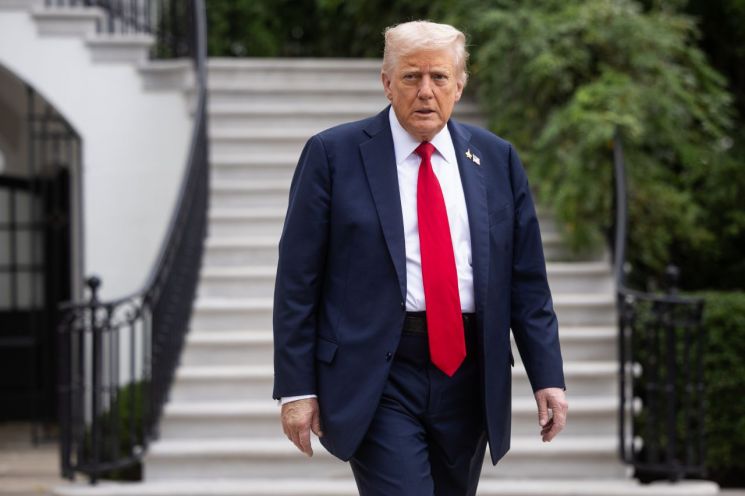
On the same day, President Trump posted on his self-created social networking service, Truth Social, saying, "Do not worry about China," and "Everything will be fine." He added, "President Xi (Xi Jinping, President of China), who is highly respected, has simply been going through a tough time," and "He does not want his country to fall into a recession, and neither do I."
These remarks came as the United States and China were raising the level of mutual pressure in their trade policies ahead of the U.S.-China summit scheduled to take place during the Asia-Pacific Economic Cooperation (APEC) summit in Gyeongju at the end of this month. Recently, after China tightened its controls on rare earth exports, the United States responded on the 10th by announcing that it would impose an additional 100% tariff on Chinese products starting November 1. The current average U.S. tariff rate on Chinese goods is about 55%, and the plan is to raise it to 155%.
President Trump's latest remarks are interpreted as an attempt to avoid a full-blown conflict and to leave room for dialogue. Previously, he had even mentioned the possibility that the U.S.-China summit might be canceled, but later said, "I plan to go there (South Korea), so the summit may take place," thus leaving open the possibility for negotiations. In particular, as the U.S.-China trade conflict intensified and the New York Stock Exchange plunged on the 10th, wiping out $2 trillion in market capitalization in a single day and causing instability in the financial markets, this seems to be another reason for President Trump's conciliatory gesture.
However, President Trump's simultaneous mention of a "recession" is also seen as a warning that he may increase pressure on China if it continues to restrict rare earth exports.
Within the Trump administration, there were also repeated messages on this day expressing a desire to avoid a trade war, while also calling for changes in China's policies.
U.S. Vice President J.D. Vance said in an interview with Fox News that he hopes China "chooses a rational path," adding, "This is a very delicate balancing act, and much depends on how China responds." He continued, "If China responds in a very aggressive manner, I can assure you that the U.S. President has far more cards than China," but also said, "If they are willing to respond rationally, the United States will do the same."
Vice President Vance mentioned that he spoke with President Trump over the phone several times over the weekend and that "he appreciates the friendship he has built with President Xi." However, he warned, "We have a lot of leverage, and neither I nor the President want to use it," and "If China moves to block global access to some of the products it manufactures, our good relationship will be at risk."
Jamison Greer, the U.S. Trade Representative, also criticized China's rare earth export controls while leaving the door open for dialogue. In an interview with Fox News, he said that regarding China's rare earth export control measures, "We were not given prior notice, and after learning about it through public reports, we requested a phone call with China, but they postponed it." He criticized this as an "attempt to seize power." He also argued, "We have refrained from broad tariffs under the previous U.S.-China tariff reduction agreement, but China has expanded its rare earth export controls," calling this a "clear violation of the agreement."
However, Greer added, "If (China) is interested in dialogue, the President, as is well known, is always willing to talk," thus leaving open the possibility of the U.S.-China summit taking place in Gyeongju.
Rare earth elements are key materials for advanced industries such as semiconductors and electric vehicle batteries, with China accounting for about 70% of the global supply. If China controls the supply chain of this strategic resource, it could deal a fatal blow to the United States.
As President Trump has expressed his intention to avoid a full-scale conflict, attention is focused on whether the United States and China can resolve their differences and find a dramatic compromise ahead of the summit scheduled for the end of this month. Since both sides would inevitably suffer significant damage if negotiations break down, there are predictions that the situation will eventually move toward a resolution. The United States could suffer major losses in its automotive industry due to China's rare earth controls, while China, already facing economic difficulties from youth unemployment and sluggish domestic demand, would find it difficult to withstand further deterioration if the conflict with the United States drags on.
© The Asia Business Daily(www.asiae.co.kr). All rights reserved.

















