Justified as Reducing the Burden on Small Business Owners...
Concerns Over Industry Contraction and Diminished Consumer Benefits
Academia Analyzes Consumer Impact of Commission Regulations
Need for Alternatives to Mitigate Negative Effects on the
As controversy continues over the delivery "commission fee cap system" (a system that limits the maximum commission rate of delivery platform intermediaries through law or administrative guidelines), there are growing calls to devise alternatives to minimize the potential adverse effects on the market. While the commission fee cap system, promoted mainly by the political sphere and the government, is justified as a way to reduce the burden on small business owners such as partner stores, concerns have also been raised that it could actually shrink the industry and reduce both riders' earnings and consumer benefits. Recently, various analyses from academia regarding the impact of commission fee regulations on consumers have further strengthened the need to seek alternatives.
 As controversy over the delivery fee cap continues, there is a growing call to devise alternatives to minimize the adverse effects on the market. Yonhap News
According to the delivery industry on October 13, a series of noteworthy research and survey results related to the commission fee cap system have been released recently. One representative example is the consumer perception survey on the delivery app commission fee cap system presented by Professor Lee Sunghui of Hoseo University at the Korea Society of Product Policy Forum on October 1. According to Professor Lee's survey of about 1,000 people, 86% of respondents said they would "reduce food delivery orders" if the cap system were introduced. In addition, 74.7% stated that they would "oppose the commission fee cap system if it leads to a reduction in benefits such as free delivery."
Consumers are concerned about negative impacts that may arise after the introduction of the commission fee cap system, such as increased delivery costs, the discontinuation of free delivery services, and a reduction in discount benefits. Professor Lee explained, "Although the commission fee cap system has good intentions, it is highly likely to cause unexpected side effects for the entire market, such as a decrease in delivery orders and reduced consumer utility. In the platform ecosystem, it is necessary to design policies that go beyond the perspective of simple price regulation and take into account the multifaceted dynamics of the market."
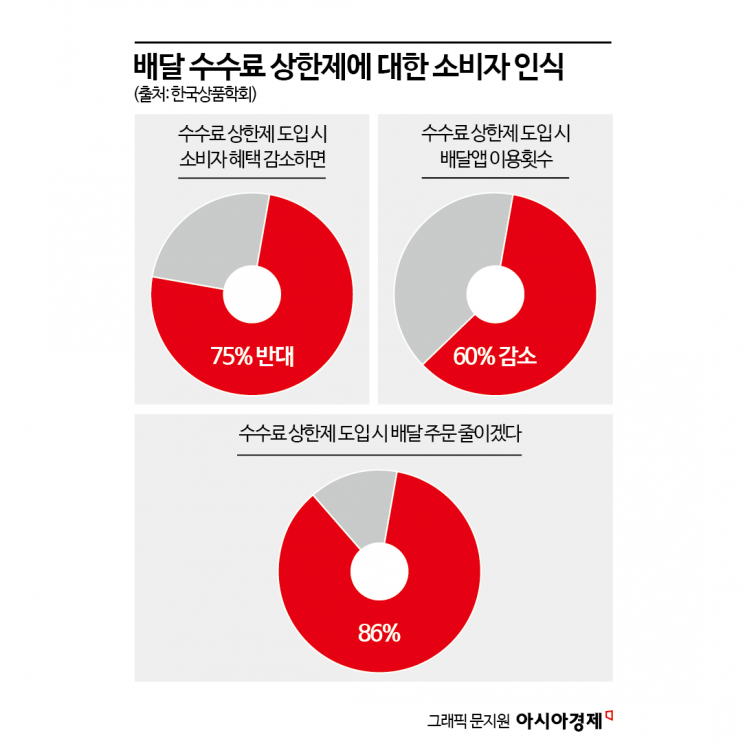
This aligns with the results of a survey presented at the National Assembly on September 5 during a forum on "Consumers' Use of Delivery Apps and Perceptions of Delivery Services." In that survey, about 70% of consumers said they would reduce their use of delivery apps if faced with additional delivery fees. Professor Lee Eunhee of Inha University stated, "If consumers who are reluctant to pay delivery fees reduce their use of delivery services, all parties involved-store owners, riders, and platforms-will face difficulties. Discussions on the total commission fee cap system must consider how it will affect consumer benefits and keep consumers in mind."
Professor Kim Sunghwan of Ajou University also remarked at the Information and Communication Policy Society Forum on September 22, "Even in the credit card industry, commission fees have been lowered for 20 years, but only consumer benefits have decreased. If price regulation is introduced, the delivery app market will shrink in the long term, and the benefits to consumers will diminish."
Concerns Over Negative Impact on the Entire Food Service Industry

The problem is that such consumer impacts could spread to the entire industry, making it difficult to achieve the original goal of protecting small business owners. Internationally, 14 cities, including New York, have implemented commission fee caps, but research by Professor Li Zhuoxin of the University of Wisconsin found that after implementation, delivery orders decreased by 6.8% and the net sales of individual restaurants fell by 3.9%.
Domestically, Professor Lee Yuseok of Dongguk University announced at the Korea Distribution Association Forum on September 25 that if the commission fee cap system is applied, the food service industry’s sales could decrease by 2.5 trillion won and operating profit by about 1 trillion won. When also considering the impact of "discontinuing free delivery," which is being discussed alongside the commission fee cap system, it is estimated that the application of delivery commission regulations could reduce food service industry sales by up to 7.8 trillion won, operating profit by 3 trillion won, and delivery orders by about 300 million. Professor Lee stated, "Since overseas cases have already demonstrated the negative impact of simple price regulation policies in the delivery app market, it is necessary to analyze the various effects that domestic commission fee regulations could have on the market and to approach the issue with caution."
Full-Scale Discussion of Alternatives to the Commission Fee Cap System
Given these circumstances, academia is now actively discussing alternatives to the commission fee cap system. Professor Lee emphasized, "It is necessary to align the goals of various stakeholders. If the government's aim is to protect small business owners, it could consider providing incentives so that delivery platforms can also share this objective."
Professor Jang Myunggyun of Hoseo University explained, "What matters is not what to regulate, but how to regulate. A balanced regulatory framework is needed that protects small business owners and small platforms while ensuring the innovation and expansion of large platforms." Professor Jang proposed a hybrid regulatory model that ensures innovation and fairness. Rather than a uniform cap system, he suggested providing guidelines for unfair trade practices, applying differentiated regulations based on platform size and delivery methods, and implementing temporary caps according to price levels.
Dr. Lee Hyewon of the Small Enterprise and Market Service Policy Research Institute also stated, "The policy focus should be on strengthening the digital capabilities of small business owners so they can fully utilize the data and opportunities provided by platforms and grow independently. Platforms should be viewed as infrastructure for the innovation and growth of small business owners, and fair, mutually beneficial rules should be established within them."
© The Asia Business Daily(www.asiae.co.kr). All rights reserved.



















