According to domestic securities analysts, the so-called 'mini everything rally,' which refers to the simultaneous rise in major asset prices, is expected to continue, driven by the establishment of the artificial intelligence (AI) ecosystem and robust liquidity. Regarding the recent weakness of the Korean won observed during the Chuseok holiday period, analysts explained that it was largely influenced by the depreciation of the Japanese yen and the euro, due to the selection of Japan's new prime ministerial candidate and political instability in France. Therefore, they assessed that this is not a negative factor significant enough to shake the domestic financial market.
Park Sanghyun, a researcher at iM Securities, stated in his report, "Background of the My Way Rally in Asset Prices," released on October 10, "Despite negative factors such as the ongoing U.S. federal government shutdown and political instability in France, major asset prices continued to reach all-time highs during the Chuseok holiday. As we anticipated, the mini everything rally is now in full swing."
Park identified three main reasons why this rally in major asset prices is continuing, even amid the lack of key U.S. economic indicators due to the government shutdown: ▲ Strengthening of the AI ecosystem ▲ Stability in government bond yields ▲ Expansion of yen-driven liquidity and continued low credit risk.
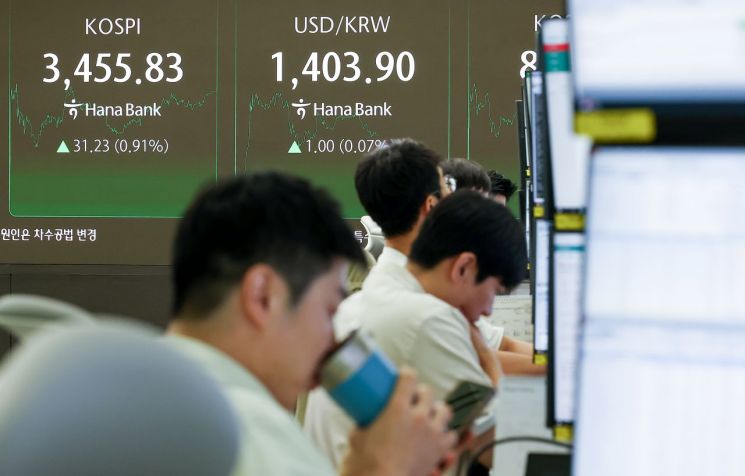 On the afternoon of the 1st, the status board in the dealing room of Hana Bank headquarters in Jung-gu, Seoul, displayed the KOSPI and the won/dollar exchange rate. Photo by Yonhap News
First, Park pointed out, "The rally in the U.S. stock market is being driven by the AI rally," adding, "While this is not a new phenomenon, what stands out is the accelerating pace of the U.S.-led AI ecosystem's development." He explained that the strengthening of organic cooperation among AI service providers, semiconductor manufacturers, and related infrastructure companies is fueling joint growth, which is having a positive impact on both the U.S. and global stock markets.
In addition, Park cited the continued stability of government bond yields in major countries, including the United States and key European nations, despite the U.S. government shutdown and political instability in France, as the second background factor.
The third factor is the liquidity effect and the downward stabilization of major credit spreads. Park noted, "Expectations for increased liquidity driven by Japan's new prime minister and the yen are once again strengthening." He emphasized that with Sanae Takaichi being elected as the new president of the Liberal Democratic Party, virtually securing her position as the next Japanese prime minister, fiscal expansion and monetary easing in Japan are now expected.
He added, "President Sanae is promoting the slogan 'Make the Japanese Archipelago Strong and Prosperous,' and is emphasizing 'Sanaenomics,' which is a continuation of 'Abenomics.' This is already being reflected in the yen, with the dollar-yen exchange rate surpassing 150 yen again." Although President Sanae has yet to reach an agreement to form a coalition government with the Komeito Party, which has caused some initial difficulties, if she is elected prime minister in the upcoming extraordinary Diet session after further negotiations, she will become Japan's first female prime minister in 140 years.
Park also explained, "Despite the prolonged risk of a U.S. federal government shutdown, U.S. credit spreads continue to stabilize downward, and the JP Morgan EMBI spread, which indicates the credit risk of emerging markets, is also on a declining trend." He added, "While the rally in gold prices to record highs suggests some preference for safe assets, the various credit spreads indicate that the global appetite for risk assets is stronger than ever."
He also assessed that the sharp rise in the won-dollar exchange rate to around 1,420 won per dollar during the Chuseok holiday period is not a negative factor significant enough to shake the domestic financial market. Park pointed out that concerns over U.S.-Korea tariff negotiations are an underlying factor in the surge of the dollar-won exchange rate, but emphasized that the weakness of the yen and euro during the holiday period played a bigger role. After President Sanae was elected in Japan, the dollar-yen exchange rate jumped to around 152 yen, indicating the weakness of both the won and the yen against the dollar.
Park stated, "The key concern is whether the weakness of the won, that is, the sharp rise in the dollar-won exchange rate, will act as a major negative factor for the Korean stock market. In conclusion, the negative impact of the weak won will be limited." He added, "Of course, tariff negotiations with the United States remain a potential risk, but at least until the APEC summit, a wait-and-see attitude toward this risk is likely to continue."
He continued, "Regarding the weakness of major currencies, including the won, what should not be overlooked is the mitigating effect on tariff risks that we have emphasized. Although major currencies have weakened and the dollar has strengthened, it is not a situation where the dollar's strength is enough to change the flow of global funds. The conditions for global liquidity to remain active will be maintained for the time being."
Park concluded, "Although there are many concerns in the financial markets, such as the AI overheating debate, the U.S. federal government shutdown, and the Federal Reserve's interest rate cut cycle, the global economy is making slow progress. However, the rally in major asset prices-the mini everything rally-will continue, supported by the development of the AI ecosystem and robust liquidity."
© The Asia Business Daily(www.asiae.co.kr). All rights reserved.
![Clutching a Stolen Dior Bag, Saying "I Hate Being Poor but Real"... The Grotesque Con of a "Human Knockoff" [Slate]](https://cwcontent.asiae.co.kr/asiaresize/183/2026021902243444107_1771435474.jpg)











