"Jungchujeol" Used on District Council Member's Holiday Banner
Netizens Debate the Use of the Term
During the long Chuseok holiday, there was heated debate among netizens over the use of the term "Jungchujeol." The controversy began on October 3, when a district council member in Seoul shared a photo of a holiday greeting banner put up in their district on social networking services (SNS) and other platforms. The banner posted by the council member read, "Have a happy Jungchujeol with your family." In response, one netizen questioned, "Not using the word Chuseok, but Jungchujeol? Are we in China?"
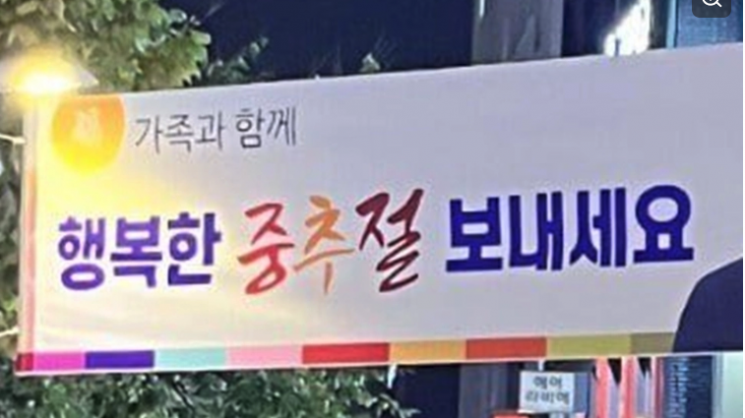 Photo of a holiday greeting banner put up by a district council member in Seoul's district on the 3rd. Online community
Another netizen also criticized the district council member who put up the banner, saying, "Jungchujeol? When have we ever called Chuseok Jungchujeol? It feels like much of our country has been taken over by China," expressing confusion. The post spread across various online communities, and many netizens accused both the banner and the council member who put it up of being pro-China. Amidst this, some netizens countered that "Jungchujeol" is simply another name for Chuseok and has no relation to being pro-China.
However, there were also opinions that using a rarely used term instead of the more popular Chuseok or Hangawi could easily cause misunderstanding. Additionally, some netizens criticized the use of the term Jungchujeol itself, pointing out that it is almost never used nowadays, even if it was used in the past. One netizen even claimed that the council member deliberately used the term Jungchujeol because there are many Chinese residents in the area.
In fact, the Encyclopedia of Korean Folk Culture explains that "Jungchu (中秋) refers to the middle month (the eighth lunar month) of the three autumn months, and when combined with 'jeol' (meaning festival), it is another name for Hangawi (Chuseok), one of Korea's four major holidays." While Hangawi is a pure Korean word combining "han" (meaning big) and "gawi" (meaning middle or derived from "gabae," the origin of Chuseok), Jungchujeol is a Sino-Korean word emphasizing the seasonal meaning of "the middle of autumn." Those refuting the pro-China accusations argue that this controversy stems from a lack of literacy. Furthermore, they point out that defining Jungchujeol solely as a Chinese term effectively hands over one of the traditional Korean names for Chuseok to China. Moreover, Jungchujeol is used not only in Korea and China, but also in other Chinese character cultural spheres such as Vietnam and Singapore.
Meanwhile, although Korea's Chuseok and China's Mid-Autumn Festival (Jungchujeol) fall on the same date, their historical origins and cultural significance are entirely different. Both holidays celebrate the full moon on the fifteenth day of the eighth lunar month, but the rituals, holiday foods, and cultural customs are distinctly separate. Chuseok is a unique Korean holiday dating back to the Three Kingdoms period. The "Samguk Sagi" records that it was called "Gabae" during the reign of Silla's third king, Yuri Isageum. Since the Silla era, ancestral rites and visits to family graves have been practiced, and by the Joseon Dynasty, Chuseok became one of the three major holidays alongside Seollal and Dano. In contrast, China's Mid-Autumn Festival centers on moon-viewing customs, and traditions such as ancestral rites or grave visits are rarely found in historical records. Furthermore, the concept of the Mid-Autumn Festival as a holiday in China was effectively discontinued after the Cultural Revolution in 1966 and was only designated as a legal public holiday in 2008. Until then, it was mainly recognized as a day for eating mooncakes. In contrast, Korea's Chuseok has developed its own unique holiday culture over time, including ancestral rites, visits to graves, and eating songpyeon.
© The Asia Business Daily(www.asiae.co.kr). All rights reserved.
![Clutching a Stolen Dior Bag, Saying "I Hate Being Poor but Real"... The Grotesque Con of a "Human Knockoff" [Slate]](https://cwcontent.asiae.co.kr/asiaresize/183/2026021902243444107_1771435474.jpg)
















