Nobel Committee: "Metal-Organic Frameworks Have Enormous Potential"
Japanese Scholars Receive Both Nobel Prize in Physiology or Medicine and Chemistry This Year
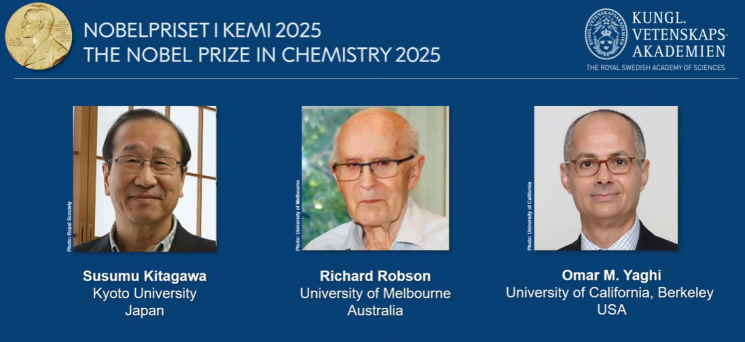
This year’s Nobel Prize in Chemistry has been awarded to three scientists who created a new molecular structure known as Metal-Organic Frameworks (MOFs).
On October 8 (local time), the Royal Swedish Academy of Sciences’ Nobel Committee announced that Susumu Kitagawa (74), professor at Kyoto University in Japan; Richard Robson (88), professor at the University of Melbourne in Australia; and Omar M. Yaghi (60), professor at the University of California, Berkeley in the United States, have been selected as the recipients of the Nobel Prize in Chemistry.
MOFs are crystal structures formed by linking metal ions with organic molecules, creating countless tiny pores inside that allow other molecules to pass through. Utilizing MOFs, technologies have been developed to extract moisture from the air in arid deserts and convert it into water, as well as to capture carbon dioxide from the atmosphere to address the climate crisis.
Heiner Linke, Chair of the Nobel Committee for Chemistry, stated, “Metal-Organic Frameworks have enormous potential. They enable the creation of tailor-made materials with new functions and offer opportunities that were previously unimaginable.”
The Nobel Committee explained that in 1989, Robson constructed an MOF structure centered on copper cations, which resembled a diamond but contained vast empty spaces within. However, this structure was unstable and had the drawback of collapsing easily.
Subsequently, Kitagawa demonstrated that gases could freely pass through the MOF structure and that it was possible to make MOFs flexible. Yaghi succeeded in creating robust and stable MOFs.
The Nobel Committee noted, “Since then, chemists around the world have created tens of thousands of MOFs, some of which are used to solve major human challenges such as carbon capture, addressing water scarcity, and environmental purification.”
With Professor Kitagawa’s award, a Japanese scholar has now received both the Nobel Prize in Physiology or Medicine and the Nobel Prize in Chemistry this year. The Nobel Prize in Physiology or Medicine, announced on October 6, included Simon Sakaguchi, Distinguished Professor at Osaka University in Japan, among the laureates.
The prize money of 11 million Swedish kronor (approximately 1.64 billion won) will be equally divided among the recipients.
Meanwhile, the Nobel Committee has announced the Nobel Prize in Chemistry following the prizes in Physiology or Medicine and Physics. The Nobel Prize in Literature will be announced on October 9, the Peace Prize on October 10, and the Prize in Economic Sciences on October 13.
© The Asia Business Daily(www.asiae.co.kr). All rights reserved.

















