Serious Secondhand Smoke Exposure Among Teenagers
in Multi-Family Housing Areas, Commercial Districts, and Academy Zones
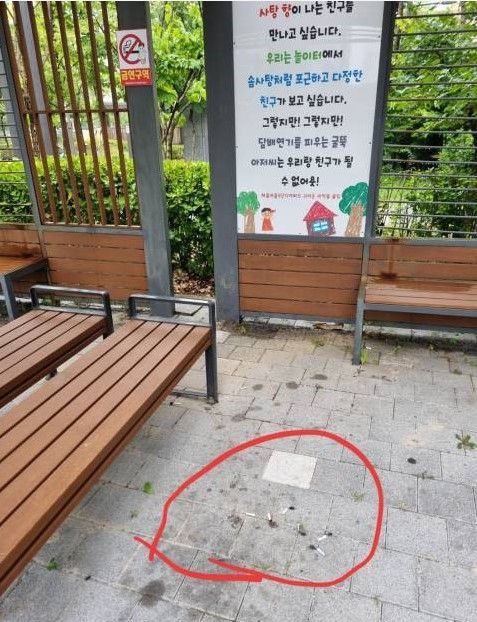 Traces of smokers smoking and discarding cigarette butts at a children's playground installed within a multi-family housing area in Daepyeong-dong, Sejong City.
 Photo by Kim Giwan
There are growing calls for stronger measures from health authorities, as teenagers continue to be exposed to cigarette smoke even within designated non-smoking areas. In particular, incidents of smoking and discarding cigarette butts have been detected at children's playgrounds within multi-family housing complexes.
According to health authorities in Sejong City on October 8, a total of 12,713 locations have been designated as non-smoking areas under local ordinances as of this year.
Notably, compliance with non-smoking regulations is lacking in multi-family housing areas and commercial districts such as Daepyeong-dong, Boram-dong, and Sodam-dong, which are part of the local government administrative town, as well as in areas with a high concentration of private academies. As a result, there are increasing complaints that teenagers are routinely exposed to cigarette smoke and are subject to secondhand smoke in their daily lives.
Under current ordinances, those who smoke in non-smoking areas are subject to fines ranging from 30,000 won to a maximum of 100,000 won. In particular, smoking within multi-family housing areas, near schools, or in commercial buildings housing private academies incurs the maximum fine.
Despite ongoing publicity efforts, there are criticisms that non-smoking area designations have become ineffective in school zones and academy districts, where there is a high flow of teenagers. Moreover, even staff members at private academies, who are responsible for educating youth, are reportedly smoking inside commercial buildings, which is said to have a significantly negative impact on teenagers' health.
Secondhand smoke, which occurs when non-smokers inhale smoke exhaled by smokers, poses serious health risks. It is known to increase the risk of cardiovascular diseases (such as arteriosclerosis, myocardial infarction, and heart failure), respiratory diseases, lung cancer, laryngeal cancer, esophageal cancer, and various other cancers. Children and pregnant women are especially vulnerable, and exposure can negatively affect fetal growth and development.
An official from the public health center stated, "Under current law, imposing fines is the strongest measure available for smoking in non-smoking areas." The official added that compliance ultimately depends on the conscience of smokers.
Some have pointed out, "While fines imposed on individuals for smoking in non-smoking areas are one thing, more forceful action should be taken against smoking in designated non-smoking commercial buildings." They emphasized, "Management offices of commercial buildings should establish internal rules and take responsibility for enforcement to ensure that strong measures are implemented."
© The Asia Business Daily(www.asiae.co.kr). All rights reserved.

















