Only One-Day Holiday for Chuseok...
Grave-Visiting Customs Remain the Same
Travel Permit Required for Movement Outside One's Residential Area
Chuseok, along with Seollal, is one of the most representative traditional holidays for Koreans. But does the saying, "May every day be as bountiful as Chuseok," hold true in North Korea as well?
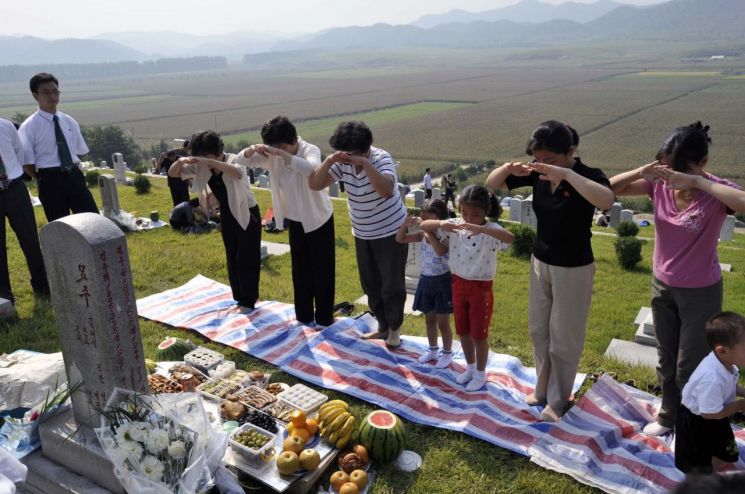
In North Korea, Chuseok is also observed as a national holiday. Unlike South Korea, where the holiday period lasts at least three days, North Korea only designates the actual day of Chuseok, October 6, as a holiday. On this day, North Koreans visit their ancestors' graves to pay respects and hold ancestral rites with dishes made from the year's new harvest. After visiting the graves, it is customary for families and relatives to share food together, a tradition similar to that of the South. However, due to restrictions on freedom of movement in North Korea, people must obtain a travel permit from the authorities to visit graves located outside their residential area. As a result, there is no large-scale "national migration" as seen in South Korea.
Representative Chuseok foods in North Korea include songpyeon and chestnut danja. Songpyeon is made with various fillings such as black beans, sesame seeds, chestnuts, or jujubes, depending on the region. Chestnut danja is a dish made by shaping glutinous rice flour into balls and topping them with honey and boiled chestnuts. The customs of Chuseok in North Korea are also similar to those in the South. During the day, people enjoy traditional folk games such as ssireum (Korean wrestling), swinging, and tug-of-war, and at night, they make wishes while gazing at the full moon.
Once Abolished as "Feudal Remnants"
Although Chuseok is now celebrated in a manner similar to the South, there was a time when North Korea abolished Chuseok and other folk holidays, considering them remnants of feudalism.
In 1967, President Kim Il-sung issued an order to "eliminate feudal remnants," which led to the abolition of Chuseok and other traditional holidays. Nevertheless, North Korean residents continued the custom of visiting ancestral graves in secret. In the 1980s, as Chairman Kim Jong-il began to emphasize "Our Nation First" ideology to strengthen the regime, Chuseok was officially reinstated as a holiday in 1988. In addition, North Korea designated other folk holidays such as Lunar New Year, Hansik, and Dano. Following the period known as the "Arduous March," these folk holidays have also been used as opportunities to reinforce loyalty to the Party and the leader, thereby strengthening regime solidarity. On holidays, Party officials and some residents visit sites such as the Revolutionary Martyrs' Cemetery on Daesongsan, the Patriotic Martyrs' Cemetery in Sinmi-ri, and the Cemetery of Fallen Fighters in the Fatherland Liberation War to pay their respects.
Holidays unique to North Korea are political in nature, such as the founding day of the Korean People's Army, the Victory Day of the Fatherland Liberation War (the day the Korean War armistice was signed), Liberation Day, and Constitution Day. Notably, this year's Chuseok falls just before the 80th anniversary of the founding of the Workers' Party of Korea on October 10, so the country appears to be focusing more on preparations for large-scale military parades and mass mobilization events than on the holiday itself.
© The Asia Business Daily(www.asiae.co.kr). All rights reserved.
![Clutching a Stolen Dior Bag, Saying "I Hate Being Poor but Real"... The Grotesque Con of a "Human Knockoff" [Slate]](https://cwcontent.asiae.co.kr/asiaresize/183/2026021902243444107_1771435474.jpg)
















