Five Parrots Rescued from Smuggling Also Transferred
To Be Unveiled During Chuseok Holiday
Zoo Expected to Become a Hub for Endangered Species Protection and Conservation Research
On October 3, Gwangju Uchi Zoo announced that it had welcomed a leopard cat that lost its sight in a traffic accident, as well as several parrots rescued from illegal smuggling, as new members of its animal family.
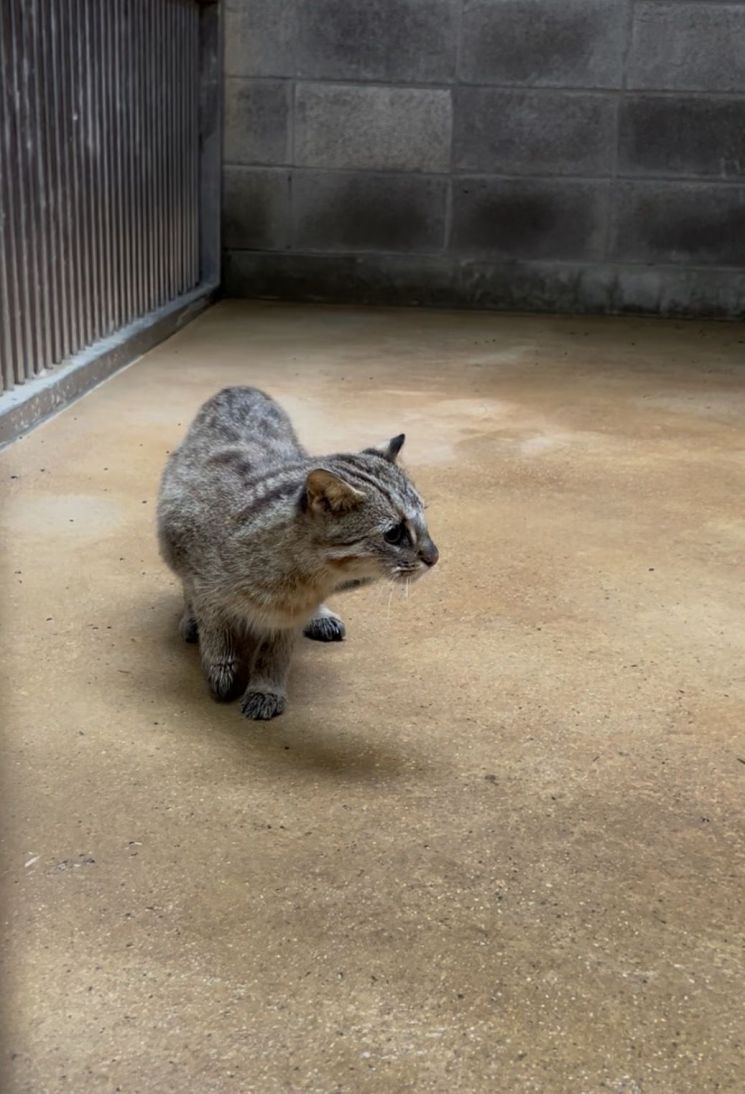 A leopard cat that lost its sight in a traffic accident is cautiously exploring its new home inside the enclosure at Gwangju Uchi Zoo. Photo by Uchi Zoo
Uchi Zoo plans to protect these animals, strengthen its research on wildlife conservation, and promote the value of respect for life among citizens.
The leopard cat, a Class II endangered wild species, was rescued and brought in from the Gwangju Wildlife Rescue Center on July 25. In 2020, it suffered a suspected traffic accident in Cheongpung-dong, Buk-gu, resulting in permanent disabilities including neurological impairment, loss of vision, and fractures, making it impossible to release back into the wild. The animal had been under the care of the rescue center, and will now receive specialized treatment and management at the zoo.
Five endangered parrots (New Guinea and rainbow lorikeets) have also found a new home. These individuals, which were seized during illegal smuggling and breeding, had been protected at the National Institute of Ecology before being transferred to Uchi Zoo on July 26. After undergoing health checks and an adaptation period, they will be introduced to the public starting from the first day of the Chuseok holiday.
Uchi Zoo expects that its continued protection of rescued animals and research on species conservation will have a positive educational impact regarding respect for life. The results of research on the leopard cat are also expected to be utilized in preparing ex-situ conservation institutions in the future.
© The Asia Business Daily(www.asiae.co.kr). All rights reserved.
![Clutching a Stolen Dior Bag, Saying "I Hate Being Poor but Real"... The Grotesque Con of a "Human Knockoff" [Slate]](https://cwcontent.asiae.co.kr/asiaresize/183/2026021902243444107_1771435474.jpg)
















