Education and Corporate Tax Hikes Expected to Add Over 1 Trillion Won in Taxes Next Year
LTV and ELS Fines Could Also Exceed 1 Trillion Won
Banks Face Dilemma as They Must Make Large-Scale Investments in Productive Finance
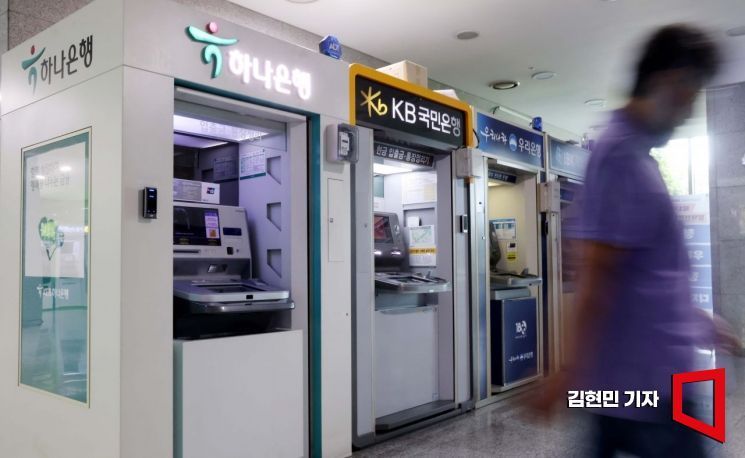
As the government moves to raise the education tax rate and the corporate tax rate, it is estimated that domestic banks will have to pay more than 1 trillion won in additional taxes next year. While the government is pushing for productive finance and pressuring the financial sector to make large-scale investments, banks are also facing increased tax burdens, raising concerns that next year’s profits could decline compared to this year.
Over 1 Trillion Won in Additional Tax Burden Expected Next Year Due to Education Tax and Corporate Tax Hikes
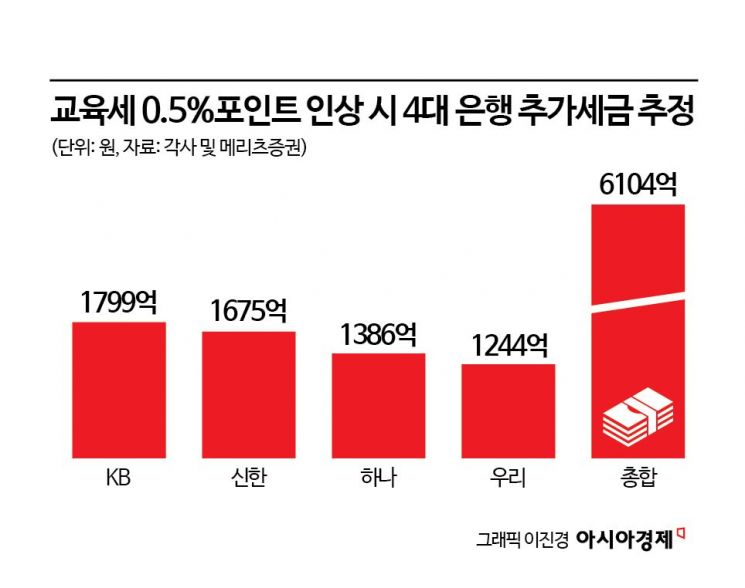
According to the financial sector on October 7, due to the government’s tax reform, financial institutions with annual revenue exceeding 1 trillion won will see their education tax rate double from the current 0.5% to 1% next year. The financial investment industry estimates that, if the education tax hike is implemented, the four major banks will have to pay approximately 610 billion won more in education tax next year compared to this year.
Along with the education tax, the government is also planning to raise the corporate tax rate by a uniform 1 percentage point. If the corporate tax rate is increased by 1 percentage point, it is estimated that the four major banks will have to pay about 220 billion won more in taxes next year. The four major banks alone will face an additional burden of 830 billion won just from the education and corporate tax hikes. If this is expanded to all banks, the increase in taxes is expected to easily exceed 1 trillion won.
In addition to the extra tax burden, banks are also facing various financial uncertainties, such as contributions to the bad bank (New Leap Fund), fines for collusion on loan-to-value (LTV) ratios, and penalties for the misselling of Hong Kong equity-linked securities (ELS). Earlier this month, the Financial Services Commission held a launch ceremony for the New Leap Fund and began full-scale debt relief for vulnerable groups. The New Leap Fund is a program in which the government buys and cancels overdue loans of debtors who have been unable to repay debts of 50 million won or less for over seven years. The fund was created by combining 40 billion won in government finances with 44 billion won in contributions from the financial sector. Of the 44 billion won in financial sector contributions, 36 billion won must be paid by banks.
Fines imposed by the Fair Trade Commission for LTV collusion and by the Financial Supervisory Service for Hong Kong ELS misselling are also factors increasing financial uncertainty for banks next year. In particular, there are concerns that the Fair Trade Commission’s LTV fine could reach as much as 1 trillion won, causing significant anxiety within the banking sector. A senior official at a financial holding company stated, “The biggest management uncertainties right now are the LTV fine and ELS compensation issues. The level of uncertainty is so high that it is even affecting the planning of next year’s management strategies.”
The market is concerned that banks’ profits next year will be lower than initially expected due to the combined burden of taxes and various fines. Choi Jungwook, a researcher at Hana Securities, said, “If we take into account concerns about taxes and fines, banks’ earnings next year will likely decrease compared to initial expectations. It is difficult to predict that the trend of profit growth will continue next year.” Lee Byungyoon, a senior research fellow at the Korea Institute of Finance, commented, “Various fines, such as those for LTV collusion between banks imposed by the Fair Trade Commission, and the government’s plan to raise the education tax on financial company earnings, will act as downward pressure on domestic banks’ profits.”
Banks Face Dilemma as They Must Make Large-Scale Investments in Productive Finance
In addition to taxes and fines, banks must also secure massive resources to invest in ‘productive finance’. The government plans to create a National Growth Fund by injecting more than 150 trillion won in astronomical funds to support 10 high-tech industries, including artificial intelligence (AI), semiconductors, and biotechnology.
The 150 trillion won fund will be established through a public-private partnership. The Industrial Bank of Korea will operate the High-Tech Strategic Industry Fund, raising 75 trillion won, while another 75 trillion won will come from private, public, and financial sector sources. The core of productive finance is to redirect financial sector funds, which are currently heavily concentrated in real estate, into high-tech strategic industries to promote the healthy development of the Korean economy. The financial sector plans for banks to take the lead in these investments. Woori Financial Group was the first among the four major financial holding companies to announce a productive finance investment plan, intending to invest about 10 trillion won in the National Growth Fund. Woori Financial Group will be responsible for 10 trillion won out of the 75 trillion won in private sector funds. Other financial holding companies are also expected to contribute at least 10 trillion won each to the National Growth Fund.
The challenge lies in how to raise tens of trillions of won in funding. While banks plan to use their own capital to finance these investments, there are concerns that their Common Equity Tier 1 (CET1) ratios could decline as a large amount of capital is withdrawn, increasing their financial burden. The financial authorities have provided policy support by easing risk-weighted asset (RWA) regulations to reduce banks’ financial burdens, but some argue that capital regulations need to be relaxed even further.
© The Asia Business Daily(www.asiae.co.kr). All rights reserved.
![Clutching a Stolen Dior Bag, Saying "I Hate Being Poor but Real"... The Grotesque Con of a "Human Knockoff" [Slate]](https://cwcontent.asiae.co.kr/asiaresize/183/2026021902243444107_1771435474.jpg)

















