Hyundai Elevator and Hyundai Construction are set to commercialize modular elevators for the first time in Korea. The two companies aim to drive innovation in safety construction methods and transform the construction paradigm by applying modular elevators to multi-family housing projects.
On October 2, Hyundai Elevator signed a Memorandum of Understanding (MOU) with Hyundai Construction for the application of modular elevators.
The signing ceremony, held at Hyundai Construction's headquarters in Jongno-gu, Seoul, was attended by Cho Jaecheon, CEO of Hyundai Elevator, Yoon Jeongil, Executive Vice President and Head of Purchasing at Hyundai Construction, and other officials from both companies. The two companies are taking on the challenge of commercializing modular elevators, which are described as "an innovative safety construction method capable of achieving zero serious accidents."
Through this MOU, Hyundai Elevator's modular elevators will be applied for the first time in Korea to multi-family housing projects led by Hyundai Construction. Both companies plan to jointly lead innovation in elevator installation methods and bring about a paradigm shift in the construction of multi-family housing.
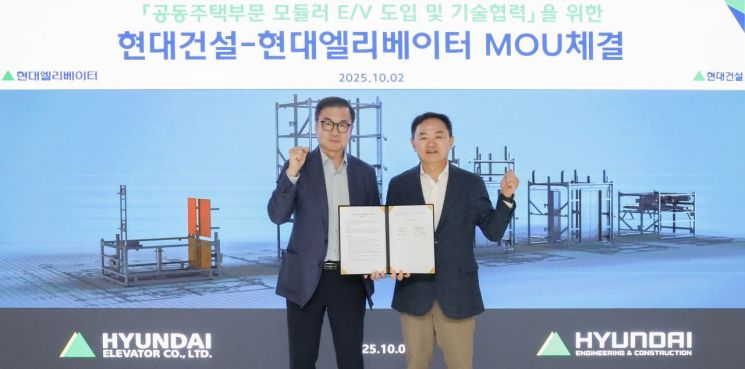 Cho Jaecheon, CEO of Hyundai Elevator (left in the photo), and Yoon Jungil, Head of Purchasing at Hyundai Engineering & Construction, are posing for a commemorative photo after signing a Memorandum of Understanding (MOU) at Hyundai Engineering & Construction headquarters in Jongno-gu, Seoul, on the morning of the 2nd. Provided by Hyundai Elevator
Hyundai Elevator recently completed the development and successful commercialization of a modular elevator with an MRL (machine room-less) design. In July, the company conducted a pilot installation at one of Hyundai Construction's sites in Icheon, Gyeonggi Province, successfully demonstrating the technology. This marks the first case of modular elevator commercialization in Korea.
Modular elevators are manufactured with 90% of their components pre-fabricated in the factory. They are then assembled on-site like Lego blocks. This process reduces high-altitude work (tasks performed at height) by up to 80%. Additionally, the consistent quality helps lower the defect rate as a secondary benefit.
In particular, high-risk tasks such as assembling the cage and car panels and installing rails and entrances inside the elevator shaft, which were previously performed in hazardous conditions, are now eliminated. With the reduction in high-altitude work, it is expected that the goal of "zero serious accidents" can be achieved.
The installation process is also simplified. For example, when installing an MRL-type modular elevator in a three-story commercial building, the construction period is reduced from 36 days to 7 days, an approximate 80% reduction compared to conventional methods. For the MR type, typically used in high-rise buildings, the construction period for a 28-story building is expected to decrease significantly from 95 days to 23 days, a reduction of about 76%.
Cho Jaecheon, CEO of Hyundai Elevator, stated, "The modular elevator is an innovative safety construction method that can achieve zero serious accidents," and added, "We will continue to lead the paradigm shift by expanding into large-scale residential and commercial projects in the future."
With the successful commercialization of the MRL type, Hyundai Elevator also plans to introduce an MR (machine room) type product in the first half of next year.
© The Asia Business Daily(www.asiae.co.kr). All rights reserved.

















