Global Capital Rapidly Shifts to Safe-Haven Assets
Gold Hits Record High for the 39th Time This Year
Cryptocurrencies Like Bitcoin Also Rise Alongside
As the U.S. federal government entered a shutdown (Shut Down·temporary suspension of government operations), global capital rapidly shifted toward safe-haven assets. Gold prices set new record highs 39 times this year, and Bitcoin also rose in tandem. In contrast, the U.S. dollar weakened, signaling shaken market confidence. Experts pointed out that if the shutdown is prolonged, damage to trust in the dollar will be inevitable, which could lead to a further decline in the value of the dollar.
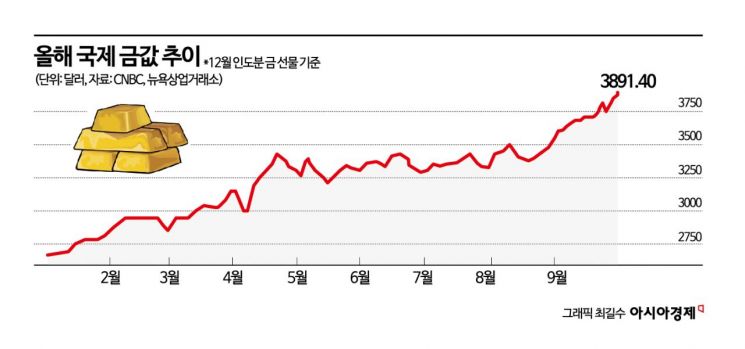
According to CNBC on October 1 (local time), the preference for safe-haven assets intensified immediately after the shutdown, driving gold prices to another all-time high. On this day, December gold futures on the New York Mercantile Exchange closed at $3,897.5 per ounce, setting a new record closing high. Spot gold prices also soared to $3,895.09 during trading. Concerns over a prolonged federal government shutdown fueled buying of safe-haven assets, while the weakening dollar further pushed up gold prices, according to analysts.
Virtual assets also showed an upward trend. According to Coinbase, as of 5:17 p.m. (Eastern Time) on this day, Bitcoin was trading at $117,911, up 3.1% from 24 hours earlier. Ethereum rose 3.61%, and Ripple increased by 2.6%. The data gap and political uncertainty caused by the shutdown constrained the U.S. Federal Reserve's decision-making, heightening expectations for an early rate cut, which in turn boosted virtual asset prices. In fact, according to CME FedWatch, the interest rate futures market reflected a 99% probability of a rate cut in October and almost a 100% probability of an additional cut in December. Both figures were higher than a week before the shutdown began.
Stephen Juneau, an economist at Bank of America, said, "The possibility of holding rates steady in October will only be maintained if the September jobs report is released," and added, "If the data is not released, Chairman Jerome Powell could push for a cut as a risk management measure."
Neil Birrell, Chief Investment Officer at Premier Miton, also stated, "With a surge in Treasury issuance, widening credit spreads, and an overvalued stock market, shocks like a shutdown will inevitably drive investors toward gold, silver, and virtual assets."
On the other hand, the dollar is experiencing its worst period. On this day, the dollar index, which compares the dollar to the currencies of six major countries, fell for the fourth consecutive trading day, recording 97.72 as of 7:56 p.m. (Eastern Time). Since the beginning of the year, the dollar index has dropped about 10%, continuing its downward trend.
Analysts suggest that if the shutdown is prolonged, as in past cases, the dollar is likely to continue its moderate weakening against the yen, euro, and franc.
The shutdown is shaking trust in the United States in the capital markets, and this loss of confidence directly leads to dollar weakness and global capital outflows, causing funds to flow into alternative currencies such as the euro and yen, as well as gold and virtual assets.
Bloomberg News pointed out, "If the shutdown is prolonged, the dollar could come under downward pressure. In fact, during the 35-day shutdown in 2018, the dollar spot index fell by about 2%." Joe Brusuelas, Chief Economist at RSM US, also predicted, "If federal employee layoffs become a reality, the value of the dollar will fall further, and funds are likely to move into the euro and yen."
Some opinions suggest that, based on past cases, the impact of a shutdown on the market is limited. UBS stated in a separate report, "Looking at past cases, shutdowns have generally brought short-term and limited volatility to the market," and analyzed, "Investors should instead focus on key factors such as consecutive rate cuts, corporate earnings, and increased investment in artificial intelligence (AI)."

Larry Adam, Chief Investment Officer at Raymond James, also assessed, "Shutdowns tend to increase short-term volatility rather than change the overall market trend." In fact, according to Dow Jones Market Data, since 1976, the S&P 500 index has risen by an average of about 0.05% during shutdown periods.
© The Asia Business Daily(www.asiae.co.kr). All rights reserved.
![Clutching a Stolen Dior Bag, Saying "I Hate Being Poor but Real"... The Grotesque Con of a "Human Knockoff" [Slate]](https://cwcontent.asiae.co.kr/asiaresize/183/2026021902243444107_1771435474.jpg)











