20th Anniversary Event Held at Cheonggyecheon on the 1st
Former President Lee Myung-bak and Mayor Oh Se-hoon in Attendance
Lee: "An Unprecedented Achievement Worldwide"
Oh: "Expanding into a World-Class Waterfront Space"
Cheonggyecheon, which was returned to the citizens after the removal of an old overpass in the heart of the city, is celebrating its 20th anniversary of restoration. After a large-scale renovation project that lasted two years and three months starting in 2002 to improve the urban environment, Cheonggyecheon has now become a tourist attraction visited by 50,000 people every day.
Today, Cheonggyecheon stands as an icon of urban environmental recovery, home to more than 600 species of flora and fauna, including the freshwater fish 'Suiry,' which only lives in clean water. The promenade stretches 20 kilometers, with seven pedestrian bridges and fifteen vehicle bridges restored along the way. Cheonggyecheon is a space where the past and future coexist.
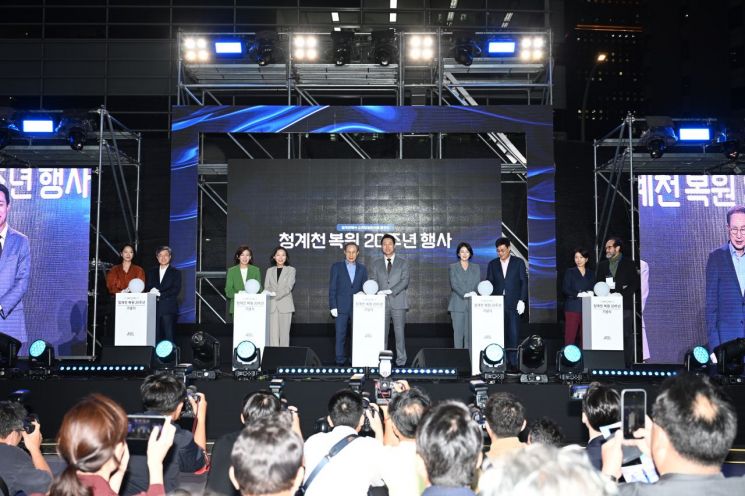 Former President Lee Myung-bak and Seoul Mayor Oh Se-hoon press the lighting button for a new public art installation at the '20th Anniversary of Cheonggyecheon Restoration Event' held at Cheonggye Plaza on the 1st. Seoul City
The '20th Anniversary of Cheonggyecheon Restoration' event, held on the evening of the 1st at Cheonggye Plaza and the surrounding area, was organized to celebrate the urban transformation and ecological restoration achieved through Cheonggyecheon, and to share a vision for its future as a place where culture, art, and advanced technology converge.
The event drew attention with the attendance of former President Lee Myung-bak, who led the restoration of Cheonggyecheon, and Seoul Mayor Oh Se-hoon, who developed Cheonggyecheon into Seoul's top tourist attraction. Former President Lee remarked, "By dismantling the overpass above Cheonggyecheon, we were able to create a dedicated bus lane down the center. This was an unprecedented achievement, making public transportation the core of the city." Mayor Oh stated, "A city where children play by the water, seniors rest along the wind paths, and history and culture flow together with nature-that is the future of Seoul."
The laser show marking the next 20 years of Cheonggyecheon began as the two current and former mayors pressed the lighting button. The 'Spring' sculpture, now a landmark of Cheonggyecheon, and new public art installations were connected by light. In addition to the commemorative ceremony, the event featured a variety of citizen participation festivals encompassing Cheonggyecheon's past, present, and future. The 'Laser Art Show,' with 20 beams symbolizing the 20th anniversary, was held, and from the plaza to Gwanggyo Bridge, public art installations by domestic and international artists were displayed under the theme of harmony between Cheonggyecheon's nature and art.
The Seoul Metropolitan Government considers the success of the Cheonggyecheon restoration as the foundation of its current 'Waterfront Sensibility City' policy. Building on this, the city plans to further develop Cheonggyecheon into a world-class waterfront space that combines culture, art, and technology.
Cheonggyecheon is one of the first destinations for both domestic and international tourists visiting Seoul. Over the past 20 years, the cumulative number of visitors has reached 330 million, with an annual average of 16 million. Compared to the early days of restoration, when almost no living creatures could be found, by 2022, the environment had dramatically improved, with 666 species of fish, birds, and plants inhabiting the area, and the discovery of the first-class freshwater fish 'Suiry.' According to the 'Cheonggyecheon Fish Ecology Survey,' the number of fish species increased significantly from 3 families and 4 species before restoration to 7 families and 21 species in 2025.
Since its opening, Cheonggyecheon has hosted 37,000 busking performances and more than 2,000 various events. 'Lucky coins' containing the wishes of domestic and international visitors, totaling 440 million won and over 390,000 foreign coins, have been donated to the Seoul Scholarship Foundation and UNICEF, adding a spirit of sharing to the site.
To mark the 20th anniversary of Cheonggyecheon’s restoration, the Seoul Metropolitan Government has transformed the area into a 'venue for contemporary public art.' Under the theme of 'Cheonggye Coexistence,' the city aims to offer a new perspective on Cheonggyecheon by adorning the restored stream with waves of art. The exhibition, which connects the story of Cheonggye Plaza, where the 'Spring' sculpture stands, with the present and future of Cheonggyecheon restored to nature, features participation from world-renowned contemporary artists, architects, and emerging artists.
At Cheonggye Plaza, visitors can see the symbolic public art piece 'Spring,' shaped like a freshwater snail. The Seoul Metropolitan Government installed the wooden 'Connectcheon Pavilion' by Obra Architects, allowing visitors to approach it closely. Standing on the pavilion offers various views of Cheonggye Plaza and the artwork. The 'Connectcheon Pavilion,' which won an international competition, has been proposed as the 23rd bridge of Cheonggyecheon. The wooden pavilion, partially installed as part of the artwork, will be used as a space for citizens for one year, and in September next year, the 'Spring' sculpture is scheduled to undergo restoration work.
At Cheonggye Plaza, a new work by world-renowned contemporary artist Lee Soo-kyung, titled 'It Was There - Cheonggyecheon 2025,' will be installed. This piece, modeled after the toad rock at the source of Cheonggyecheon on Bugaksan Mountain and adorned with gold leaf, expresses the Korean sentiment of wishing for Cheonggyecheon's abundance and prosperity.
From the entrance of Cheonggyecheon to Gwanggyo Bridge, works by four teams of emerging artists will be unveiled. These pieces feature chairs that hold memories from the Cheonggyecheon area, native plants and wild birds that inhabit the stream, and stones that create the rhythm of the waterway. Jeong Seongguk, Director of the Seoul Water Circulation Safety Bureau, said, "The success of Cheonggyecheon’s restoration is recognized as a leading example of urban environmental and ecosystem restoration not only in Korea but also internationally," adding, "Cheonggyecheon will continue to evolve beyond a simple urban waterway to become a space that embraces the lives and future of citizens."
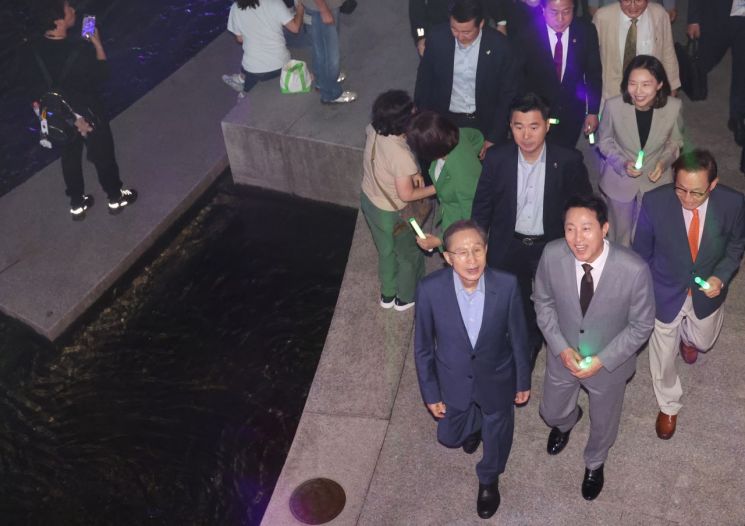 Former President Lee Myung-bak and Seoul Mayor Oh Se-hoon attended the '20th Anniversary of Cheonggyecheon Restoration' event held at Cheonggye Plaza on the 1st and are walking along the Cheonggyecheon promenade. Photo by Yonhap News
© The Asia Business Daily(www.asiae.co.kr). All rights reserved.


















