Confirmed at the 1st Power Grid Expansion Committee Chaired by the Prime Minister
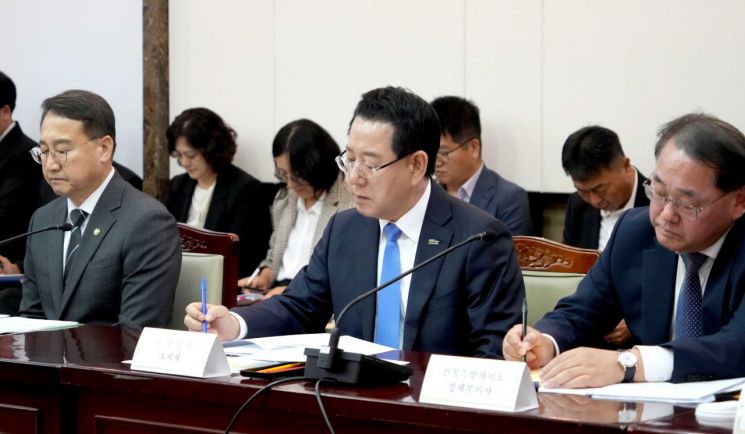 Kim Youngrok, Governor of Jeollanam-do, is attentively listening to the opening remarks at the '1st National Power Grid Expansion Committee' held at the Government Seoul Office on the afternoon of the 1st, attended by Prime Minister Kim Minseok (Chairman), related ministers, local governments, and appointed committee members. Provided by Jeonnam Province
Kim Youngrok, Governor of Jeollanam-do, stated on the 1st, "We, together with all residents of the province, warmly welcome the swift designation of Jeonnam’s core power grid facilities as part of the national power grid infrastructure."
According to Jeonnam Province on the 1st, at the '1st Power Grid Expansion Committee' chaired by Prime Minister Kim Minseok, a large number of transmission and substation facilities planned for the Jeonnam region were designated as national power grid infrastructure. In particular, key transmission and substation facilities of 345kV or higher to expand renewable energy were designated, including a total of 123 kilometers of transmission lines such as the 96-kilometer section from Sinhaenam to Sinjangseong and the 27-kilometer section from Sinhaenam to Singangjin, as well as the West Coast HVDC (High Voltage Direct Current) line.
The expansion of the national power grid will resolve output control issues, enabling the construction of more solar and wind power plants throughout Jeonnam and allowing for stable power transmission. With the expanded renewable energy infrastructure, the foundation has also been laid for the establishment of RE100 industrial complexes in various parts of the province. This is expected to attract not only domestic companies but also global AI companies, resulting in the creation of a large number of quality jobs for local youth.
Furthermore, it will now be possible to attract AI data centers based on renewable energy, which are essential infrastructure in the era of artificial intelligence. In addition, energy independence will be achievable through distributed energy and local production for local consumption.
Governor Kim assessed, "This decision was made just five days after the implementation of the Special Act on Power Grids and simultaneously with the establishment of the Ministry of Climate, Energy, and Environment, demonstrating the Lee Jaemyung administration's strong commitment to advancing the energy highway, the main artery for renewable energy."
With this designation, 35 government special exemptions for permits and approvals will significantly shorten related procedures, including exemptions from preliminary feasibility studies for certain projects, improvements to environmental impact assessments, and the promotion of joint construction of social overhead capital such as roads. Compensation and support for residents and local governments will also be greatly strengthened, and the standard construction period for the power grid, which typically took 13 years, will be shortened by four years to nine years, allowing for earlier completion of the facilities.
Governor Kim stated, "A system of energy independence will be established, enabling industrial complexes and residents in the province to directly use renewable energy produced locally, which will allow companies and residents to benefit from lower electricity rates."
He added, "We will definitely usher in an era of 1 trillion won in annual energy basic income, a new growth model led by Jeonnam," and emphasized, "We will provide all possible administrative support to ensure the smooth implementation of the national power grid construction."
Meanwhile, at the 1st Power Grid Committee meeting that day, Governor Kim said, "I have been continuously advocating for the expansion of the national power grid, including HVDC, for the past four years," and expressed his gratitude to the Lee Jaemyung administration, saying, "With the new administration, the project has been rapidly promoted in just three months."
He also proposed several measures to continuously expand renewable energy and resolve grid saturation, including: ▲drastic expansion of investment in energy storage systems (ESS), ▲continuous monitoring of speculative business operators, ▲increasing transmission capacity when replacing existing transmission lines, ▲establishing microgrids at major industrial hubs such as petrochemicals, steel, and shipbuilding, ▲expanding solar income villages and energy self-sufficient villages, ▲forming a government-led social consensus body, and ▲significantly discounting electricity rates in RE100 industrial complexes to promote investment by energy-intensive high-tech companies.
© The Asia Business Daily(www.asiae.co.kr). All rights reserved.

















