"350,000 Combat Troops by 2040, Remaining Forces to Be Outsourced" Plan Also Unveiled
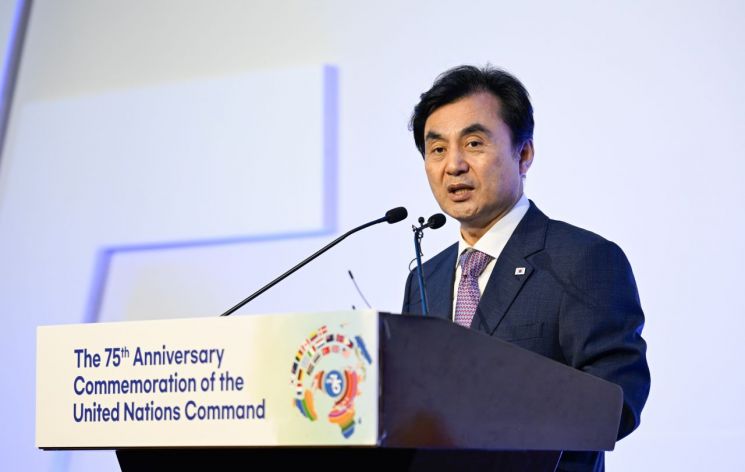
On September 30, Minister of National Defense Ahn Gyu-baek responded to recent calls by Minister of Unification Chung Dong-young and others to preemptively suspend live-fire drills in border areas in order to ease inter-Korean tensions, stating, "Soldiers fundamentally need to train." He added, "Unless both Koreas agree to suspend such exercises within the framework of the September 19 Inter-Korean Military Agreement, it would not be appropriate for us to unilaterally halt our training."
During his first press conference since taking office, held at the Defense Convention in Yongsan-gu, Seoul, Minister Ahn was asked about the recent exposure of differences between the self-reliance and alliance factions within the government regarding North Korea policy. He replied, "Even children from the same mother can be different, so opinions may vary. However, unless the other side (North Korea) also suspends its activities, it is not appropriate for us to unilaterally suspend live-fire drills or other training," reiterating his position.
Minister Ahn referred to a conversation from the Chinese classic "Zhuangzi" between Duke Huan of Qi from the Spring and Autumn period and a wheelwright named Yunpyeon, who made a living carving wheels, to illustrate his point: "If you do not exercise regularly, you lose your touch," he said. "Training is about honing your senses. Soldiers must regularly refine their skills through education and training. Neither side should stop unilaterally."
Minister Ahn also mentioned that he had approved the recent live-fire maritime drills conducted by the Marine Corps near the northwestern islands, saying, "For example, if we previously fired 100 shells during exercises, we could reduce it to 50 to 70 shells and conduct training in stages." He continued, "Restoring the September 19 Military Agreement cannot be achieved simply by deciding to start. We need to resolve issues through dialogue and negotiation, not by unilaterally suspending live-fire drills."
Regarding the restoration of the September 19 Military Agreement, he stated, "It has been temporarily suspended, not scrapped. However, considering various circumstances, I believe restoring the agreement will be extremely difficult." He added, "To achieve restoration during the Lee Jaemyung administration, we must begin with the lowest-level initiatives such as civilian diplomacy and artistic exchanges, and maintain dialogue with neighboring countries, including the United States, China, and Russia."
When asked whether the United States Forces Korea might be reduced or withdrawn following a potential second term for President Donald Trump, Minister Ahn responded, "Although the United States is considering various aspects of alliance modernization, under the Korea-U.S. Mutual Defense Treaty, neither side can unilaterally reduce or withdraw United States Forces Korea." He emphasized, "For the solidity of the Korea-U.S. alliance and combined defense posture, both countries must operate smoothly without disruption, and I do not anticipate major changes."
Regarding defense cost-sharing negotiations with the United States, Minister Ahn said, "Regardless of U.S. preferences, we must transfer wartime operational control and continue to increase our defense budget for self-reliant defense. The rate of increase will inevitably exceed 8%." He added, "To meet the second condition for the transfer of wartime operational control, which is to establish the capability to respond to North Korea's nuclear and missile threats, we will inevitably need to procure high-cost weaponry to build the Korea Air and Missile Defense system (KAMD)."
Minister Ahn also addressed the disbandment of the Defense Security Command, which played a leading role in the December 3 Martial Law, stating, "The core counterintelligence function-catching spies-must remain, and with the expansion of K-Defense exports, there will likely be many issues such as military secrets being leaked. The counterintelligence agency should continue to perform its essential duties." He added, "This will be discussed by the Joint Civil-Military Special Advisory Committee for Overcoming Internal Strife and Designing Future National Defense."
Regarding the Army Intelligence Command, which was mobilized during the December 3 Martial Law, Minister Ahn said, "I believe we should first resolve the dual role of the Director of the Defense Intelligence Agency also serving as Director of the Joint Chiefs of Staff Intelligence Bureau, and I expect this change to proceed." He added, "As the Intelligence Command is preparing for a major reform, please keep an eye on the developments."
At the press conference, Minister Ahn also partially unveiled his plans for restructuring the military in response to the era of demographic decline. The Ministry of National Defense anticipates that, due to low birth rates and an aging population, the number of military personnel will decrease to around 350,000 by 2024.
Minister Ahn stated, "Military restructuring must align unit structure, personnel structure, and force structure. Since we need to maintain a total force of around 500,000, we will keep 350,000 active-duty combat troops, and may consider fully outsourcing all non-combat units."
The Ministry of National Defense further explained that Minister Ahn's plan involves maintaining 350,000 active-duty combat troops, and adding 150,000 personnel composed of civilian employees, civil-military cooperation companies (CMCC), and standing reservists, to maintain a total force of 500,000.
© The Asia Business Daily(www.asiae.co.kr). All rights reserved.

















