Greer of the U.S. Trade Representative Hints at Negotiations
Possible Agreements with Malaysia and Others
Detailed Talks with South Korea, China, and Japan Remain Stalled
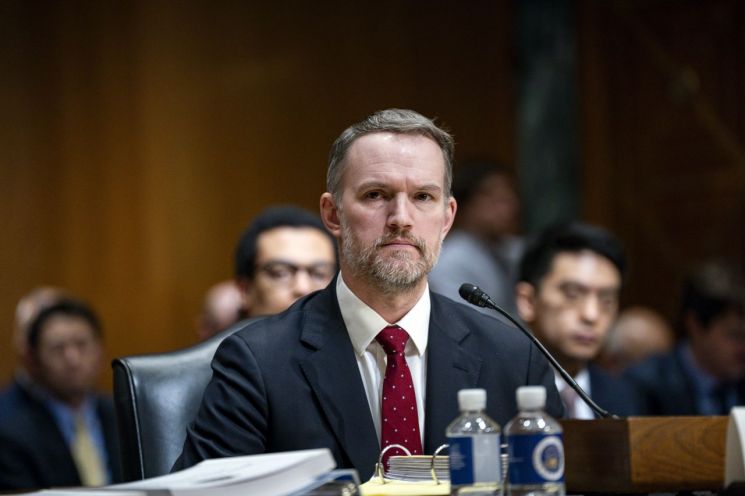 Jamison Greer, United States Trade Representative (USTR), is speaking about the Trump administration's '2025 Trade Policy' at the Senate Finance Committee hearing held at the U.S. Capitol in Washington D.C. on April 8 (local time). Photo by UPI News Agency
The Donald Trump administration in the United States is expected to sign more trade agreements with Southeast Asian countries during President Trump's tour of Asia, including South Korea, in October.
Jamison Greer, United States Trade Representative (USTR), said in an interview with Fox Business on September 30 (local time), "President Trump is scheduled to tour Asia at the end of October. We expect that some agreements could be signed at that time."
President Trump is scheduled to visit South Korea to attend the Asia-Pacific Economic Cooperation (APEC) Summit, which will be held in Gyeongju from October 31 to November 1. On this occasion, a summit meeting between President Trump and Chinese President Xi Jinping is also expected.
Prior to this, President Trump will also attend the Association of Southeast Asian Nations (ASEAN) Summit, which will be held in Malaysia from October 26 to 28. Malaysian Prime Minister Anwar Ibrahim announced in July that President Trump had accepted the invitation to the summit.
Although Representative Greer did not specify particular countries, there is a high likelihood of agreements being signed with countries such as Malaysia. Malaysian Minister of Investment, Trade and Industry, Tengku Zafrul Aziz, stated that Malaysia aims to conclude tariff negotiations with the United States before the ASEAN Summit. The current tariff rate applied by the United States to Malaysian imports is 19%.
However, when expanding the scope to all of Asia, the United States has not been able to accelerate detailed discussions with major countries such as South Korea, China, and Japan. Even the governments of South Korea and Japan, which are considered to have reached broad trade agreements, are clashing with the U.S. government over details related to investment in the United States, as the U.S. side emphasizes "up-front investment."
Regarding South Korea's $350 billion (about 490 trillion won) investment in the United States, President Trump used the term "up front," while National Security Office Director Wi Sunglak said last month, "I am not sure of the true intention at this point." In Japan, regarding the $550 billion (about 766 trillion won) investment in the United States, Sanae Takaichi, a leading candidate for the next prime minister and former minister for economic security, also stated, "We will not hesitate to renegotiate with the United States."
The United States also appears to have failed to find a breakthrough for improving relations in negotiations with China. The United States and China, which once engaged in a game of chicken with tariffs exceeding 100% and export restrictions on semiconductors and rare earths, have been holding behind-the-scenes talks ahead of the end of the 90-day "tariff war" truce, which expires on November 10.
At a discussion hosted by the Economic Club of New York on this day, Representative Greer stated that the 55% tariff rate on China is a "good status quo." He said, "If you ask President Trump whether there is a deal with China, he will probably answer, 'We imposed a 55% tariff, and that's our deal.'" Nevertheless, the Trump administration left room for negotiation, expressing a desire to find areas where bilateral trade could be further liberalized. Reuters analyzed that Greer's remarks indicate the Trump administration is not considering further reductions in tariffs on China.
In particular, the Trump administration plans to maintain its America-centered trade policy even if the U.S. Supreme Court rules that reciprocal tariffs are "illegal" in a case regarding reciprocal tariff lawsuits. The Wall Street Journal (WSJ) reported that the first oral arguments are scheduled for the first week of November, and a ruling is also expected within the year.
Representative Greer explained, "If we lose, we will rely on alternative legal means to impose tariffs," adding that tariffs will remain "part of the policy environment." He continued, "Whether we win or lose at the Supreme Court, regardless of the final outcome, we should think about trade in this way going forward."
In academia, it is widely believed that the Trump administration is likely to utilize Section 232 of the Trade Expansion Act (which allows the president to restrict imports in cases of national security threats) and Section 301 (which allows retaliation against unfair trade practices by other countries).
Jesse Cryer, a professor of law at Georgetown University, warned at a seminar hosted by the Korea-U.S. Congressional Exchange Center on September 25 that even if the U.S. Supreme Court rules against President Trump on reciprocal tariffs, "President Trump, who is determined to change trade relations with the entire world, has a wide range of tools at his disposal," adding, "It is difficult to expect that the United States will suddenly return to a kind of 'open economy' as it was 20 years ago, or even just four years ago."
© The Asia Business Daily(www.asiae.co.kr). All rights reserved.
![A Woman Who Jumps Holding a Stolen Dior Bag... The Mind-Shaking, Bizarre Con of a "Human Knockoff" [Slate]](https://cwcontent.asiae.co.kr/asiaresize/183/2026021902243444107_1771435474.jpg)
















