President Lee's Address on the 77th Armed Forces Day:
"People" Mentioned 31 Times, "Armed Forces" 15 Times, "Peace" 13 Times
First Time Since Inauguration He Stresses "Self-Reliant Defense" and Restoration of OPCON
"There Is No Reason for South Korea to Be Anxious"
First Armed Forces Day Ceremony Since Martial Law
Event Scaled Down, No Parade Held
Medal Awarded to Colonel Park Junghoon, Who Exposed External Pressure in the Chae Sangbyeong Case
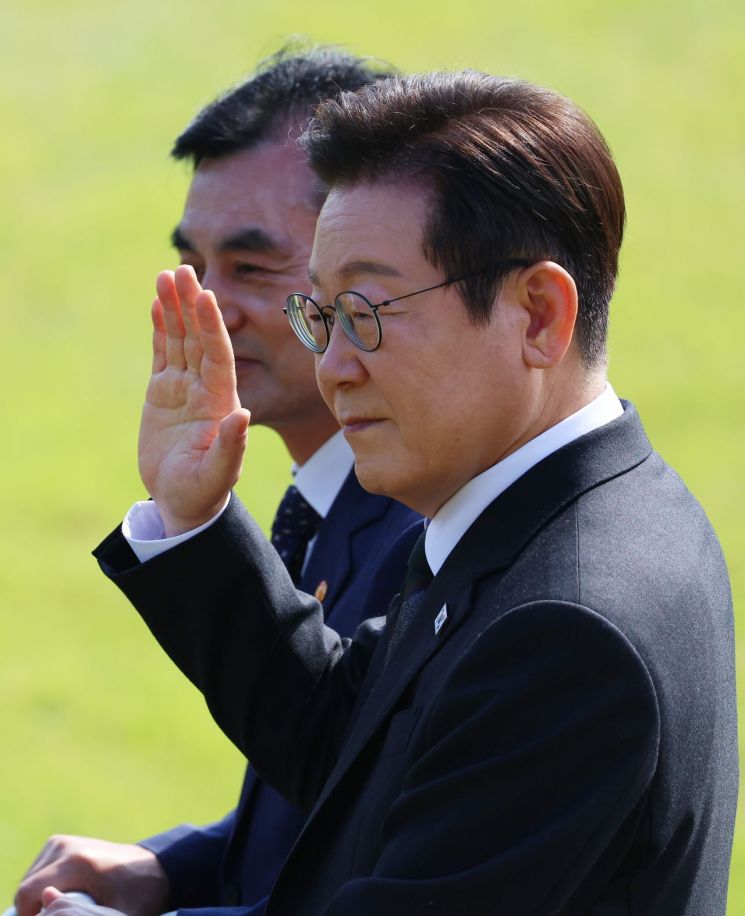 President Lee Jae-myung is riding in a parade vehicle and reviewing the troops at the 77th Armed Forces Day ceremony held on the 1st at the Grand Review Parade Ground of Gyeryongdae, Chungnam. Photo by Yonhap News
President Lee Jae-myung announced his intention to restore wartime operational control (OPCON) on the occasion of the 77th Armed Forces Day. He emphasized that self-reliant national defense is essential to respond to rapidly changing security environments, which means that the authority to command and control the military in times of emergency must rest with the South Korean government. President Lee also pledged to turn the "dream of a strong, self-reliant national defense" into reality by restructuring the military into a "smart, elite, and powerful force" and actively fostering the defense industry to achieve both enhanced national defense and economic development. He further promised to significantly improve the welfare and treatment of military personnel.
On October 1, at the Armed Forces Day ceremony held at Gyeryongdae in Chungnam under the theme "An Advanced and Powerful Military Together with the People," President Lee stated, "On the solid foundation of the ROK-US alliance, we will restore wartime operational control and take the lead in the combined defense posture of South Korea and the United States." He emphasized, "A robust combined defense capability and posture will contribute not only to peace and stability on the Korean Peninsula but also to regional stability and shared prosperity."
Wartime operational control refers to the authority to command troops within a limited time and space for specific operations. In South Korea, the Chairman of the Joint Chiefs of Staff (a four-star general) holds this authority during peacetime, but in wartime, it is exercised by the Commander of the ROK-US Combined Forces Command, who is a U.S. general. This is the first time President Lee has directly stated his intention to reclaim OPCON, rather than through campaign pledges or the National Policy Planning Committee.
The presidential office explained that President Lee personally chose the phrase "restoration of wartime operational control." The original draft of his commemorative address used the term "transfer of wartime operational control," but President Lee revised it to "restoration of wartime operational control." Kim Nambun, spokesperson for the presidential office, explained in a briefing, "The word 'restoration' means 'returning to the original state.' Please understand that this expression emphasizes that there was an 'original state' for wartime operational control." Regarding the background of President Lee mentioning the restoration of OPCON in his address, Kim added, "This has been President Lee's conviction since before the presidential election. The President's determination is clear, and he reiterates it whenever the opportunity arises."
President Lee also explained that South Korea's national defense capabilities are stronger than ever. He stated, "South Korea is a military powerhouse with the world’s fifth-largest military strength, spending 1.4 times North Korea’s GDP on defense, and is a strong nation whose overall national power, including economic and cultural strength, is second to none." He added, "We also possess a solid ROK-US alliance and the firm nuclear deterrence based on it." He pointed out, "There is no reason for such a nation as South Korea to doubt its defense capabilities, and even less reason to be anxious."
As measures for self-reliant national defense, President Lee proposed: ▲building a smart, elite, and powerful military; ▲fostering the defense industry; and ▲improving the treatment of military personnel. He said, "Cutting-edge innovative technologies are completely transforming the paradigm of the battlefield," and suggested, "Units equipped with advanced unmanned and manned weapon systems, such as AI combat robots, autonomous drones, and ultra-precise high-performance missiles, are the solution."
First Armed Forces Day since inauguration, held on a reduced scale without a parade... Medal awarded to Colonel Park Junghoon, who exposed external pressure in the Chae Sangbyeong case
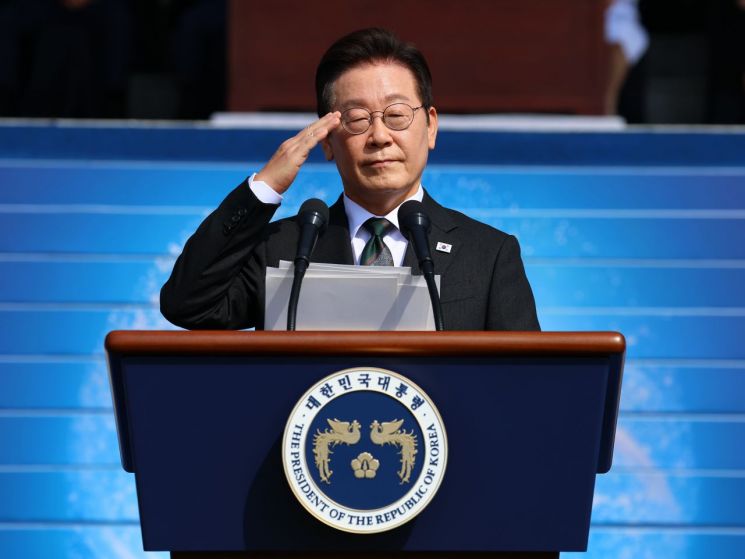 President Lee Jae-myung is giving a salute at the Armed Forces Day ceremony marking the 77th anniversary of the founding of the armed forces, held on the 1st at the Grand Parade Ground of Gyeryongdae in Chungnam. Photo by Yonhap News
President Lee also stressed his commitment to thoroughly eradicate the remnants of illegal martial law and to further strengthen the democratic and institutional foundations for rebuilding the military as a force that protects the Constitution and the people. He stated, "The consequences of the illegal December 3 Martial Law are truly immense. The regression of democracy, the collapse of the people's economy, and the decline in national prestige have imposed incalculable damage on our citizens." He emphasized, "The military, which must protect the people, must never again turn its guns on the people." During his 16-minute commemorative address, President Lee used the word "people" 31 times, "armed forces" 15 times, and "peace" 13 times.
This event, the first since the December 3 Martial Law, was held on a smaller scale compared to last year's large-scale parade. The number of attendees at the ceremony was about 5,000, significantly reduced from last year's 10,000, and the venue returned to the Grand Review Parade Ground at Gyeryongdae. The commander of the parade was Major General Choi Jangsik (ROTC Class 30), who is not a graduate of the Korea Military Academy.
The assets showcased at the event were also limited. The Hyunmoo-5 ballistic missile, known as the "monster missile," and the KF-21, South Korea's 4.5-generation fighter jet, were featured, but from the U.S. side, only two F-16s participated. This contrasts with last year, when strategic assets such as the B-1B strategic bomber, known as the "Black Swan of Death," were showcased. This is interpreted as an effort by the Lee Jae-myung administration, which emphasizes easing tensions between the two Koreas, to avoid provoking the North.
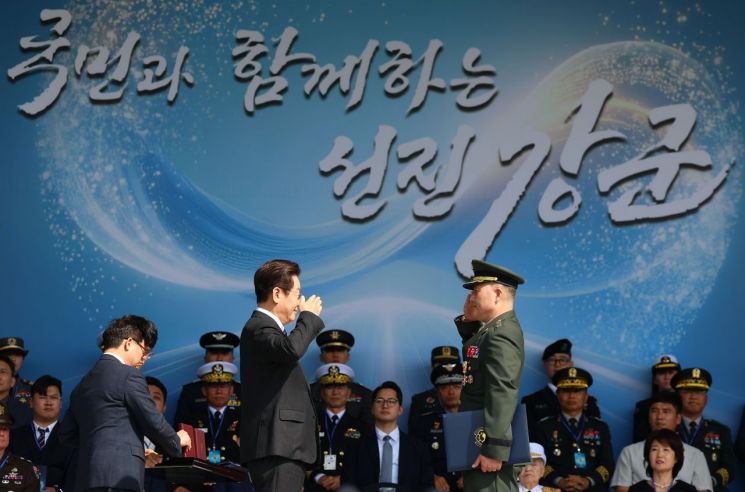
Eleven individuals were also recognized for defending constitutional values by refusing to follow illegal or unjust orders during the December 3 Martial Law. Notably, Colonel Park Junghoon, head of the Marine Corps Investigation Team who led the initial investigation into the Chae Sangbyeong case, received the Order of National Security Merit, Samil Medal. After the review, President Lee personally presented the medal certificate and pinned the medal on Colonel Park, who, in turn, saluted and pledged, "I will serve with loyalty."
Meanwhile, Minister of National Defense Ahn Kyubaek held his first press conference since taking office the previous day. Minister Ahn responded to some calls for suspending ROK-US joint exercises and live-fire drills near the border to ease inter-Korean tensions by saying, "Unless both Koreas agree to suspend them under the framework of the September 19 Military Agreement, it is not appropriate for us to unilaterally halt the exercises." He also dismissed the idea of the withdrawal or reduction of U.S. forces in Korea, stating, "It is impossible under the ROK-US Mutual Defense Treaty, and there have been no discussions between South Korea and the United States on this matter."
© The Asia Business Daily(www.asiae.co.kr). All rights reserved.
![Clutching a Stolen Dior Bag, Saying "I Hate Being Poor but Real"... The Grotesque Con of a "Human Knockoff" [Slate]](https://cwcontent.asiae.co.kr/asiaresize/183/2026021902243444107_1771435474.jpg)


















