KOSPI Sees 84 Trillion Won and KOSDAQ 9 Trillion Won Cancellation Effect
"Announcement of Cancellation Acts as a Signal, Driving Share Price Up"
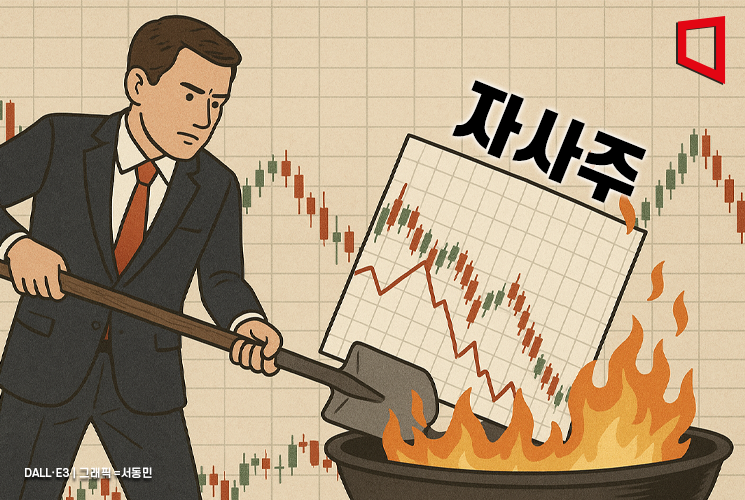
The third amendment to the Commercial Act, which would mandate the cancellation of treasury shares, is currently under discussion in the National Assembly. Prior to this, some listed companies have issued exchangeable bonds (EBs) using treasury shares as the underlying asset, drawing backlash from minority shareholders. As the issue of treasury share cancellation has become a major topic among stock investors, on October 1, Daishin Securities published a report titled "Treasury Share Cancellation Scenarios and EPS Improvement Effects."
Surge in EB Issuance Ahead of Mandatory Treasury Share Cancellation
According to Daishin Securities, as of September, the number of companies that issued EBs using treasury shares as the underlying asset reached a record monthly high of 38 (12 in the KOSPI market and 26 in the KOSDAQ market). This marks a sharp increase from 9 companies in August. Looking at the entire year, 66 companies have pursued EB issuance. There are a total of 7 companies where the proportion of treasury share EBs exceeds 10% of the total number of shares issued. Taekwang Industrial has the highest issuance ratio at 24.4%.
Companies that chose to issue EBs instead of canceling treasury shares have faced strong opposition from minority shareholders. Truston Asset Management, the second-largest shareholder of Taekwang Industrial, filed for an injunction to prohibit the issuance, but the request was dismissed. Taekwang Industrial has stated that it will temporarily withhold the EB issuance and make a decision at a board meeting this month. On September 24, KCC announced the issuance of EBs equivalent to 9.9% of its treasury shares, but as minority shareholders continued to object, the company withdrew the plan on October 1.
"Treasury Share Cancellation, a Catalyst for Enhancing Shareholder Value"
Lee Kyungyeon, an analyst at Daishin Securities, stated, "If all treasury shares are canceled, the KOSPI would see a cancellation effect of approximately 84.3 trillion won (3.1% of market capitalization), and the KOSDAQ about 9.2 trillion won (2.1% of market capitalization)." He further analyzed, "If all shares are canceled, the EPS (earnings per share) of KOSPI would improve by about 3.2%, and KOSDAQ by about 2.1%." Even if the cancellation ratio is lowered to 95% or 90%, the KOSPI would still see an improvement of around 2.9%, and the KOSDAQ about 2%.
When treasury shares are purchased, cash decreases on the debit side and equity decreases on the credit side of the balance sheet, and the financial impact ends there. Nevertheless, the effect on share prices is significant. Analyst Lee Kyungyeon emphasized, "Announcing the cancellation of treasury shares sends a strong signal to investors, often driving up the share price," adding, "Treasury share cancellation can serve as a catalyst not only for improving EPS but also for enhancing shareholder value and triggering a valuation rerating."
© The Asia Business Daily(www.asiae.co.kr). All rights reserved.

















