Imported Soybean Shortages Persist Despite Additional Government Supply
Concerns Mount Over Repeated Annual Shortages for SMEs
This year, the supply of imported soybeans in Korea has decreased compared to last year, causing serious raw material supply instability for small business owners and small and medium-sized enterprises (SMEs) that rely on them. As concerns grew within the industry over the possibility of tofu factories having to halt production due to a shortage of soybeans, the government rushed to provide additional supply last month. However, critics argue that this is still insufficient to cover the shortfall. Furthermore, as the Ministry of Agriculture, Food and Rural Affairs is expected to continue limiting the supply of imported soybeans in order to promote the use of domestic soybeans, small business owners and SMEs in the sector are likely to face recurring soybean shortages every year.
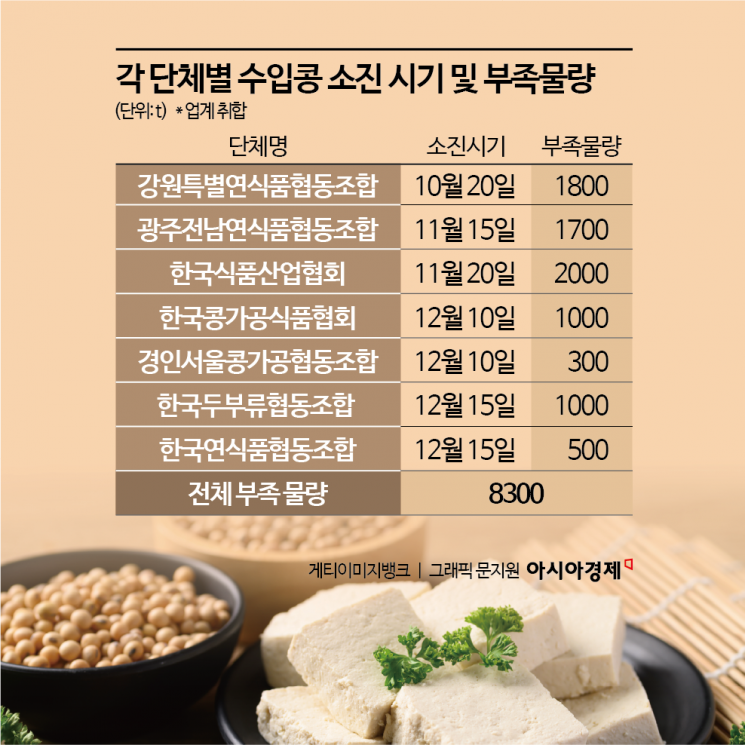
According to the tofu manufacturing industry on October 1, the current shortage of imported soybeans among small and medium-sized companies is estimated at about 8,300 tons. This figure was compiled by major cooperatives consisting of companies that use imported soybeans to make tofu, fermented sauces, and other products. Most of these companies expect to exhaust their supply of imported soybeans during the fourth quarter. This means that by the end of the year, they may have to shut down their factories due to a lack of soybeans. An industry official said, "If the shortage of imported soybeans is not fully resolved, it could lead to production shutdowns, and in the worst-case scenario, many small business owners and SMEs could face bankruptcy."
The shortage of imported soybeans began when the government reduced its direct supply this year. Soybeans, which are controlled by the government as an import-managed item, have traditionally been supplied at a rate of 250,000 tons per year through the Tariff Rate Quota (TRQ) system. This year, only the basic amount was supplied, with no additional increase, resulting in a 13% decrease in supply compared to the previous year, according to industry sources. As the supply of imported soybeans dwindled, companies that use them as raw materials faced an emergency. About 80% of tofu produced in Korea is made from imported soybeans, which are much cheaper than domestic soybeans and are mainly used by small and medium-sized manufacturers. There are about 1,800 small and medium-sized tofu manufacturing companies nationwide.
As these companies faced the risk of halting factory operations in the second half of the year due to a shortage of imported soybeans, the Ministry of Agriculture, Food and Rural Affairs responded last month by supplying additional quantities to meet industry demand. The supply method consisted of 16,000 tons through direct allocation and 11,000 tons through public auction. The ministry explained that the directly allocated amount was distributed to organizations of actual consumers based on their previous year's usage, while the public auction allowed companies to bid for quantities regardless of past performance, based on their demand.
Industry voices say that even this additional supply of 27,000 tons is insufficient to resolve the shortage of imported soybeans. Moreover, with a general shortage across the industry, the amount supplied via public auction was not enough, leading to overheated competition and a sharp rise in prices. According to the results of this year's public auctions for edible soybeans, the price per ton in the third round reached about 600,000 won, nearly double that of the first round. Only companies with sufficient financial resources were able to secure soybeans. An industry official said, "In order to avoid production stoppages due to raw material shortages, we participated in the public auction, but since the auctioned quantity was less than what we needed, we had to bid more than 70% higher than before to win the bid."
The problem is that such industry turmoil caused by a shortage of imported soybeans is likely to be repeated every year. This is because the Ministry of Agriculture, Food and Rural Affairs is maintaining its policy direction of expanding domestic soybean production and encouraging industries that use imported soybeans to switch to domestic soybeans. A ministry official said, "In order to promote the use of domestic soybeans, we plan to maintain the policy of not increasing the TRQ supply," adding, "We will also implement support measures for companies that use domestic soybeans." In response, the head of a small tofu manufacturing company said, "The market for products made from domestic soybeans and imported soybeans is already divided, and the price of domestic soybeans is about three times higher than imported soybeans, making it virtually impossible for small business owners and SMEs who have been using imported soybeans to enter the market."
© The Asia Business Daily(www.asiae.co.kr). All rights reserved.
![Clutching a Stolen Dior Bag, Saying "I Hate Being Poor but Real"... The Grotesque Con of a "Human Knockoff" [Slate]](https://cwcontent.asiae.co.kr/asiaresize/183/2026021902243444107_1771435474.jpg)

















