Slightly Higher Than Bank of Korea and KDI Projections
Recovery in Private Consumption Drives Growth
External Uncertainties Pose Downside Risks
On September 30, the National Assembly Budget Office projected this year's real Gross Domestic Product (GDP) growth rate at 1.0%. The real GDP growth rate for next year is forecast at 1.9%. This represents a slight improvement compared to previously released economic outlooks.
The Budget Office presented its economic outlook for next year in the report titled "2026 NABO Economic Outlook: 2025-2029," released on the same day. The current projections are higher than those of major institutions such as the Bank of Korea. Previously, the Bank of Korea forecast growth rates of 0.9% for this year and 1.6% for next year. The Korea Development Institute projected 0.8% for this year and 1.6% for next year.
This is because the Budget Office expects a faster pace of recovery in domestic demand, including private consumption. However, the office diagnosed that "construction investment remains sluggish, and the growth in facility investment has weakened."
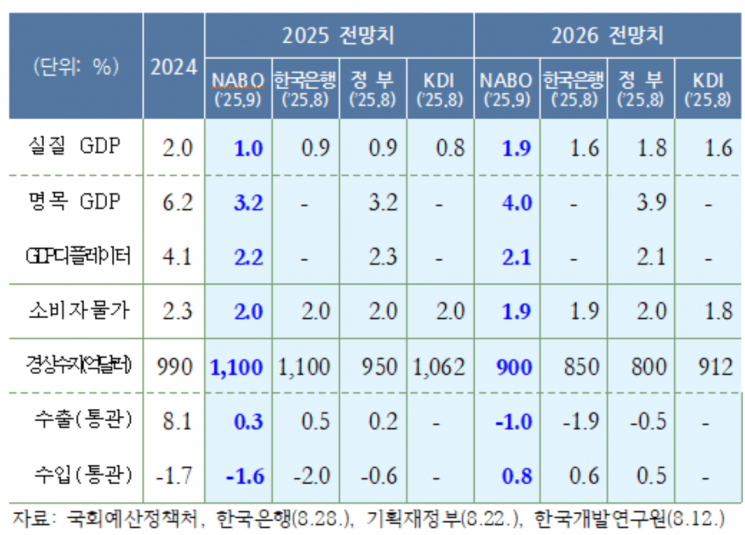
Accordingly, the nominal GDP growth rate, which includes inflation and other factors, is projected at 3.2% for this year and 4.0% for next year. Inflation is expected to remain relatively stable at 2.2% this year and 2.1% next year.
The real GDP growth rate from 2025 to 2029 is forecast to average 1.8% per year.
Regarding employment trends, the number of employed persons is expected to increase by 160,000 next year. However, the increase is mainly in low-wage jobs, so there are limitations in terms of qualitative improvement. The Budget Office noted that rising demand for elderly care workers due to an aging population, as well as expanded employment in health and social welfare services and the creation of 50,000 senior jobs through fiscal support, are driving the increase in employment.
However, external factors were cited as sources of instability for the Korean economy. The Budget Office pointed out that "the expansion of uncertainties related to U.S. tariff and immigration policies, intensified price competition in exports due to China's aggressive low-cost strategies, and the potential deterioration of corporate financing conditions stemming from financial market uncertainties are all downside risks to the outlook."
© The Asia Business Daily(www.asiae.co.kr). All rights reserved.

















