Ocean Energy Pathway and Green Transition Institute Release Analysis Results
97 Trillion Won in Added Value Created... 492 Million Tons of Carbon Reduction Expected
"Need for a Long-Term Roadmap Over 10 Years and Halving Power Generation Costs"
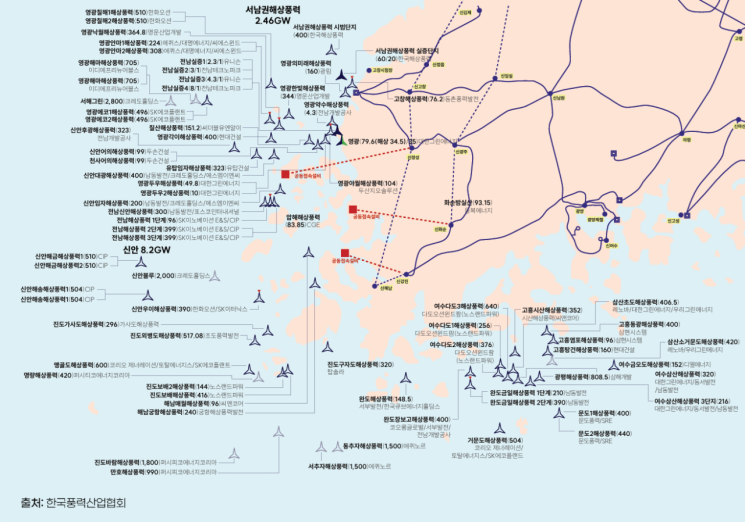
It is projected that a massive investment of 157 trillion won will be required to fully develop all 57 offshore wind power projects currently being promoted in the Jeollanam-do region. It is also forecast that this would create 1.04 million jobs nationwide.
The international non-profit organization Ocean Energy Pathway and the Korean climate and energy think tank Green Transition Institute held a press briefing on September 30,
where they released a comprehensive analysis of the investment scale, added value, employment, and climate and social benefits that the planned 18 gigawatt (GW) offshore wind power projects in Jeollanam-do would bring to the Korean economy and local communities.
This analysis covered a total of 57 projects, amounting to 17,960.6 megawatts (MW), that had received power generation permits in the Jeollanam-do sea area as of 2024.
It is estimated that a total of 156.6 trillion won (an annual average of 3.3 trillion won) will be invested over 47 years, from 2018 to 2064, to develop all these projects. Of the total investment, 91.6 trillion won, or 58.5%, is expected to be concentrated over a 10-year period from 2028 to 2037. This annual investment is equivalent to 10% of Jeollanam-do's gross regional domestic product (GRDP) in 2022.
Through this, in the Jeollanam-do region alone, up to 44 trillion won in added value and approximately 470,000 jobs will be created, while nationwide, the ripple effect is expected to expand to up to 97 trillion won in added value and about 1.04 million jobs.
Ocean Energy Pathway stated, "This demonstrates that offshore wind power is not just an electricity infrastructure, but a strategic tool for economic revitalization through the formation of industrial clusters, linkage with local manufacturing, and job creation," adding, "At the same time, it means that offshore wind power can contribute to strengthening industrial competitiveness and expanding employment at the national level."
According to the analysis report, if offshore wind power in Jeollanam-do operates at a capacity of 18GW, it is estimated that a total of 492 million tons of carbon dioxide could be reduced. When converted into economic value based on the social cost of carbon (SCC), this amounts to up to 84 trillion won.
Furthermore, by replacing coal and liquefied natural gas (LNG) power plants, it is expected to reduce air pollutants such as sulfur oxides, nitrogen oxides, and fine dust by 200,000 to 660,000 tons. This is equivalent to replacing 3 to 8 coal-fired power plants.
The report analyzed that these effects would reduce social damage caused by climate disasters such as heat waves, droughts, and floods, and would serve as a key means to prevent a decline of up to 21% in gross domestic product (GDP) in the long term.
In addition, the offshore wind power projects are expected to generate an additional 115.1 billion won in local tax revenue annually from 2025 to 2063. Furthermore, if a resident participation profit-sharing system is introduced, it is predicted that resident dividends could reach 20 trillion won over 39 years. If resident share participation is increased to 10%, this could expand to 35 trillion won.
The research team that conducted this analysis emphasized that for the various effects of offshore wind power to be realized, policy support and institutional improvements from both the central government and local governments must be implemented in parallel.
At the central government level, they recommended: ▲ presenting a long-term supply roadmap of at least 10 years, ▲ fostering the industry and providing institutional support, and ▲ proactively expanding core infrastructure such as power grids, ports, and vessels. They particularly pointed out that, as in leading offshore wind countries, achieving a supply scale of 3 to 4GW and nearly halving the power generation cost is a key challenge for gaining public acceptance.
At the local government level, including Jeollanam-do, they proposed that it is essential to: ▲ establish offshore wind power industry clusters, ▲ develop hinterland ports and industrial complexes, ▲ foster specialized talent, and ▲ operate transparent and participatory public-private councils.
Jang Dawool, Korea Director of Ocean Energy Pathway, stated, "Offshore wind power is not merely a power source, but a strategic industry that can simultaneously drive responses to the climate crisis, revitalize local economies, and alleviate social inequality," adding, "For Korea to maintain industrial competitiveness and not fall behind in the global energy transition, expanding offshore wind power is essential."
© The Asia Business Daily(www.asiae.co.kr). All rights reserved.

















