Government Holds 8th Biohealth Innovation Committee Meeting
Discussion on U.S. Tariff Response and Utilization of Health Insurance Big Data
Announcement of Five "Killer Regulations" Reviewed by Ministries
As the U.S. government has announced a plan to impose a '100% tariff' on pharmaceuticals, the Korean government will strengthen support for the entire export process of pharmaceuticals, medical devices, and cosmetics. The 'Innovative Medical Technology Early Access Program', which evaluates the potential value of advanced medical technologies and grants market entry opportunities, will have its implementation requirements relaxed.
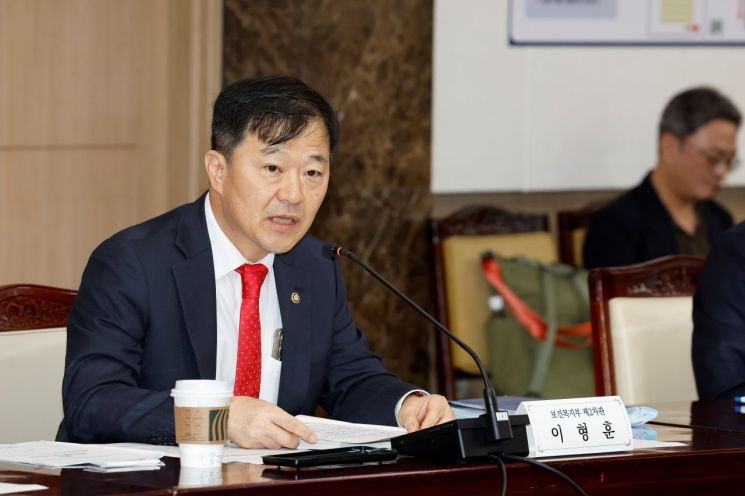 On the 30th, Lee Hyun, the 2nd Vice Minister of the Ministry of Health and Welfare, is speaking at the 8th Biohealth Innovation Committee meeting held at the Government Seoul Office Building. Ministry of Health and Welfare
On the 30th, the government held the '8th Biohealth Innovation Committee' meeting at the Government Seoul Office, where it reviewed the export trends of pharmaceuticals, medical devices, and cosmetics in response to the U.S. tariff measures, assessed the impact on the industry, gathered opinions from the sector, and sought support measures to minimize damage to Korean companies.
Although a specific tariff policy for pharmaceuticals has not yet been determined, making predictions difficult, it is expected that Korea's main export items, such as biosimilars (generic drugs), will inevitably face competition with U.S.-made products. In response, the government plans to strengthen support for every stage of the export process, from development and approval to marketing, logistics, and distribution.
The government also reviewed follow-up measures for issues discussed at the recent presidential Bio Innovation Forum. In relation to expanding the use of national health insurance big data, the committee discussed challenges and countermeasures at each stage of data application, provision, and utilization needed for medical artificial intelligence (AI) research and industry. In particular, as there have been continued concerns about the difficulty of accessing and utilizing health insurance big data, the government decided to reduce the data construction period from five months to one month and to develop synthetic data that can be easily used for AI analysis and learning without concerns about personal information identification.
As of this month, out of 222 management tasks identified by the Biohealth Innovation Committee's regulatory reform platform, excluding overlapping tasks, 133 have been completed. At the meeting, among the 23 regulations reviewed by ministries since the 7th meeting, 5 were designated as 'killer regulations' that require improvement.
First, regarding the Innovative Medical Technology Early Access Program, the government plans to relax the scope of performance reporting requirements, which are currently stricter than those for the New Medical Technology Evaluation Deferment, and reflect this in the guidelines. In addition, since the designated institutions and doctors for the evaluation-deferred new medical technologies are often out of touch with actual clinical practice, the government will review ways to relax the implementation requirements by next month.
The process for amending patient consent forms under the Innovative Medical Technology Early Access Program will also be improved. Currently, even minor changes to the consent form, which must be obtained from patients when implementing evaluation-deferred new medical technologies, require approval from the National Evidence-based Healthcare Collaborating Agency each time. Going forward, the government plans to establish standards and procedures by November that will allow for minor changes to be implemented first and reported afterward.
Regarding the decision to further extend the deferment period for new medical technology evaluation (up to two years), there have been difficulties due to the lack of disclosure of the criteria and reasons for the extension, which has affected companies' ability to predict outcomes. The government plans to establish methods and levels of disclosure for the reasons behind future extensions.
Kim Youngtae, Vice Chair of the committee and Director of Seoul National University Hospital, who presided over the meeting, said, "Through the regulatory reform platform, various issues identified in the field are being reviewed and addressed by ministries and experts, and the results are being transparently released. We will strengthen publicity to attract more interest and participation," adding, "Going forward, the private sector and the government will continue to discuss concrete tasks across the entire biohealth sector, including approval, R&D, investment, and AI/data."
© The Asia Business Daily(www.asiae.co.kr). All rights reserved.

















