Identical to the 2025 National Defense Authorization Act Text
It was confirmed on September 29 (local time) that the 2026 fiscal year U.S. National Defense Authorization Act (NDAA), which passed the House of Representatives, includes a recommendation to maintain the current size of U.S. Forces Korea.
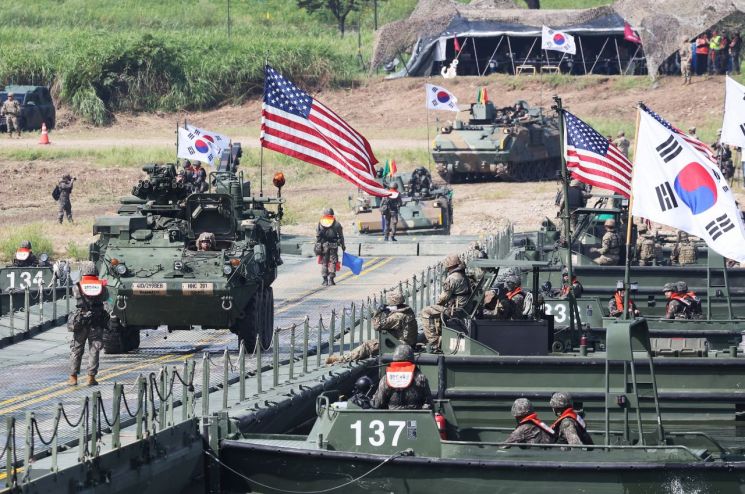
According to the U.S. Congress bill information site, the 2026 fiscal year (October 2025 to September 2026) National Defense Authorization Act, which was passed by the House on September 10, includes a provision to "maintain the stationing of approximately 28,500 U.S. troops in South Korea."
The bill states, "It is the sense of Congress that the Secretary of Defense should continue efforts to strengthen U.S. security alliances and partnerships to expand the United States' comparative advantage in strategic competition with China in the Indo-Pacific region." It further specifies, "This includes maintaining the stationing of approximately 28,500 U.S. troops in South Korea, enhancing mutual defense-based cooperation, reaffirming the commitment to provide extended deterrence by utilizing all U.S. defense capabilities in accordance with the U.S.-ROK Mutual Defense Treaty, and strengthening the alliance with South Korea." This wording is identical to that of the 2025 National Defense Authorization Act, which passed Congress in December last year.
The National Defense Authorization Act is an annual bill that authorizes the Department of Defense's budget and policies. During the first Trump administration, for the 2019-2021 fiscal years, Congress specified the size of U.S. Forces Korea in the NDAA and stipulated that the NDAA budget could not be used for reducing U.S. Forces Korea.
However, since the 2022 fiscal year, Congress has removed the clause prohibiting the use of NDAA funds for reducing U.S. Forces Korea and instead has expressed its support for the stationing of U.S. Forces Korea by specifying the current troop level. While this is not legally binding, it has been interpreted as a congressional recommendation to maintain the status quo regarding the size of U.S. Forces Korea.
Like other U.S. legislation, the National Defense Authorization Act must be passed separately by both the Senate and the House of Representatives. If there are differences between the versions passed by each chamber, a conference committee reconciles them into a single bill, which is then passed again by both chambers and signed by the President to become law.
Earlier, the Senate's 2026 fiscal year National Defense Authorization Act, which passed the Senate Armed Services Committee in July, included a provision directing the Chairman of the Joint Chiefs of Staff, the Commander of the Indo-Pacific Command, and the Commander of U.S. Forces Korea to conduct independent assessments of the risks associated with a reduction of U.S. Forces Korea or the transfer of wartime operational control.
© The Asia Business Daily(www.asiae.co.kr). All rights reserved.
![Clutching a Stolen Dior Bag, Saying "I Hate Being Poor but Real"... The Grotesque Con of a "Human Knockoff" [Slate]](https://cwcontent.asiae.co.kr/asiaresize/183/2026021902243444107_1771435474.jpg)











