Abandoned Without an Owner for About 1,400 Years
A Mix of Various Types of Coins
Significant Value for Numismatic Research
Dozens of gold coins and precious metal items have been discovered in Hippos, an ancient Roman city near the Sea of Galilee in Israel. On September 26 (local time), international media outlets such as the Times of Israel and Live Science reported that an excavation team led by Dr. Michael Eisenberg from the University of Haifa unearthed 97 pure gold coins, believed to be from the Byzantine period 1,400 years ago, as well as dozens of precious items such as pearls, semi-precious stones, and glass-decorated earrings at the Hippos archaeological site near the Sea of Galilee.
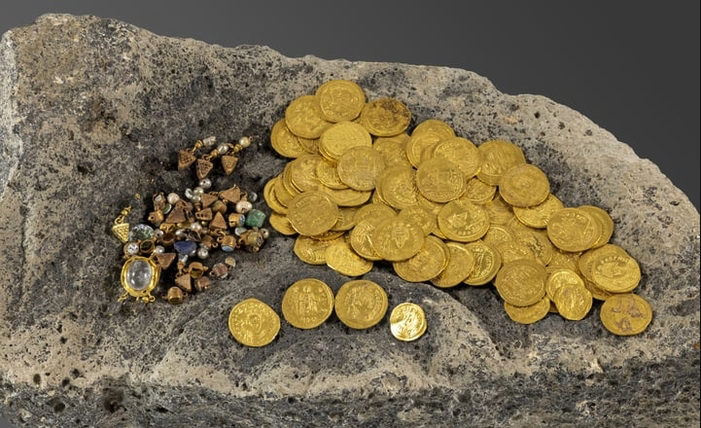 Byzantine gold coins from about 1,400 years ago discovered near the Galilee. Excavation team from Haifa University
The excavation team suggested that these artifacts provide clues to the state of the city just a few years before the Sassanid Empire swept through the region in 614. This was also just a few years before the Islamic conquest dramatically reshaped the area. The team speculated that these treasures may have been hidden by a wealthy resident, possibly a goldsmith, as the Sassanid army advanced on the city. These treasures remained lost and ownerless for about 1,400 years until they were accidentally discovered.
The excavation team has been working in the area for about six years, but their original goal was not to find treasure. During a survey in July, Edi Lipsman, a team member responsible for metal detection, accidentally struck a stone while walking around the site. At that moment, the detector suddenly emitted a loud "beep! beep! beep!" Lipsman recalled, "The equipment went wild. Gold coins kept appearing from that spot. I couldn't believe it." The artifacts were found between two walls in an area that had previously been excavated. The team reported that traces of fabric on the coins suggest they were hidden in a cloth pouch.
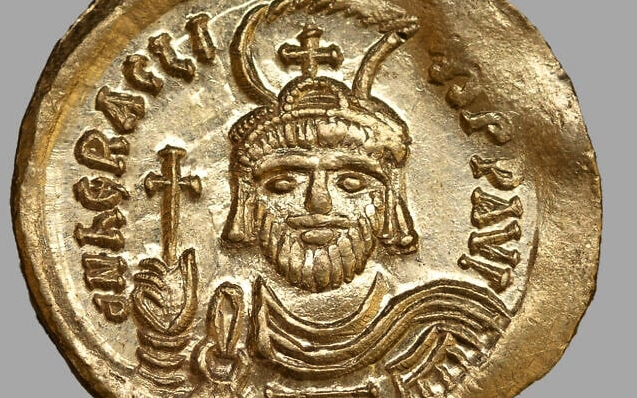 Byzantine gold coin from about 1,400 years ago discovered near the Galilee ship. It depicts Emperor Heraclius. Excavation team from Haifa University.
Dr. Eisenberg explained, "Someone must have realized enemies were coming, gathered the family's wealth, and hid it, intending to retrieve it once the danger passed. But they never returned." The gold coins discovered this time were analyzed as having been minted over about a century, from the reign of Emperor Justin I (518-527) to the early reign of Emperor Heraclius (610-613) of the Roman Empire. The team noted that the mix of various types of coins adds significant value for numismatic research.
Various Gemstone Pieces: Similar, But Not Identical Designs
Not only high-value coins such as the solidus were found, but also semissis, worth half a solidus, and tremissis, worth a third, were discovered together. Dr. Eisenberg pointed out that the tremissis is a rare coin almost never found in the region of Israel. The team stated that this discovery could offer a new perspective on Hippos. Dr. Eisenberg explained, "Until now, the prevailing view was that Hippos was in decline during the late Byzantine period, as its architectural remains were less grand compared to the Roman or early Byzantine eras. However, the considerable amount of gold treasure discovered suggests that wealthy residents still lived in Hippos at that time, and the city likely maintained its prosperity."
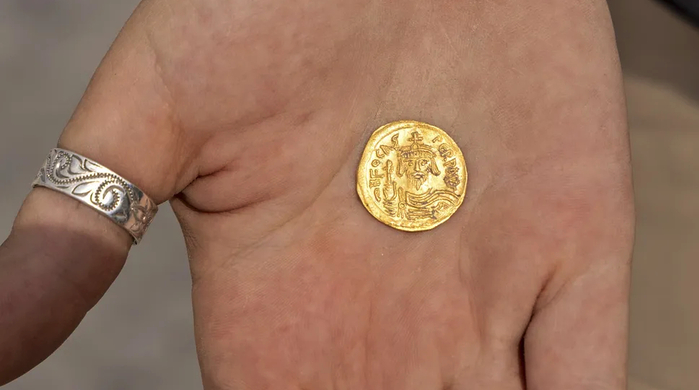
The fact that the various earring pieces included among the artifacts are similar but not identical in design led the excavation team to suggest that the owner of the treasure may have been a jeweler or goldsmith. In a previous study, an inscription from 556 found in a church in Hippos mentioned a donor named "Simeonios the goldsmith." However, as this remains speculative, further detailed research is needed. After being conquered by the Arabs in the 7th century, Hippos persisted for a while, but the city declined and was ultimately abandoned following a major earthquake in 749.
© The Asia Business Daily(www.asiae.co.kr). All rights reserved.
![Clutching a Stolen Dior Bag, Saying "I Hate Being Poor but Real"... The Grotesque Con of a "Human Knockoff" [Slate]](https://cwcontent.asiae.co.kr/asiaresize/183/2026021902243444107_1771435474.jpg)


















