Expansion of US Public Investment in Quantum Security
Quantum Security in the Spotlight in Korea After Hacking Incidents
Mandatory Quantum Cryptography Drives Demand for Telecom Equipment Upgrades
There are growing predictions that the commercialization of quantum computers will be accelerated. The CEO of IonQ, a US-listed quantum computing company, has announced plans to develop a quantum chip that will surpass Nvidia's GPUs by 2027. Investments in quantum computing by global big tech companies are also gaining momentum.
As a result, interest in quantum security is also increasing. The US government is considering implementing quantum security defenses five years earlier than originally planned. On September 30, Hana Securities analyzed in its report, "Quantum Cryptography Beneficiaries Are in the Telecommunications Equipment Sector," that attention to telecommunications equipment related to quantum security is expected to rise.
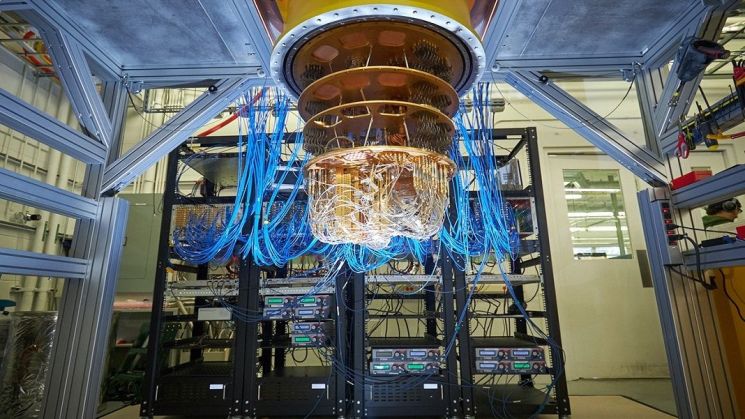
Preparing for Hacking in the Quantum Computing Era... The US Accelerates Quantum Security
The US government is preparing various executive orders to enhance security in the quantum computing era. Previously, on September 23, the Trump administration announced its five major research and development (R&D) priorities for fiscal year 2027, naming artificial intelligence (AI) and quantum technologies as the top priorities. The government is also pushing to reauthorize the National Quantum Initiative Act (NQIA), which expired in 2023.
It is reported that the current executive order is discussing moving up the timeline for the federal government to fully transition its computer networks from existing public key cryptography systems (RSA/ECC) to post-quantum cryptography (PQC), from the original 2035 to 2030. The reason the US government is expediting the transition to PQC is due to hackers' "harvest now, decrypt later" strategy. This involves storing encrypted data obtained through hacking, then decrypting it all at once when quantum computers become commercially available and capable of breaking the encryption.
Expansion of the Encrypted Communications Market Expected to Benefit Telecommunications Equipment
The transition to PQC in the US is likely to encourage not only the US but also its allied countries to adopt PQC. This is because, in addition to the National Institute of Standards and Technology (NIST), the National Security Agency (NSA) requires all suppliers related to US security systems to be fully equipped with quantum cryptography solutions. Given the size of the US government procurement market, overseas companies participating in government contracts will also need to comply with the new encryption standards. In particular, in key private sectors such as finance, telecommunications, and defense, the US roadmap is highly likely to become the global standard.
Kim Hongsik, an analyst at Hana Securities, stated, "Along with AI, the mandatory adoption of quantum cryptography is a definite positive for telecommunications equipment companies. Therefore, in addition to ICTK and Woorinet, attention should also be paid to wireless telecommunications equipment companies such as Solid, RFHIC, Innowireless, and KMW." He added, "As both public and private companies are actively adopting quantum encrypted communications, products equipped with quantum encrypted communications are likely to enter the market in large numbers when investing in new frequency networks."
© The Asia Business Daily(www.asiae.co.kr). All rights reserved.

















