A bill allowing witnesses who commit perjury during National Assembly committee investigations or hearings to be prosecuted even after the committee's activities have concluded passed the National Assembly plenary session on September 29.
On the evening of that day, the National Assembly held a plenary session and passed the revised bill on the 'Act on Testimony and Appraisal before the National Assembly' (Testimony and Appraisal Act), with 175 out of 176 members present voting in favor and 1 abstention.
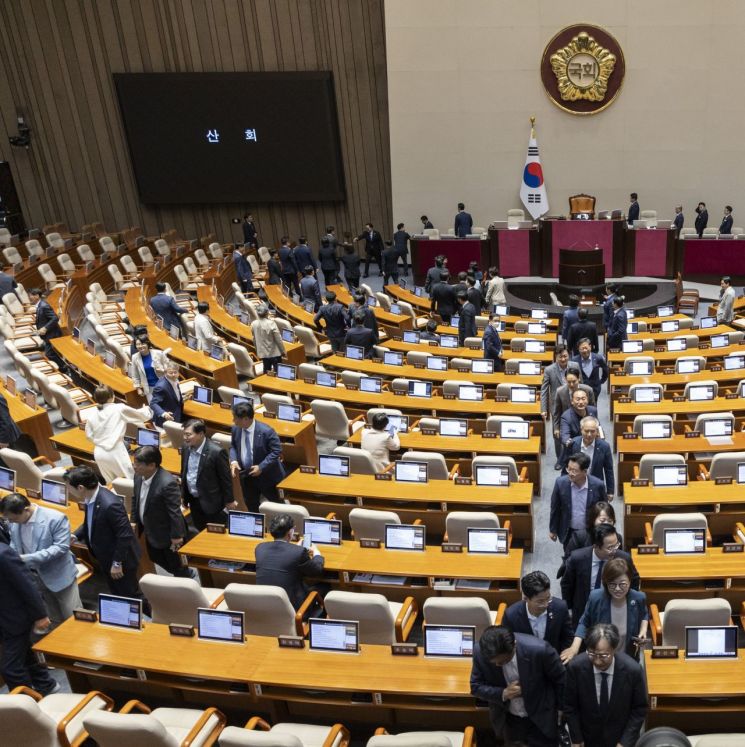 On the 29th, lawmakers centered around the Democratic Party of Korea left the plenary hall after completing the passage of five bills following a 4-night, 5-day filibuster (unlimited debate). Photo by Yonhap News
Regarding this bill, the People Power Party began a filibuster (an unlimited debate as a legitimate means of delaying proceedings) on the evening of the previous day. The Democratic Party of Korea forcibly ended the debate at 8:45 p.m. on the day after 24 hours had passed, then introduced the revised bill and proceeded to a vote.
The People Power Party, which opposed the revision, did not participate in the vote. Assemblyman Jin Sungjoon of the Democratic Party of Korea abstained.
The revision allows prosecution through joint signatures by a majority of the committee members if the committee chair refuses or avoids filing a complaint.
If the committee's activity period has ended and it is unclear which committee is responsible for prosecution, the complaint may be filed in the name of the Speaker of the National Assembly through a plenary session.
The revision also mandates that, once a perjury complaint is filed, investigative agencies such as prosecutors from the Corruption Investigation Office for High-ranking Officials, prosecutors, or judicial police officers must complete their investigation within two months and promptly report the results to the plenary session or the committee.
Additionally, if the investigative agency cannot complete the investigation within two months due to special circumstances, the head of the investigative agency may submit an interim report and request an extension of the investigation period to the plenary session or committee. The Speaker of the National Assembly or the committee chair may approve this request and extend the investigation period by up to two additional months.
© The Asia Business Daily(www.asiae.co.kr). All rights reserved.

















