Testimony and Appraisal Act Amendment Passed with 175 Votes in Favor at Plenary Session
Speaker of the National Assembly Restored as Charging Authority When Committee Responsibility Is Unclear
Five-Day Filibuster Ends... Four Contentious Bills Passed
With the passage of the amendment to the Act on Testimony and Appraisal before the National Assembly (the Testimony and Appraisal Act) at the National Assembly plenary session on September 29, the five-day, four-night filibuster (unlimited debate) over four contentious bills also came to an end.
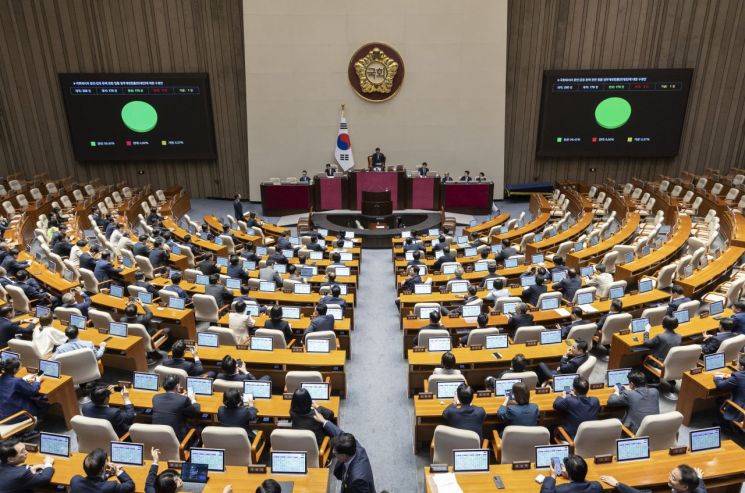
On this day, the National Assembly passed the amendment to the Testimony and Appraisal Act with 176 members present, 175 in favor, and 1 abstention (Assemblyman Jin Sungjoon of the Democratic Party of Korea). The People Power Party, opposing the vote, left the plenary chamber immediately after the filibuster.
Just before the agenda was introduced at the plenary session the previous day, the Democratic Party had submitted a proposal allowing the Legislation and Judiciary Committee to file charges for perjury and other offenses under the name of the committee chair if the committee responsible for filing charges had expired and was unclear. However, this was revised back to the original plan, which allows the Speaker of the National Assembly to file charges at the plenary session. Chief Spokesperson Park Soo-hyun told reporters after the Supreme Council meeting held before the vote, "The reason for revising the charging authority to the committee chair was out of consideration for the Speaker, as it was deemed inappropriate for someone of the Speaker's rank, which is second in protocol order." He added, "However, since the Speaker's office expressed a general and principled stance, we decided to submit the revised proposal accordingly."
The plan to allow charges to be filed under the name of a committee member, with the signatures of a majority of the committee members, if the committee chair does not file charges for perjury or other offenses, will proceed as per the revised proposal. The institutions to which charges can be filed will be expanded beyond the prosecution to include the Corruption Investigation Office for High-ranking Officials or the police. If the head of an investigative agency requests an extension because the investigation cannot be concluded within two months, an extension of up to two months may be granted. If the investigative agency extends or exceeds the investigation period without formal approval, the head of the agency may be required to provide an explanation and disciplinary action may be requested. The retroactive application clause included in the original proposal was removed.
As the Democratic Party-led amendment to the Testimony and Appraisal Act was introduced, the People Power Party began a filibuster from the previous day, arguing that it could become a privilege for the majority Democratic Party. The Democratic Party submitted a motion to end the filibuster immediately after it began, and as a result, the filibuster was concluded 24 hours later, on this day.
With the passage of the Testimony and Appraisal Act amendment at the plenary session, four contentious bills-including the Government Organization Act, the Broadcast Media Communications Commission Act, and the National Assembly Act amendment-were passed under the leadership of the ruling coalition. The People Power Party continued its five-day filibuster, denouncing it as "majority tyranny," but only managed to delay the proceedings without blocking the passage of the bills.
The Democratic Party originally aimed to pass four contentious bills and 69 non-contentious bills. However, after the People Power Party announced its intention to filibuster not only the contentious bills but also the remaining non-contentious bills, the Democratic Party restructured the agenda to focus on the four main contentious bills.
The Government Organization Act amendment, which had already passed the plenary session, includes the abolition of the Prosecutors' Office, the establishment of the Public Prosecution Office and the Serious Crimes Investigation Office, the reorganization of the Ministry of Environment into the Ministry of Climate, Energy, and Environment, and the transfer of energy affairs from the Ministry of Trade, Industry, and Energy to the new ministry, with the Ministry of Trade, Industry, and Energy being renamed the Ministry of Trade and Industry. The original amendment also included a plan to reorganize the Financial Services Commission into the Financial Supervisory Commission, but this was removed in the revised proposal.
The Broadcast Media Communications Commission Act establishes the "Broadcast Media Communications Commission" as a central administrative agency under the President, consisting of seven members: two nominated by the President, two (including one standing member) recommended by the ruling party, and three (including one standing member) recommended by the opposition party.
Civil servants from the Ministry of Science and ICT and the Korea Communications Commission, which previously oversaw these duties, will have their responsibilities transferred to the new commission, but political appointees will be excluded. As a result, Lee Jinsook, the current chairperson of the Korea Communications Commission appointed under the Yoon Suk-yeol administration, will step down before her term expires in August next year.
The amendment to the National Assembly Act includes changes to the standing committees in line with the reorganization of the Government Organization Act. The Planning and Finance Committee will be renamed the Planning and Economic Affairs Committee and will also oversee the Ministry of Planning and Budget and the National Data Office. The Environment and Labor Committee will be renamed the Climate, Energy, Environment, and Labor Committee, and the Gender Equality and Family Committee will be renamed the Gender Equality and Family Committee.
Meanwhile, the partial amendment to the Act on the Allocation and Trading of Greenhouse Gas Emission Permits also passed the plenary session on this day with 177 members present and 177 in favor.
© The Asia Business Daily(www.asiae.co.kr). All rights reserved.


















