Board of Audit and Inspection Releases Findings on 2023 National Communications Network Incident
Alert About Equipment Issue at 1:40 a.m. Went Unnoticed for Nearly Seven Hours Due to Disabled Alert Window
Employee Who Identified the Problem Took V
The results of an audit have revealed that complacent practices were among the causes of the 2023 national communications network outage. Despite warnings about equipment issues at the time, the responsible ministry turned off notification windows, resulting in a delay of nearly seven hours in responding to the incident. An employee who received information about the situation went on vacation without taking any action. The Board of Audit and Inspection pointed out that unless unreasonable systems that force the continued use of outdated equipment are changed, large-scale paralysis incidents could recur.
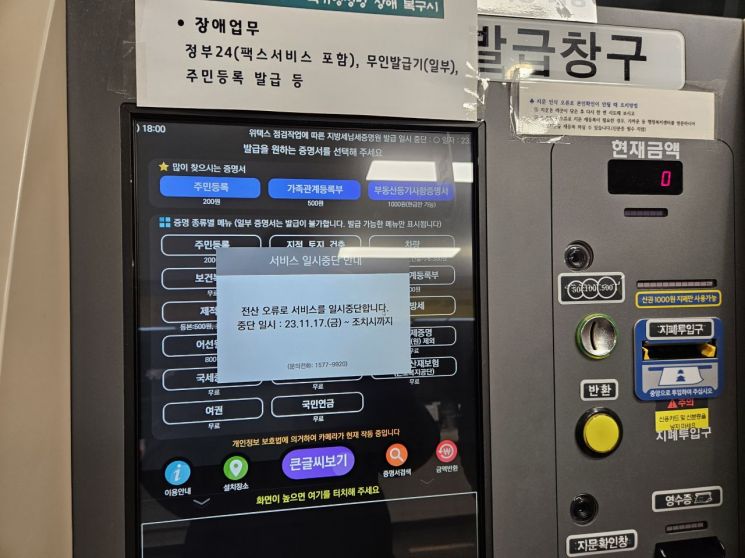 On the afternoon of November 17, 2023, the unmanned issuance counter at Suseong District Office in Daegu was not operating due to a national information resource network equipment error. Photo by Yonhap News Agency
Unaware of 'Equipment Issues' Notification for Seven Hours
On the 29th, the Board of Audit and Inspection announced the results of its audit on the "Establishment and Operation of the National Administrative Information System," which included these findings. This audit was conducted to determine the causes of the November 17, 2023, national information and communications network (NICN) outage, which affected 189 administrative information systems, including Government 24. President Lee Jaemyung also recently mentioned that "there was significant damage in 2023" following the fire incident at the National Information Resources Service in Daejeon.
The Board of Audit and Inspection pointed out that complacent monitoring and administration exacerbated the scale of the incident. According to the Board, at 1:42 a.m. on the day of the incident, a notification indicating a problem with equipment (router) was generated by the national resource monitoring system. However, the main situation room failed to detect this because it routinely kept the monitoring system’s notification window closed. As a result, the situation room only became aware of the incident at 8:40 a.m., nearly seven hours later.
The duty office at the Seoul Government Complex recognized the incident through the monitoring system but failed to properly communicate the occurrence. The information should have been relayed to the night shift staff in the main situation room, but instead, it was mistakenly sent to the day shift staff who had already left. The day shift staff member, having learned of the error, arbitrarily judged it to be unimportant and went on vacation.
Even after the incident was reported, none of the national resource personnel responded to the mobilization order. A second mobilization order was sent out, and a response team was eventually formed, but the team leader responsible for the relevant equipment did not receive the message and therefore did not respond.
The Older the Equipment, the Longer the Service Life... Replacement Becomes More Difficult
The Board of Audit and Inspection analyzed that "this outage should have been resolved within two hours (105 minutes) according to regulations, but instead it lasted for two days, prolonging the disruption," and that "the golden time during which the faulty equipment could have been checked and addressed before the confusion escalated was lost."
Weaknesses in the management of outdated equipment were also highlighted. According to relevant regulations, the service life of equipment is calculated based on its period of use. As a result, the longer equipment is used, the more its service life increases, making replacement even more difficult. In the case of the router equipment that caused the incident, its service life was six years in 2008, but by 2022, it had increased to nine years.
The Board also found that the National Information Resources Service had prioritized replacing individual equipment under the jurisdiction of each ministry over shared equipment that affects multiple systems. In fact, while outdated individual equipment increased by just over 8%, outdated shared equipment increased by 47%, making the aging problem 5.6 times more severe.
The Board of Audit and Inspection issued a "cautionary notice" to the head of the National Information Resources Service, instructing thorough monitoring work. The Board stated, "We have instructed the National Information Resources Service and the Ministry of the Interior and Safety to establish measures to prevent recurrence," adding, "Matters requiring standard improvements have been reported to the Ministry of Science and ICT, and those requiring budget allocation have been reported to the Ministry of Economy and Finance, so that relevant agencies can work together to resolve the issues."
© The Asia Business Daily(www.asiae.co.kr). All rights reserved.

















