Calls for Deregulation Raised at National Assembly Discussion
Government Weighs Careful Review Citing Security Concerns
At a National Assembly discussion, voices were raised calling for the removal of 'botulinum toxin' from the list of national core technologies, in order to prevent both tangible and intangible industrial losses, including annual losses of approximately 100 billion won due to approval delays. The government stated that it is listening to these calls, but emphasized the need for careful review in consideration of national security.
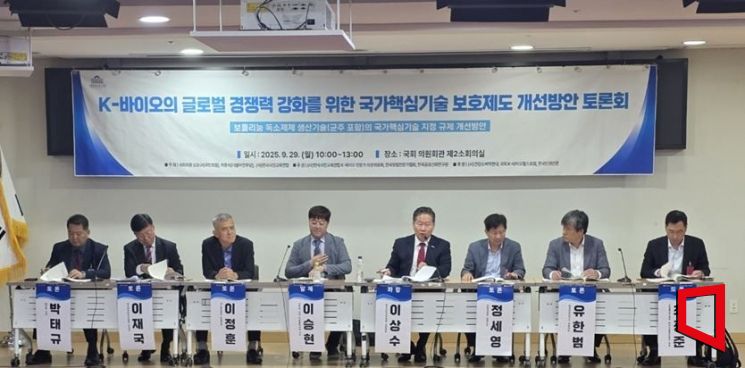 At the 'Discussion on Improving the National Core Technology Protection System to Strengthen the Global Competitiveness of K-Bio' held on the 29th at the National Assembly Members' Office Building in Yeongdeungpo-gu, Seoul, hosted by Kang Seungkyu of the People Power Party and Heo Jongsik of the Democratic Party of Korea, experts from various fields are expressing their views. Photo by Choi Taewon
The pharmaceutical and bio industries, related academic circles, and the government expressed these views at the 'Discussion on Improving the National Core Technology Protection System to Strengthen the Global Competitiveness of K-Bio,' held on the 29th at the National Assembly Members' Office Building in Yeongdeungpo-gu, Seoul, hosted by Assemblyman Kang Seungkyu of the People Power Party and Assemblyman Heo Jongsik of the Democratic Party.
The national core technology system is designed to protect technologies that could have a significant impact on national security, the economy, and public health if leaked overseas. Exporting such core technologies to foreign companies requires approval from the Minister of Trade, Industry and Energy, and violations can result in penalties. The production technology for botulinum toxin was designated as a national core technology in 2010, and the strain was added in 2016.
Lee Seunghyun, a professor in the Department of Microbiology at Konkuk University School of Medicine and the presenter at the event, stated, "It is estimated that the export approval process alone takes an average of 74 days, and in some cases over a year, resulting in annual losses of 90 to 100 billion won. The majority of the 18 domestic companies in this field have officially raised the need for removal, and the Korea Pharmaceutical and Bio-Pharma Manufacturers Association has also requested deregulation."
Arguments were also made that botulinum toxin technology is no longer a core technology. Botulinum toxin products are biopharmaceuticals used for cosmetic procedures such as improving frown lines and for treating conditions like migraines, and are commonly known as 'Botox.' Professor Lee explained, "According to a U.S. Department of Defense report, the technical entry barrier is so low that it is considered 'low-tech.' Botulinum strains can be easily found in nature, and more than 30 companies across 15 countries have already succeeded in commercializing the technology."
There was also criticism that concerns over weaponization have led to excessive regulation. Botulinum toxin is already regulated by more than seven laws under six ministries, including the Biochemical Weapons Act, the Foreign Trade Act, and the Infectious Disease Control and Prevention Act, making its designation as a national core technology a case of overlapping regulation.
Some argued that regulations on botulinum toxin are being eased in other countries as well. Lee Sangsoo, executive director of the Korea Civic Education Association, said, "The United States, the United Kingdom, and China also strictly control botulinum strains. However, each country strikes a different balance between safety regulations and industrial activation compared to Korea."
He added, "Korea is the only country that regulates industrial activity by designating botulinum technology as a national core technology. The United States, the European Union, and China manage the strains from a biosecurity perspective, but do not implement regulations that hinder industrial development."
The pharmaceutical and bio industries are also overwhelmingly in favor of deregulation. According to a survey conducted by the Korea Civic Education Association from the 12th to the 24th of this month among 18 domestic pharmaceutical companies producing botulinum toxin, 14 out of 17 respondents (82.4%) supported deregulation. The main reason cited was that 'the cost of lost opportunities far outweighs the benefits of regulation' (32.6%).
However, the government maintained a cautious stance. Choi Kwangjun, director of the Bio-Convergence Industry Division at the Ministry of Trade, Industry and Energy, who attended the discussion, said, "Whether to deregulate national core technology must be carefully reviewed by gathering opinions from the perspectives of national security and the national economy. We plan to listen to expert opinions in a balanced way and review the designation and deregulation of botulinum toxin production technology in accordance with the procedures and standards of the Industrial Technology Protection Act."
Meanwhile, the pharmaceutical and bio industries also requested the removal of botulinum toxin from the list of national core technologies in 2023, but the Industrial Technology Protection Expert Committee in the biotechnology sector decided that the designation should be maintained. The industry renewed its request for deregulation in September last year, and the Ministry of Trade, Industry and Energy is currently gathering opinions on the matter.
© The Asia Business Daily(www.asiae.co.kr). All rights reserved.

















