"Not a Human Problem, but a Structural Issue"
"National IT Systems Are Severely Outdated"
"Special Modernization Budget Needed for Complete Reconstruction"
Lee Junseok, leader of the Reform New Party and a member of the National Assembly's Science, ICT, Broadcasting, and Communications Committee, urged President Lee Jaemyung to "completely rebuild Korea's digital infrastructure with the funds instead of pursuing populist policies that distribute 13 trillion won in cash," in response to the network paralysis caused by the fire at the National Information Resources Service.
On the 29th, Lee stated on his social networking service (SNS), "The best time to plant a tree was 20 years ago. The second best time is now," adding, "With the government’s computer systems paralyzed for several days due to the fire at the National Information Resources Service, we are now faced with a choice that can no longer be postponed."
 Lee Junseok, leader of the Reform New Party, appeared on Asia Economy AK Radio at the National Assembly on August 5th and was interviewed by specialist So Jongseop. Photo by Kim Hyunmin
Emphasizing the need to strengthen legislation to guarantee high availability for certain systems, Lee argued, "We must prepare a separate bill that specifically mandates 99.99% availability and geographic redundancy for all core government systems," and added, "A special budget should be allocated for IT infrastructure modernization, requiring at least 30% of the annual IT budget to be dedicated to system modernization."
Lee also stressed, "We need to fully modernize the e-Government Standard Framework," and continued, "The government should secure its own development capabilities and directly develop and operate core systems by specially recruiting digital talent." He further noted, "Deploying and managing software is as difficult as developing it," and predicted, "Among the 17,060 government systems, those developed a long time ago will be virtually impossible to reinstall and recover in a short period." In particular, he pointed out, "Some systems have lost their developers, lack proper documentation, and in some cases, even the source code is not properly managed," diagnosing, "It may take months to recover such systems, so instead of giving the public false hope, we must inform them of the reality as it is and seek fundamental solutions."
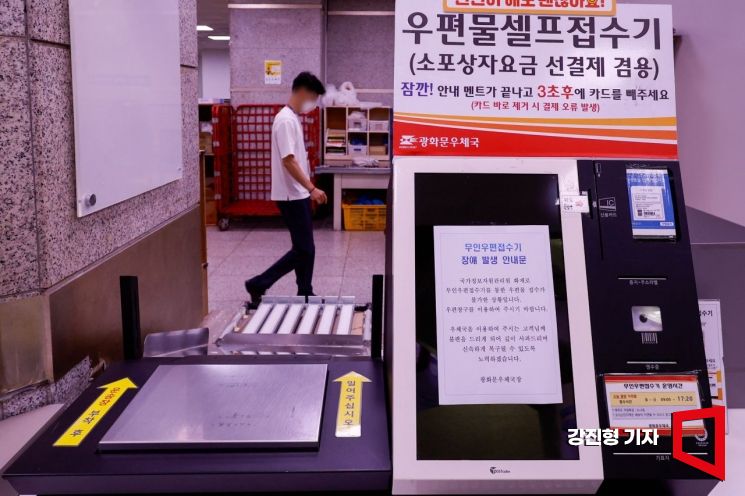 On the 29th, as the nationwide network paralysis continues due to a fire in the data center of the National Information Resources Service's Daejeon headquarters, a notice indicating that mail cannot be accepted is posted on an unmanned mail reception machine installed at Gwanghwamun Post Office in Jongno-gu, Seoul. Photo by Kang Jin-hyung
He concluded, "It is ironic that the President, who usually envisions a rosy future with a 4.5-day workweek, is now instructing civil servants to work overnight restoring systems, but this is not a matter of manpower," adding, "No matter how hard we try, structurally flawed systems have their limits. This is an issue that requires fundamental refactoring, which will need sufficient budget and time."
Lee Junseok: "A 10-Year Plan Is Needed for a Complete Rebuild of Government Systems"
On this day, Lee also proposed a 10-year plan for the complete reconstruction of government systems. He said, "There were branches of the National Information Resources Service in Daegu and Gwangju, but they did not function. This is because they were not originally designed for geographic redundancy," emphasizing, "We must establish a truly redundant system where Daejeon, Gwangju, and Daegu can each independently operate all services."
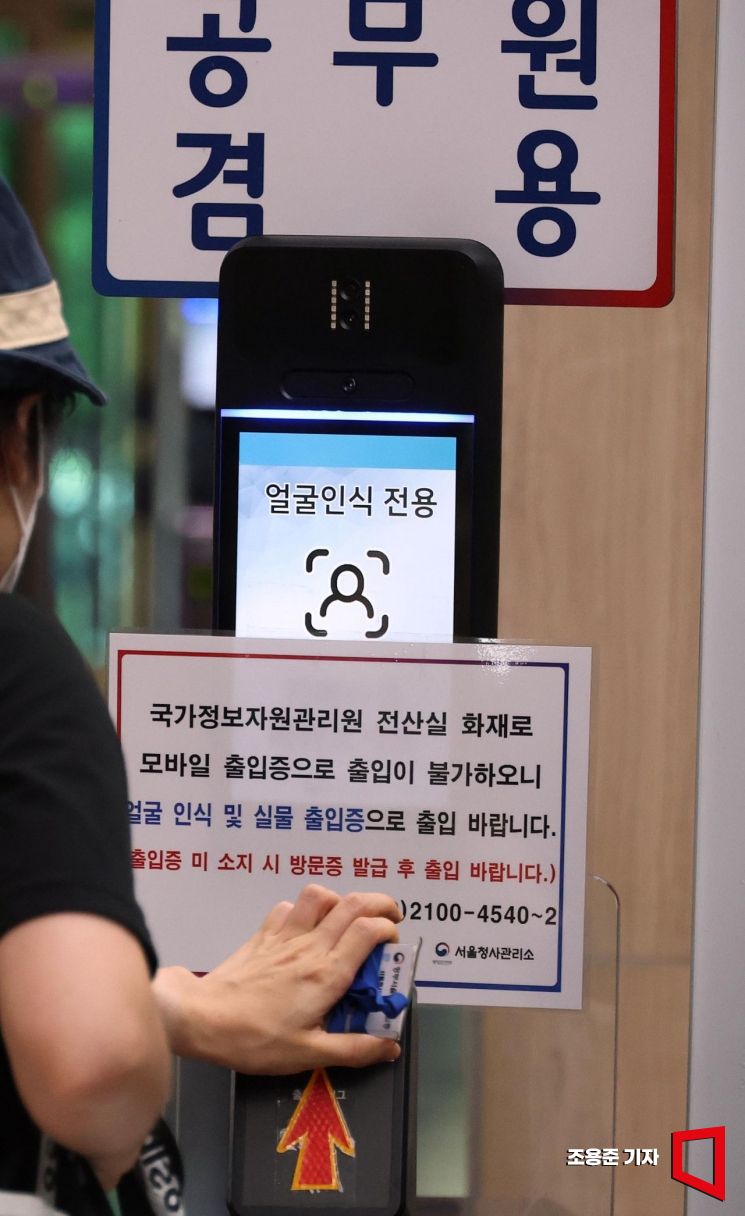 Amid the near paralysis of the government network due to a fire at the National Information Resources Service, on the 29th, a notice stating "Access not allowed with mobile pass due to fire at the National Information Resources Service" was posted at the entrance of the Government Seoul Building in Jongno-gu, Seoul. Photo by Jo Yongjun
Previously, on the day before, Lee had also proposed the idea of true geographic distribution on his SNS. In that post, Lee said, "We should recall the wisdom of our ancestors who stored the Annals of the Joseon Dynasty in multiple locations such as Hanyang, Chunchugwan, Chungju, Jeonju, and Seongju," and argued, "Just as only the Jeonju archive survived during the Japanese invasions, allowing history to continue, national core services must be distributed not just through simple equipment redundancy, but in data centers that are geographically completely separated."
Specifically, he stated, "The government, which must consider handling sensitive information, will ultimately need to further strengthen geographic redundancy through its own data centers," and added, "We must build additional data centers not only in the Daejeon and Sejong areas, but also in the Yeongnam and Honam regions." Currently, national resources are operated in a three-center system: Center 1 (Daejeon), Center 2 (Gwangju), and Center 3 (Daegu). The government is working to establish a Gongju branch in Gongju, Chungcheongnam-do, to ensure data protection and normal system operation even if the Daejeon, Gwangju, and Daegu centers are paralyzed in an emergency, but it is not yet fully operational.
© The Asia Business Daily(www.asiae.co.kr). All rights reserved.



















