Mentioning China's Talent Pool and "996" Work Culture
Urges U.S. Government to Halt Tech Regulations
Huawei Unveils AI Chip Roadmap
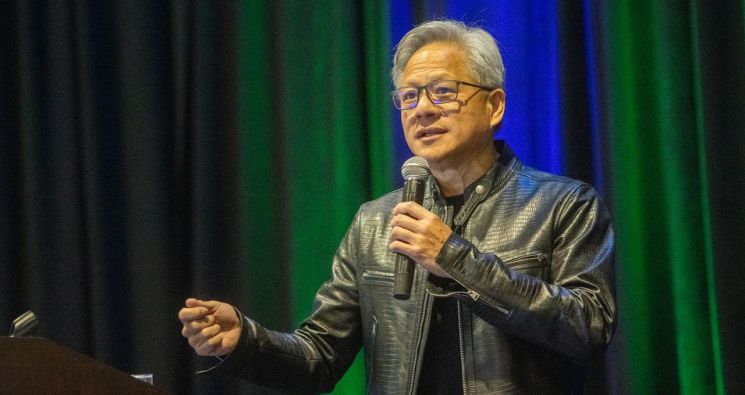
Jensen Huang, Chief Executive Officer (CEO) of Nvidia, has urged the U.S. government to halt its regulatory actions, stating that the technological gap between the U.S. and China in the semiconductor sector amounts to just a few nanoseconds (billionths of a second).
According to the South China Morning Post (SCMP) on the 29th (local time), CEO Huang appeared on the recent "BG2" podcast, where he remarked that China's semiconductor sector is "a few nanoseconds behind" the U.S., emphasizing, "That is why we (American companies) must compete."
He highlighted China's vast talent pool and internal competition between Chinese regions, stressing the rapid advancement of China's semiconductor manufacturing capabilities. He also mentioned China's intense work culture, such as the "996 work system," which refers to working from 9 a.m. to 9 p.m., six days a week.
CEO Huang has previously criticized U.S. government policies that restrict China's access to advanced artificial intelligence (AI) chips. The U.S. government blocked Nvidia from exporting its AI chip H20, designed for the Chinese market, in April, but partially permitted exports in July during U.S.-China tariff negotiations.
In the podcast interview, CEO Huang argued that allowing American companies to compete within China would benefit both the U.S. and China. He specifically urged U.S. authorities to enable the technology industry to compete globally, including in China. By doing so, semiconductor technology could be spread worldwide, maximizing both America's economic success and its geopolitical influence.
Addressing China, he referenced the authorities' stance on "market openness," expressing his belief and hope that China would continue to welcome foreign investment. He added, "What best serves China's interests is for foreign companies to invest and compete in China."
Regarding concerns raised by some about potential overcapacity in AI production facilities, he responded, "I believe the likelihood of overcapacity is very low until all general-purpose computing is fully converted to accelerated computing and AI," adding, "No one needs an atomic bomb, but everyone needs AI."
SCMP noted that these remarks come as Chinese companies are preparing for a "post-Nvidia" era. In fact, Chinese AI and semiconductor firms have been rapidly introducing domestic alternatives, eroding Nvidia's market share. Huawei, which serves as both technical advisor and control tower for China's semiconductor ecosystem, unveiled its AI chip roadmap this month, presenting clustering methods and advanced manufacturing technologies that could bypass Nvidia.
Chinese tech giants such as Alibaba, Tencent, ByteDance, and Baidu are also investing heavily in chip development through in-house research and development as well as external investments, aiming to strengthen their control over supply chains. Startups like Cambricon Technologies, Moore Threads Technology, Enflame, and MetaX are reportedly joining this movement as well.
© The Asia Business Daily(www.asiae.co.kr). All rights reserved.
![Clutching a Stolen Dior Bag, Saying "I Hate Being Poor but Real"... The Grotesque Con of a "Human Knockoff" [Slate]](https://cwcontent.asiae.co.kr/asiaresize/183/2026021902243444107_1771435474.jpg)











