Seoul National University Hospital Public Healthcare Center: Survey of 1,000 Citizens
More Than Half Support Improving Health Insurance Fund Efficiency
"Increase Out-of-Pocket Costs for Minor Illnesses and Expand Support for Innovative New Drugs"
A recent survey found that a significant portion of Koreans agree with reducing health insurance coverage for minor illnesses such as the common cold, in order to provide greater support for patients with severe or rare diseases. As the health insurance fund reaches its limits and the burden of treatment and medication costs for patients with severe or rare diseases increases, there are growing calls to reprioritize health insurance coverage.

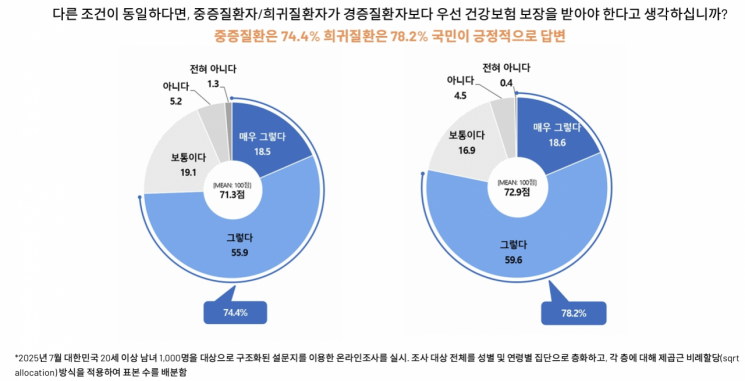
According to a study titled "Measures to Improve the Efficiency of Health Insurance Fund Management to Strengthen Patient Access to Treatments for Severe Diseases," released by Professor Kwon Yongjin's team at the Public Healthcare Center of Seoul National University Hospital on the 29th, 18.5% of 1,000 respondents answered "strongly agree" and 55.9% answered "agree" when asked whether patients with severe diseases should receive health insurance coverage before those with minor illnesses. This means that 74.4% of respondents expressed active support. When asked whether patients with rare diseases should be prioritized over those with minor illnesses, 18.6% answered "strongly agree" and 59.6% answered "agree," with a total of 78.2% in agreement.
Severe diseases refer to illnesses such as cancer and heart or brain diseases that are extremely serious, difficult to cure, and require advanced medical services and high costs for treatment. Rare diseases are defined as those affecting fewer than 20,000 people or those with unknown patient numbers due to diagnostic difficulties. Intractable diseases are conditions for which treatments exist but are difficult to cure, and discontinuing treatment can result in death or severe disability. Representative examples include Lou Gehrig's disease, spinal muscular atrophy, and Parkinson's disease.
However, it is not feasible to continuously raise health insurance premiums to cover all such diseases, and the health insurance fund itself has already reached its limits. When the research team asked whether it is necessary to reduce coverage for minor illnesses in order to strengthen coverage for severe diseases, 9% of respondents answered "strongly agree" and 37.6% answered "agree." For the same question regarding strengthening coverage for rare diseases, 9.4% answered "strongly agree" and 43.3% answered "agree," with more than half in favor. When including those who answered "neutral," over 80% of respondents agreed with both questions.
Additionally, 60.0% of these respondents said they would reduce their hospital visits if health insurance coverage for minor illnesses such as the common cold was reduced. Furthermore, 71.7% stated that if coverage amounts for minor illness treatments decreased and their out-of-pocket costs increased, they would opt for self-care instead of seeking treatment.
Professor Kwon Yongjin suggested reprioritizing health insurance coverage to focus on severe and rare diseases, taking into account the seriousness of the illnesses and social costs. He also recommended rationally adjusting the prices of generic drugs and reinvesting the resulting savings into innovative new drugs for the treatment of severe and rare diseases.
Professor Kwon emphasized, "This survey confirmed that the public also agrees with reprioritizing the health insurance fund. By operating the reimbursement decision system more flexibly to reflect the characteristics of innovative treatments, we should create a patient-centered treatment environment while also enhancing the efficiency and transparency of the fund."
© The Asia Business Daily(www.asiae.co.kr). All rights reserved.


















