"Taiwan Is Key to U.S. Indo-Pacific Strategy"
Some Argue China's Attempt Will Fail
The Wall Street Journal (WSJ) reported on the 27th (local time) that Chinese President Xi Jinping plans to pressure the United States to declare its opposition to Taiwan's independence during trade negotiations with U.S. President Donald Trump.
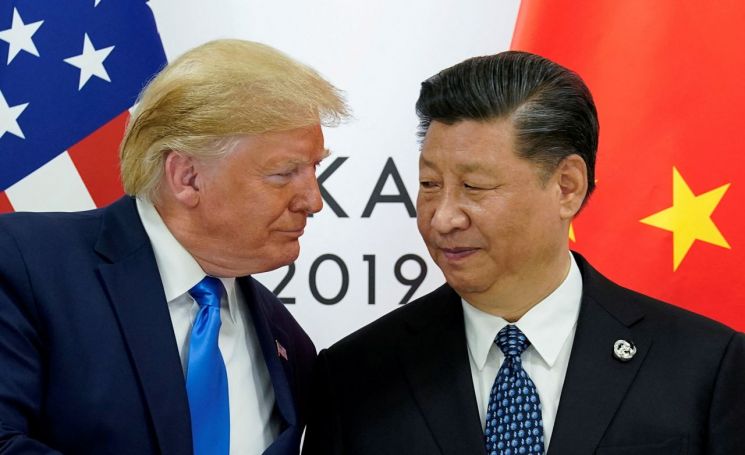
Until now, the United States has defined its relationship with Taiwan through the "One China Policy." This policy opposes any unilateral changes to the current situation by either China or Taiwan and is based on the peaceful resolution of cross-strait (China and Taiwan) issues. Under this policy, the United States has maintained strategic ambiguity by not stating a clear position on the most sensitive issues of Taiwan's independence and sovereignty.
Former President Joe Biden once stated that the United States would defend Taiwan if China invaded, which sparked controversy over whether U.S. policy toward Taiwan had changed. In response, he reaffirmed the "One China Policy" and declared that the United States does not support Taiwan's independence. According to sources, President Xi is no longer satisfied with this stance of the former Biden administration.
The WSJ analyzed that if the Trump administration declares its opposition to Taiwan's independence, it would signal a shift in U.S. policy from a previously neutral stance to one more actively aligned with China, which opposes Taiwan's independence. This could further consolidate President Xi's power within China.
The Trump administration has not yet officially adopted the position of not supporting Taiwan's independence. Unlike former President Biden, President Trump has avoided making clear statements on whether the United States would intervene if China invades Taiwan, arguing that taking a clear stance would weaken the U.S. negotiating position.
There are also claims that China's attempts to induce a change in U.S. policy on cross-strait issues will not succeed. According to the Taipei Times on the 29th, a Taiwanese national security official who requested anonymity said, "China is seeking opportunities to weaken mutual trust and cooperation between Taiwan and the United States," adding, "Taiwan, which continues to develop, holds a key position for stability in the Indo-Pacific region. This is directly linked to the United States' strategic interests."
Sun Yun, a China expert at the U.S. think tank Stimson Center, also stated, "China will not be able to change U.S. policy toward Taiwan overnight," adding, "However, through continuous and repeated pressure, China will try to gradually destabilize the relationship between Taiwan and the United States."
© The Asia Business Daily(www.asiae.co.kr). All rights reserved.
![Clutching a Stolen Dior Bag, Saying "I Hate Being Poor but Real"... The Grotesque Con of a "Human Knockoff" [Slate]](https://cwcontent.asiae.co.kr/asiaresize/183/2026021902243444107_1771435474.jpg)











