Market Contraction Seen After Cheongna EV Fire
Potential Delays in Public Sector Orders
As it was revealed that the fire at the main data center of the National Information Resources Service in Daejeon originated from a lithium-ion battery in an uninterruptible power supply (UPS), the battery industry is closely monitoring the potential impact on the market.
According to industry sources and relevant authorities on September 29, the UPS battery involved in the fire was a nickel-cobalt-manganese (NCM) type product manufactured by LG Energy Solution between 2012 and 2013 and supplied to the National Information Resources Service in 2014. Although the battery had exceeded its recommended lifespan of 10 years, it reportedly passed an inspection in June with a result of "no abnormalities."
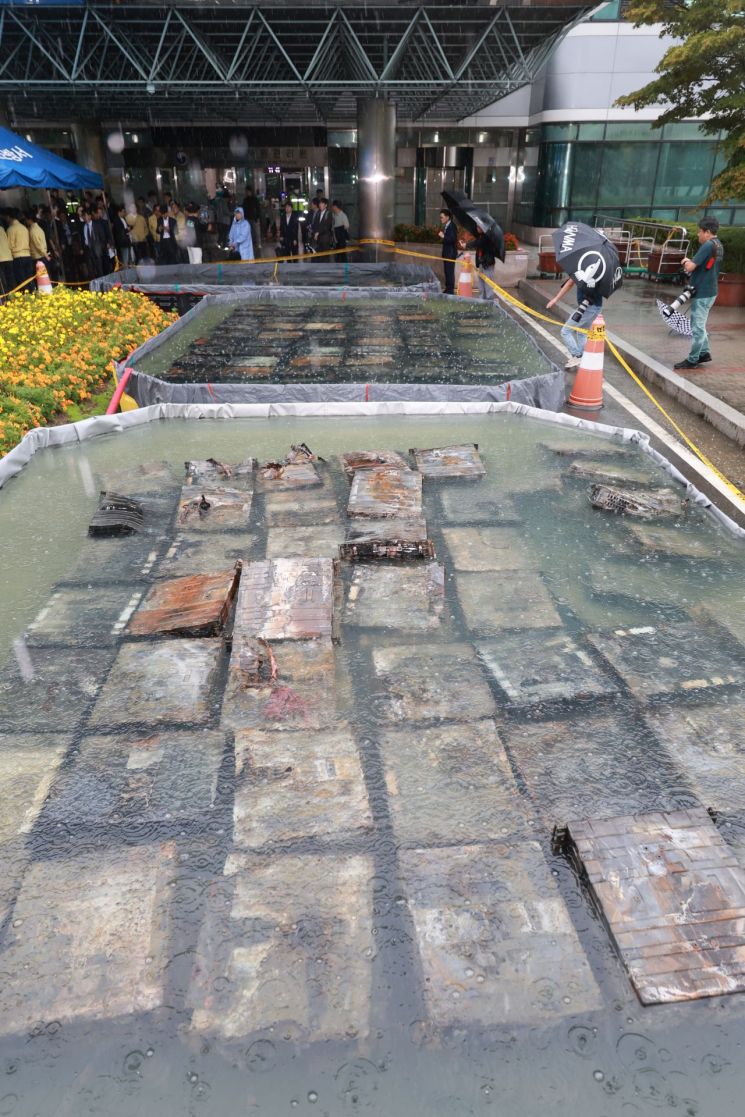 On the 28th, a lithium-ion battery burned in a fire at the National Information Resources Service in Yuseong District, Daejeon, is submerged in a fire suppression water tank. On the 26th, a fire broke out in a lithium-ion battery used for an uninterruptible power supply (UPS) at the National Information Resources Service, which houses government computer systems, causing a large-scale disruption of government computer services. Yonhap News Agency
The industry cautiously suggests that, since there have been cases where properly managed UPS batteries have been used for up to around 15 years, the fire may have been caused not by a defect in the battery itself but by human error during the work process, specifically a failure to properly disconnect the power supply.
However, there are growing concerns that the battery fire, having escalated into a large-scale disaster, could further shrink the market. It is possible that public institutions and data center clients will strengthen safety verification or delay new orders. The industry is also worried because, after the electric vehicle fire in Cheongna, Incheon last year, consumer confidence was shaken and sales temporarily declined.
Anxiety over battery fires is also evident in the statistics. According to the office of Assemblyman Wi Seongon of the National Assembly’s Public Administration and Security Committee, there were 296 battery fire incidents in the first half of this year. If this trend continues in the second half, the total could surpass last year’s 543 cases. Meanwhile, related training by fire authorities was conducted 25 times in 2023, 50 times in 2024, but only 9 times in the first half of this year, highlighting concerns that response capabilities are insufficient compared to the frequency of incidents.
The industrial ripple effects of this incident are expected to be significant. If replacement demand increases, especially among public institutions and data centers, the related market could expand in the short term, but stricter standards and higher costs may also follow.
The battery industry is accelerating the development of technology that emphasizes safety. LG Energy Solution, Samsung SDI, and SK On are increasing the proportion of lithium iron phosphate (LFP) batteries, which are considered safer, in the energy storage system (ESS) market, and are also working on developing all-solid-state batteries that further reduce the risk of explosion and fire. Recent products are equipped with various safety features, such as circuit protection devices that cut off current in case of overheating and cell-level thermal dissipation structures.
Lee Deokhwan, a professor of chemistry at Sogang University, warned, "Once a lithium-ion battery catches fire, no extinguishing agent can penetrate to the inside," adding, "Larger-scale energy storage systems (ESS) are much more dangerous if not properly managed."
© The Asia Business Daily(www.asiae.co.kr). All rights reserved.
![Clutching a Stolen Dior Bag, Saying "I Hate Being Poor but Real"... The Grotesque Con of a "Human Knockoff" [Slate]](https://cwcontent.asiae.co.kr/asiaresize/183/2026021902243444107_1771435474.jpg)
















