Visa-Free Entry Policy Expected to Attract 1 Million Chinese Tourists
Duty-Free Shops, K-Beauty, and Fashion Go All-Out as Local Governments Join In
The number of Chinese tourists visiting Korea is expected to increase due to the implementation of visa-free entry. The industry and local governments are targeting Chinese tourists with customized services and K-culture experience packages tailored to evolving travel trends.
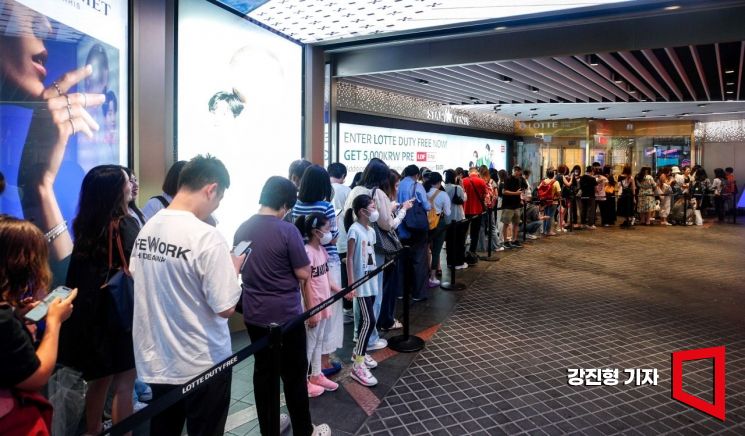 Foreign tourists lining up to enter a duty-free shop in downtown Seoul. Photo by Asia Economy Database
From September 29 until June 30 next year, Chinese tour groups of three or more people, organized by designated domestic and international travel agencies, can visit Korea without a visa. The government expects that this visa-free policy will attract more than 1 million Chinese tourists to Korea.
According to the Korea Tourism Organization, the number of Chinese tourists visiting Korea reached 8.07 million in 2016, but sharply declined due to the THAAD dispute and the COVID-19 pandemic, remaining at an annual average of 1.07 million from 2020 to 2022. Since last year, the figure has rebounded to 4.6 million, and the number of Chinese arrivals has continued to grow this year, from approximately 364,000 in January to about 602,000 in July.
The tourism and retail industries are revising their strategies to adapt to the changing consumption patterns of Chinese tourists. As individual and small-group travel has increased compared to the previous focus on large group tours, companies are concentrating on providing customized services and enhancing payment convenience. Major duty-free shops and department stores have introduced payment methods preferred by Chinese tourists, such as Alipay, WeChat Pay, and UnionPay, and are operating multilingual information desks and AI interpretation services to lower language barriers.
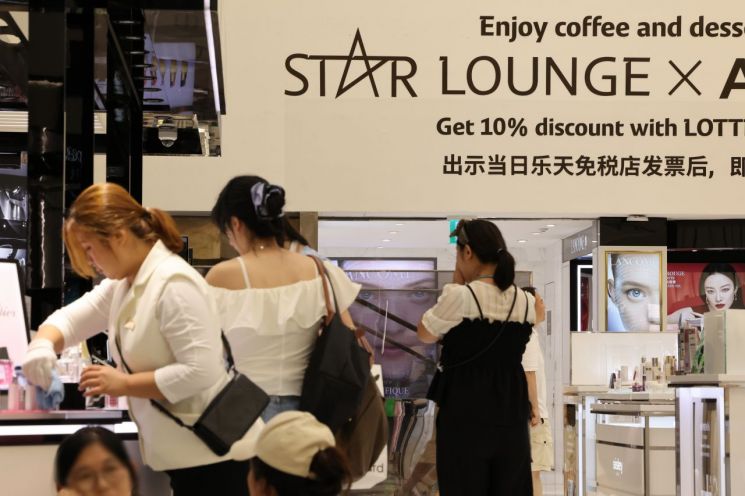
Shilla Duty Free has attracted group tourists by bringing passengers from the Dream cruise ship of Tianjin Dongfang International Cruise to its Seoul location, while Lotte Duty Free has resumed business with Daigong (Chinese personal shoppers), which had been suspended. Convenience store CU has launched an "instant VAT refund" service for foreign customers as part of its differentiated marketing, and GS25 is offering discounts and prize events for customers using Alipay and other payment methods.
The K-beauty and K-fashion industries are also moving quickly. Olive Young is strengthening its China-focused strategies at its major stores in Myeong-dong, Gangnam, Hongdae, and Seongsu. A company representative explained, "We have secured inventory comparable to our biggest annual event, the Olive Young Sale, and focused on products favored by foreign customers." Musinsa, which has emerged as a K-fashion hub, is holding a review event using the Chinese map app Gaode Map at its Musinsa Standard store, and is targeting foreign customers with discounts for Alipay Plus users and instant tax refund services.
The government and local authorities are also accelerating the development of experiential tourism products that combine K-food and K-culture. The Korea Tourism Organization is jointly developing packages with Chinese travel agencies that include Hallyu experiences, visits to drama filming locations, and K-food tours, while local governments are launching specialized tourism products tailored to their regions.
© The Asia Business Daily(www.asiae.co.kr). All rights reserved.


















