The environment ministers of South Korea, China, and Japan have agreed to hold regular policy dialogues on climate change starting next year. They also reached consensus on discussing the 2035 Nationally Determined Contributions (NDCs) for greenhouse gas reduction and expanding cooperation on carbon markets and labeling.
The Ministry of Environment announced that the three countries reached this agreement at the 26th Korea-China-Japan Environmental Ministers Meeting (TEMM26), which was held in Yantai, Shandong Province, China, from September 27 to 28.
The meeting was attended by Kim Sungwhan, Minister of Environment of South Korea; Huang Runqiu, Minister of Ecology and Environment of China; and Asao Keiichiro, Minister of the Environment of Japan. The ministers from the three countries shared the outcomes of their environmental cooperation and discussed future directions through bilateral meetings, plenary sessions, and a joint press conference.
During the meeting, Minister Kim stated, "South Korea has adopted climate crisis response and sustainable energy transition as national strategies, and to support this, the Ministry of Climate, Energy and Environment will be launched in early October." The Chinese and Japanese delegations welcomed South Korea's organizational restructuring and expressed their expectations for the advancement of carbon neutrality policies.
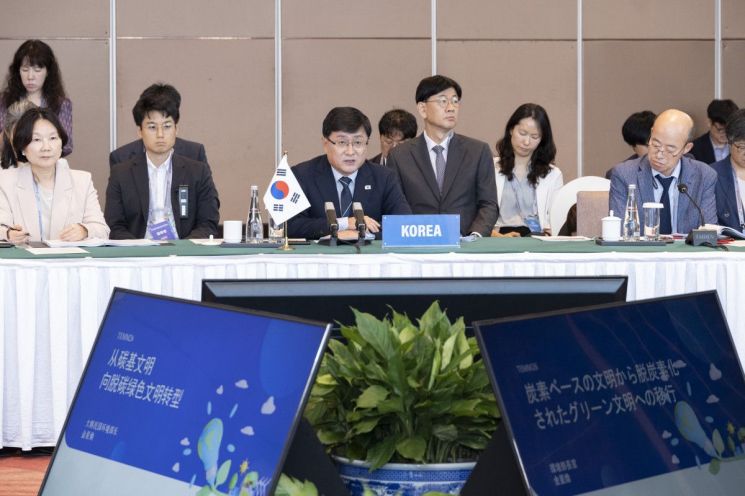 Kim Sungwhan, Minister of Environment, is presenting South Korea's environmental policy at the 26th Korea-China-Japan Environmental Ministers Meeting (TEMM26) held on the 28th in Yantai, China. (Photo by Ministry of Environment)
In particular, the three countries agreed to strengthen cooperation in the climate sector, moving beyond existing collaborations on air quality and biodiversity. To this end, they agreed to discuss the 2035 Nationally Determined Contributions (NDCs), institutionalize regular climate policy dialogues starting in 2026, and expand cooperation on carbon markets and labeling. Minister Kim emphasized, "South Korea, China, and Japan together account for more than one-third of global greenhouse gas emissions," adding, "Cooperation among the three countries will play a crucial role in achieving global carbon neutrality."
In the Korea-China meeting held prior to the main session, the two countries shared experiences on improving air quality and agreed to strengthen joint responses to the climate crisis and plastic pollution. In the Korea-Japan meeting, the two sides discussed sharing South Korea's experience with carbon markets in relation to the implementation of Japan’s Emissions Trading System (ETS), as well as cooperation on managing invasive alien species and protecting endangered species.
In addition to the main session, side events such as a youth forum and the Korea-China-Japan Environmental Industry Roundtable were held. Minister Kim met with youth representatives and stressed the need for cross-border joint action, highlighting the importance of cooperation among future generations. At the roundtable, industry leaders and experts discussed ways to achieve carbon neutrality, and the necessity of introducing a Korean-style green taxonomy and transition finance was raised.
In his closing remarks, Minister Kim stated, "South Korea, China, and Japan have pledged new actions in the face of the civilizational challenge of the climate crisis," adding, "I hope today’s agreement will serve as the foundation for a green transition not only in Northeast Asia but also around the world."
© The Asia Business Daily(www.asiae.co.kr). All rights reserved.

















