Mandatory “Disaster Management Plan” Now Required Even for OTT Platforms
Stricter Regulations Imposed After Kakao Data Center Fire
Yet No Disaster Recovery System in Place for Government Data Center Fire
As criticism mounts that the government failed to properly establish a disaster recovery (DR) system, thereby exacerbating the damage caused by the fire at the National Intelligence Resource Management Center’s data center, there are also concerns that excessive regulations are being imposed on private companies.
According to materials submitted by the Ministry of Science and ICT to Hwang Jeonga, a Democratic Party lawmaker from Yuseong District, Daejeon, and a member of the National Assembly’s Science, ICT, Broadcasting, and Communications Committee, major IT companies such as Naver, Kakao, Google, Meta, and Samsung Electronics will be required to establish a “Basic Plan for Communication Disaster Management” starting next year, in addition to key telecommunications operators such as the three major telecom companies. Online video service (OTT) providers like Netflix and Coupang Play have also been included in the list of mandatory operators.
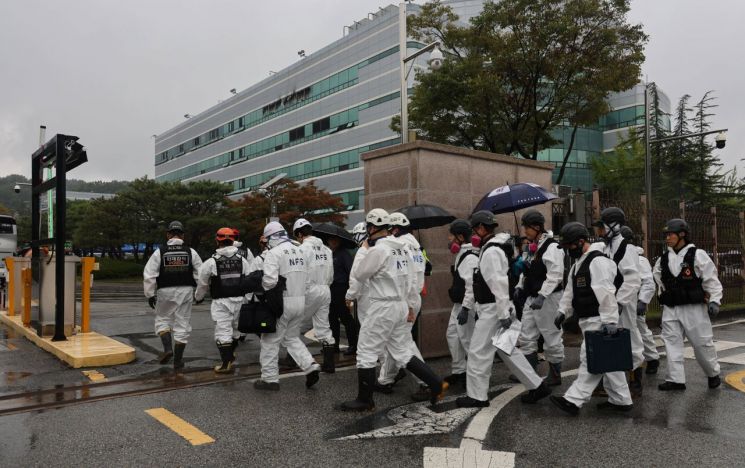 On the 28th, joint investigation team officials from Daejeon Police Agency, Fire Department, and National Forensic Service entered the interior of the Daejeon National Information Resources Service (NIRS). Photo by Yonhap News
The criteria for mandatory designation are “an average of more than 10 million daily users” or “an average daily traffic share of more than 2%.” The issue is that these criteria encompass services with little direct relevance to safety, thereby diminishing the effectiveness of the regulations. There are also predictions that this obligation to establish disaster management plans will eventually be expanded to include large game companies.
This government measure was introduced as a follow-up after the Kakao service outage caused by the 2022 fire at the SK C&C data center in Pangyo. However, during the recent fire on the 26th at the National Intelligence Resource Management Center’s data center in Daejeon, the government failed to implement a DR system, resulting in a large-scale administrative work paralysis. This contradiction has drawn criticism: while the government imposed stringent obligations on the private sector-such as data redundancy and securing emergency power-after the Kakao incident three years ago, it did not apply the same standards to its own internal systems.
This kind of double standard has been repeated in the past. In 2018, during the KT Ahyeon Office fire, the lack of backup facilities, alternative networks, and insufficient fire protection systems led to significant damage, yet the government failed to learn from the incident. At that time, the government announced a “Plan to Strengthen Communication Network Stability,” but the current administrative network paralysis has once again revealed the vulnerability of its response system.
Lawmaker Hwang Jeonga stressed, “The government’s administrative expediency-focusing only on the speck in companies’ eyes while ignoring the beam in its own-undermines public trust. The government must first establish its own internal disaster response systems.”
© The Asia Business Daily(www.asiae.co.kr). All rights reserved.
![Clutching a Stolen Dior Bag, Saying "I Hate Being Poor but Real"... The Grotesque Con of a "Human Knockoff" [Slate]](https://cwcontent.asiae.co.kr/asiaresize/183/2026021902243444107_1771435474.jpg)
















