Seminar on "Inclusive Finance 3.0 Era" Held at National Assembly on the 26th
Need to Include Financially Vulnerable Groups Such as Foreign Workers
Calls for Changes to the Existing Credit Evaluation System
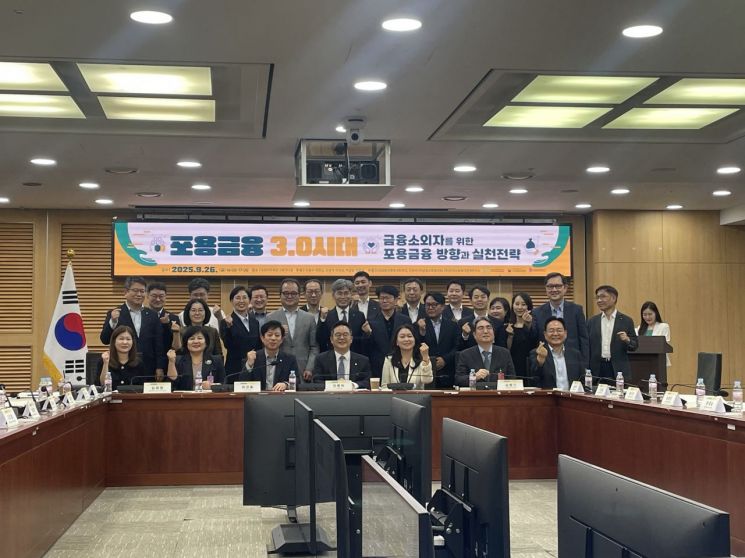 On the afternoon of the 26th, attendees are taking photos while shouting "Inclusive Finance 3.0" at the 'Inclusive Finance 3.0 Era' seminar held at the National Assembly Members' Office Building in Yeouido, Seoul.
Financial industry experts and stakeholders have agreed that changes to the existing credit evaluation system are necessary to expand inclusive finance.
At the 'Inclusive Finance 3.0 Era: Directions and Practical Strategies for Inclusive Finance for the Financially Excluded' seminar, hosted by the Finance and Happiness Network and held on the afternoon of September 26 at the National Assembly Members' Office Building in Yeouido, Seoul, participants argued that alternative credit evaluation systems must be actively pursued.
"Improvement of Credit Evaluation Needed to Include the Financially Marginalized"
Song Jongwoon, director of the Korean Social Economics Association and a presenter at the event, stated, "The Korean government's inclusive finance policy has had a positive impact by expanding loan opportunities for low-income and credit-vulnerable groups, thereby improving financial accessibility." However, he pointed out, "The technological sophistication and institutional support for alternative credit evaluation are still insufficient."
Song further emphasized, "Alternative information such as telecommunications data, distribution data, and mobile micropayment data should be incorporated into the evaluation system and processed as big data to predict borrowers' credit risks." Currently, Korea's credit evaluation system relies on the traditional credit bureau (CB) model, which is centered on credit transactions.
There were also calls for institutional improvements to include foreign workers, who are considered a representative financially vulnerable group. Due to a lack of financial history, foreign workers are often excluded from the financial system. As a result, only 7% of foreign workers in Korea hold credit cards, and just 4% utilize financial loans. Most foreign workers rely on local private lending or turn to high-interest and illegal financial services.
Moon Jaenam, CEO of Telecom Alternative Evaluation, said, "Financial inclusion of foreigners is a key task for national competitiveness and social integration." He added, "We need to realize financial inclusion by uncovering the hidden creditworthiness of 2.65 million foreigners using telecom alternative evaluation technology." He further suggested that processing the raw data from Korea's three major telecom companies to assess creditworthiness based on everyday data could serve as an alternative.
Oh Younghwan, Secretary-General of the Senior Financial Education Council, also noted, "It is difficult for newcomers to society without financial history, people with disabilities, foreign workers, full-time homemakers, and seniors to obtain loans from institutional finance." He stressed, "We need to improve credit accessibility by utilizing alternative credit evaluation methods that assess personal creditworthiness based on various non-financial information, such as telecommunications and micropayment history, rather than traditional criteria like income or collateral."
In relation to this, Sung Bokyung, Director of the Inclusive Finance Support Division at the Financial Services Commission, said, "The Financial Services Commission is also very interested in alternative credit evaluation." She explained, "We are discussing with the Korea Credit Information Services the development of a credit evaluation model for self-employed individuals and small business owners that reflects the business nature of their loans. We will also convey the suggestions regarding foreign workers."
"Prevention of Financial Fraud Crimes Requires Expanded Participation from Private Companies"
Meanwhile, at the seminar, there were also calls for increased participation from private companies in eradicating voice phishing crimes under the Lee Jaemyung administration.
Kim Hwarang, CEO of TheCheat (an online platform for reporting online transaction fraud), stated that the industry for preventing financial fraud needs to be fostered. He said, "Recently, a voice phishing prevention platform is being developed under the initiative of the Financial Services Commission, but due to the rapid implementation, private sector participation is lacking." He added, "Positive policy support is needed."
© The Asia Business Daily(www.asiae.co.kr). All rights reserved.

















