The KOSPI fell by more than 2% to the 3,380 level as both foreign investors and institutions engaged in net selling.
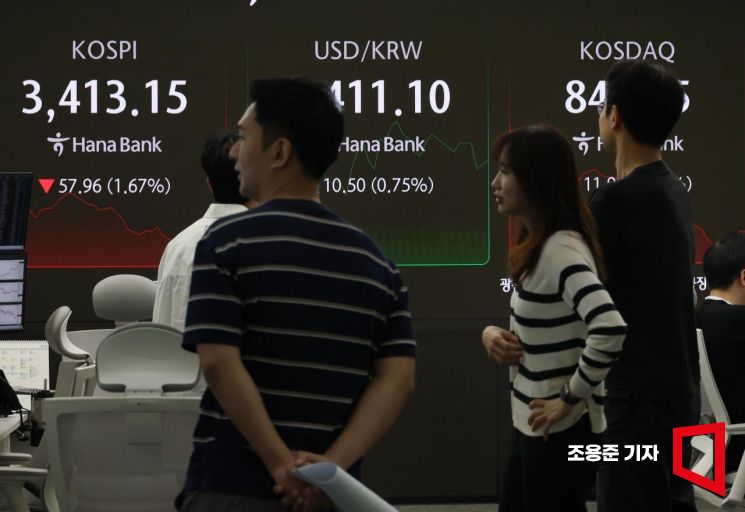 On the 26th, as the KOSPI fell nearly 2% and the won/dollar exchange rate rose by more than 10 won, the KOSPI and won/dollar exchange rate were displayed on the monitor in the dealing room of Hana Bank in Jung-gu, Seoul. On that day, the KOSPI opened at 3,440.39, down 0.89% from the previous session, the KOSDAQ index fell 0.56% to 847.67, and the won/dollar exchange rate started at 1,409.0 won, up 8.4 won. September 26, 2025 Photo by Cho Yongjun
The KOSPI closed at 3,386.05, down 85.06 points (2.45%) from the previous trading day.
On this day, the KOSPI opened at 3,440.39, a decrease of 0.89% from the previous session. From the start of the session, the KOSPI was dragged down by simultaneous net selling from foreign investors and institutions. By 11 a.m., it had fallen below the 3,400 level. At 2 p.m., it dropped as low as 3,365.73. Although it recovered some of its losses later in the session, it ultimately finished trading at the 3,380 level.
Lim Jeongeun, a researcher at KB Securities, explained, "The sell-off intensified due to diminished expectations for a U.S. rate cut, uncertainty over tariff negotiations, and caution ahead of the holiday." She added, "U.S. President Donald Trump fueled market concerns by stating that South Korea's $350 billion investment in the U.S. is 'prepaid,' which put upward pressure on the exchange rate, causing it to surge by more than 11 won to close at 1,412 won."
Na Jeonghwan, a researcher at NH Investment & Securities, also said, "The current KOSPI correction appears to reflect concerns that tariff negotiations between South Korea and the United States could face difficulties in advance." He warned, "If negotiations break down and the U.S. pushes ahead with high-tariff policies, stock price weakness could persist for an extended period."
However, he assessed that the likelihood of the tariff negotiations collapsing is low. Na continued, "Given the upcoming APEC meeting in October and the expansion of Korean companies' investments in the U.S., the chances of an extreme scenario are slim." He added, "After the Chuseok holiday, progress in negotiations is expected to ease external uncertainties." He further stated, "Structurally, a shift to more accommodative policy by the U.S. Federal Reserve, a recovery in semiconductor sector earnings, and increased global investment in artificial intelligence (AI) are expected to support the market on the downside."
By investor type, foreign investors and institutions recorded net sales of 660.6 billion won and 489.1 billion won, respectively. In contrast, individual investors recorded net purchases of 1.0976 trillion won.
By sector, electrical and electronics fell by 3.82%. Construction, medical and precision equipment, machinery and equipment, and metals each dropped by more than 2%. Chemicals, pharmaceuticals, transportation and warehousing, entertainment and culture, and distribution also declined by more than 1%. On the other hand, food and beverages, tobacco, electricity and gas, and insurance saw slight gains.
Among large-cap stocks, Samsung Electronics ended trading at 83,300 won, down 2,800 won (3.25%) from the previous session. SK Hynix plunged 5.61%, while LG Energy Solution also dropped 3.46%. In addition, Samsung Biologics, HD Hyundai Heavy Industries, and Hanwha Ocean each fell by more than 2%. Conversely, NAVER and Celltrion posted slight gains.
On the KOSPI, 121 stocks rose, including five that hit the daily upper limit such as Kolon Mobility. A total of 779 stocks declined without any hitting the daily lower limit, while 31 stocks remained unchanged.
The KOSDAQ closed at 835.19, down 17.29 points (2.03%) from the previous session.
By investor type, foreign investors recorded net sales of 83.6 billion won. In contrast, individuals and institutions recorded net purchases of 80.6 billion won and 8.9 billion won, respectively.
By sector, electrical and electronics, medical and precision equipment, machinery and equipment, non-metals, chemicals, and construction each dropped by more than 2%. Metals, paper and wood, transportation and warehousing, and transportation equipment and parts also fell by more than 1%. On the other hand, publishing and media reproduction, as well as textiles and apparel, rose by more than 1%.
Among large-cap stocks, Alteogen closed at 447,000 won, down 8,000 won (1.76%) from the previous session. Ecopro BM and Samchundang Pharm each fell by more than 4%, while Ecopro and Kolon TissueGene both dropped by more than 3%. In contrast, PharmaResearch rose by 5.67%.
On the KOSDAQ, 239 stocks rose, including three that hit the daily upper limit such as iToxy and Photon. A total of 1,418 stocks declined without any hitting the daily lower limit, while 77 stocks remained unchanged.
© The Asia Business Daily(www.asiae.co.kr). All rights reserved.

















