Japanese "Harmful Animal Eradication" Project
Jeong Hogun Founded to Hunt Korean Tigers
Behind the Goal of Eliminating Dangerous Animals
Imperial Self-Congratulation and Western-Style Trophy Hunting Motives
The popularity of the Netflix animation "K-Pop Demon Hunters" (K-Pop Demon Hunters) has drawn international attention to the mass hunting of tigers that took place during the Japanese colonial period. Under Japanese rule, the Governor-General of Korea carried out large-scale tiger hunts under the pretext of eradicating harmful wild animals. However, analysts suggest that this was driven by a combination of Japanese imperialist ambitions and the trophy hunting culture that was widespread in the West at the time.
The Governor-General of Korea Wiped Out Tigers in 25 Years
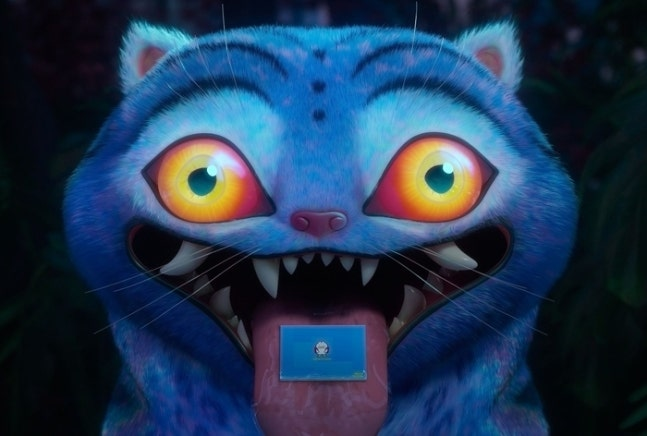
The tiger character "Duffy," which has become the mascot of K-Pop Demon Hunters, is reportedly inspired by the tigers that once inhabited the Korean Peninsula. The Korean Peninsula tiger is a subspecies of the Siberian tiger that used to live in the region, but indiscriminate hunting in the early 20th century under Japanese colonial rule led to its extinction. Today, it is classified as a first-grade endangered wild animal and is under protection.
The tiger population plummeted due to the Japanese extermination policy known as the "Harmful Animal Eradication Project," which was carried out from 1915 to 1940. This policy, implemented by the Governor-General of Korea, aimed to eliminate wild animals that posed threats to people and property. According to records from the magazine "Joseon Bulletin" published by the Governor-General, the entire project mobilized not only public authorities such as police and military police, but also civilians including hunters and beaters.
There were also cases where Japanese individuals directly participated in tiger hunting. Yamamoto Tadasaburo, a businessman who became wealthy through trade, established a private organization called "Jeong Hogun" in 1917, which means "conquering tigers," and led large-scale tiger hunts on the Korean Peninsula. The group hunts conducted by Jeong Hogun are detailed in Yamamoto's book "Jeong Hogi" (translated by Lee Eunok).
Imperial Self-Congratulation and Trophy Hunting Desires Behind the Eradication Policy
Why were Japanese people so eager to exterminate large predators on the Korean Peninsula?
On the surface, the policy was justified as a harmful animal eradication initiative, but according to "Jeong Hogi," Yamamoto described Jeong Hogun as "a hunting event to boost the morale of our empire's (Japan's) youth." For this reason, Yamamoto was also proactive in promoting Jeong Hogun's activities. Nineteen Japanese journalists joined Jeong Hogun, tasked with publicizing the group's exploits to the Japanese mainland.
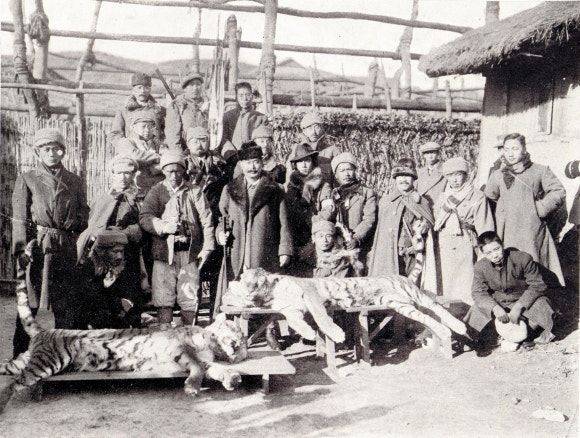 The tiger hunted by Jeong Hogun. The person standing in the center is Yamamoto Tadasaburo, the Japanese businessman who founded Jeong Hogun. Korea Tiger Conservation Fund
Yamamoto also invited influential politicians and business leaders from Japan to feasts where tiger meat was served. At a particular event held at the Imperial Hotel in Tokyo in 1917, he remarked, "During the Sengoku period, the warrior Kato Kiyomasa captured a Korean tiger to boost morale during the Imjin War, and now we have captured a tiger on Korean land, which has become Japanese territory. This is deeply significant."
Some interpret Jeong Hogun's activities as reflecting the Japanese desire not to fall behind Western powers. The early 20th century, when Jeong Hogun was active, was also a time when trophy hunting was popular in the West. Trophy hunting involved seeking out dangerous animals in remote areas and preserving their skins or horns as mementos. Tigers from the Korean Peninsula also became targets for trophy hunters, with British and American hunters-including Kermit Roosevelt, the son of former U.S. President Theodore Roosevelt-exploring Korea to hunt tigers.
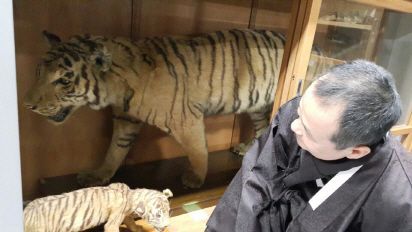 Hye Moon, the representative of Cultural Heritage Repatriation, is inspecting the stuffed Joseon tiger exhibited at Doshisha Junior High School in Kyoto, Japan. Cultural Heritage Repatriation
Yamamoto had journalists compose a military song to promote Jeong Hogun, with lyrics such as "Let us show the courage of Japanese men. Who is Roosevelt to us?" and "This year, we hunt Korean tigers; next year, we hunt Russian bears." Yamamoto also displayed typical trophy hunting behavior by skinning dead Korean Peninsula tigers and donating the taxidermied remains to Japan.
Koreans Also Participated in the Extinction of Korean Tigers: "The Japanese Justification Was Effective"
Koreans also participated in the Japanese animal eradication project, including Yamamoto's Jeong Hogun.
Lee Hang, professor emeritus at Seoul National University's College of Veterinary Medicine, who worked on annotating "Jeong Hogi," told Asia Economy, "It is believed that a significant number of the approximately 170 hunters and beaters who joined Jeong Hogun were Koreans. They appear to have been hunters hired for material rewards such as money. The Korean people did not strongly resist Japanese policy, likely because the justification of 'removing animals harmful to the people' was persuasive."
Professor Lee emphasized, "Considering Yamamoto's statements and the lyrics of Jeong Hogun's military song, it is reasonable to infer that the complete eradication of Korean Peninsula tigers was intended to undermine Korean identity. The extinction of the Korean Peninsula tiger is a direct responsibility of Japanese imperialism."
© The Asia Business Daily(www.asiae.co.kr). All rights reserved.



















