Medical Expenditures Surge as Japan Enters Super-Aged Society
Wage Increases Have Little Effect Amid Growing Burden on Younger Generation
In Japan, which has entered a super-aged society, the surge in medical expenses for the elderly has rendered last year's record-high wage increases virtually ineffective. Above all, as health insurance premiums that individuals must pay have ballooned due to rising medical costs for the elderly, there is growing discontent, particularly among the younger generation.

On September 25, the Japan Health Insurance Association announced that last year, subsidies for elderly medical care reached a record high of 3.8591 trillion yen (approximately 36.28 trillion won), up 5.7% from the previous year. The average health insurance premium rate also hit an all-time high at 9.31%, up 0.04 percentage points from the previous year. This year, the premium rate is expected to rise by another 0.03 percentage points to 9.34%, setting a new record. Notably, subsidies for elderly medical care now account for 40% of health insurance expenditures, further deepening the structure in which the working-age generation shoulders the burden of elderly medical costs. Out of roughly 1,400 health insurance associations, 660-nearly half-recorded deficits, and 334 associations, or about a quarter of the total, had premium rates exceeding 10%.
 In Japan, which has entered a super-aged society, the surge in medical expenses for the elderly has rendered the record-high wage increases implemented last year virtually ineffective. Photo by AFP Yonhap News
Unlike South Korea, which operates a single health insurance system, Japan has a multi-layered structure: "Kenpo associations" run by large corporations, "Kyokai Kenpo" for small and medium-sized enterprise employees, and "Kokumin Kenpo" managed by local governments for the self-employed, retirees, and part-time workers. Currently, about 30 million people, mainly large company employees and their families, are enrolled in the approximately 1,400 Kenpo associations. The financial burden for Kenpo associations and Kyokai Kenpo is split equally between employers and employees.
To address these structural issues, last year the Japanese government outlined a reform roadmap to secure funding for low birthrate countermeasures and to require people with higher income and assets-regardless of age-to pay higher insurance premiums. The reforms are set to be implemented by 2028, but a specific timeline has not yet been announced.
Japan's Medical Expenses Hit Record High for Fourth Consecutive Year
The problem is that as the Dankai generation enters the late elderly stage at age 75 and above, the surge in medical expenses is accelerating. Last year, Japan's total medical expenses reached 48 trillion yen (451 trillion won), marking a record high for the fourth consecutive year. In particular, as the Dankai generation (born 1947-1949) turned 75 or older, for the first time, medical expenses for those aged 75 and above accounted for more than 40% of total elderly medical spending. Medical expenses for the late elderly, which stood at 12.7 trillion yen (119.3 trillion won) in 2010, soared to 19.6 trillion yen (184.2 trillion won) last year.
As a result, even though major Japanese companies implemented record-high wage increases averaging over 5% during this year's spring labor negotiations, the rise in health insurance premiums has limited the real increase in disposable income. Last year, the current account balance of health insurance associations showed a surplus of 14.5 billion yen (1.36 trillion won), but this was barely achieved thanks to a 106.9 billion yen (1 trillion won) increase in premium income from wage hikes. In 2023, the associations recorded a deficit of 136.5 billion yen (1.283 trillion won).
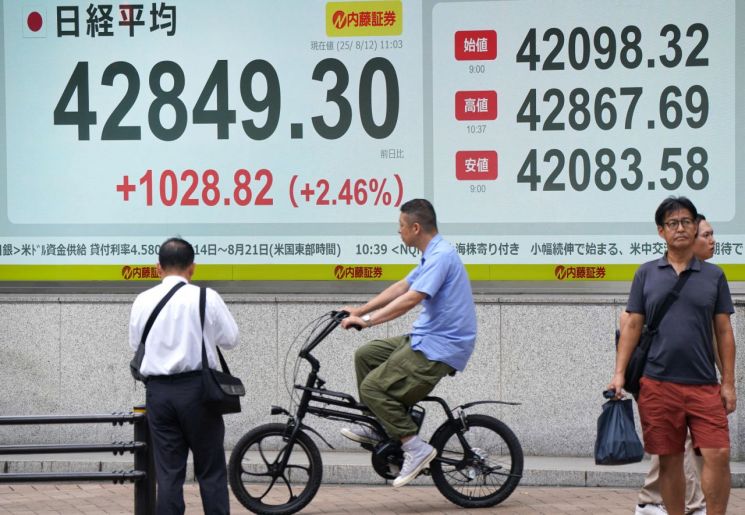
 The problem is that the Dankai generation is entering the late elderly stage at age 75 and older, accelerating the surge in medical expenses. Last year, Japan's total medical expenses reached 48 trillion yen, setting a record high for the fourth consecutive year. AP Yonhap News
With growing concerns about the increased burden on the younger generation, the Japanese government has also begun to take action. Starting in October, some late elderly individuals will face higher out-of-pocket medical costs based on income, and by 2028, a differentiated premium system based on income and asset levels will be introduced. The Nihon Keizai Shimbun analyzed, "The structure in which the working-age generation supports the elderly medical system through insurance premiums could undermine the positive effects of wage increases, such as expanded consumption," and added, "This will be a litmus test for reforms aimed at curbing premium increases for the working-age generation."
© The Asia Business Daily(www.asiae.co.kr). All rights reserved.



















