Korea Pharmaceutical and Bio-Pharma Association Hosts AI Pharma Korea Conference
Experts have emphasized that researchers themselves must build datasets for AI-based drug development, and that even small but visible achievements are necessary.
At the "AI Pharma Korea Conference 2025," hosted by the Korea Pharmaceutical and Bio-Pharma Manufacturers Association on September 25 at COEX in Gangnam-gu, Seoul, discussions focused on how artificial intelligence can be applied to drug development and what Korean companies need to change first in order to advance AI-driven drug discovery.
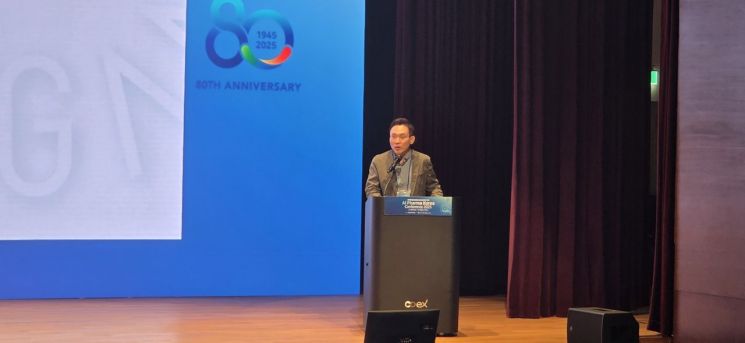 Shin Hyunjin, director of the Mokam Life Science Research Institute, is giving a lecture at the "AI Pharma Korea Conference 2025" held by the Korea Pharmaceutical and Bio-Pharma Manufacturers Association on the 25th at COEX in Gangnam-gu, Seoul. Photo by Jung Donghoon
AI Drug Development Still Faces Limitations Due to Insufficient Data... Need for Data Accumulation Through Automated Experiments
Professor Tae Young Yoon of the Department of Biotechnology at Seoul National University (CEO of Protina) began by explaining why it is difficult to design antibody drugs using AI. With the emergence of technologies like AlphaFold (developed by DeepMind), which predicts protein structures, there were expectations that AI could immediately design antibodies. However, in reality, the success rate remains low. Professor Yoon explained, "The region of the antibody that binds to the antigen, known as the CDR (complementarity-determining region), does not have a fixed structure and can change its shape depending on the situation." He added, "Simply put, it's like a moving target that cannot be captured in a photograph." He further pointed out that, "Factors such as the binding strength of the antibody to the target protein, its manufacturability, and its thermal stability must all be considered together," and that current AI models still have limitations.
His solution ultimately comes down to "producing many variants and testing them frequently." Professor Yoon's team introduced the "SPID platform," which creates thousands of CDR sequence variants using automated equipment and simultaneously measures binding affinity, stability, and productivity via a dedicated chip. This technology enables rapid and precise measurement of protein-protein interactions at the single-molecule level. By combining chips, automated devices, and fluorescence imaging, researchers can easily observe the action of drug candidates or discover new protein interactions in a short period of time. When such data is used to train AI, and the AI's proposed results are evaluated in turn, a "rapid feedback loop" is formed, significantly improving design accuracy.
Professor Yoon revealed that, in the process of improving the autoimmune disease treatment "adalimumab," his team found a candidate antibody that achieved equivalent efficacy at a lower dose than the original. There was also a case where AI suggested an unconventional combination that resulted in more than a fivefold increase in binding affinity. He stressed, "What Korean companies can do right now is to build such a repetitive experimental system internally to accumulate data," adding, "By labeling not only binding affinity but also productivity, stability, and cell penetration, the risks at the final stage of development can be reduced."
AI: Ultimately a Tool for Reducing Time and Cost
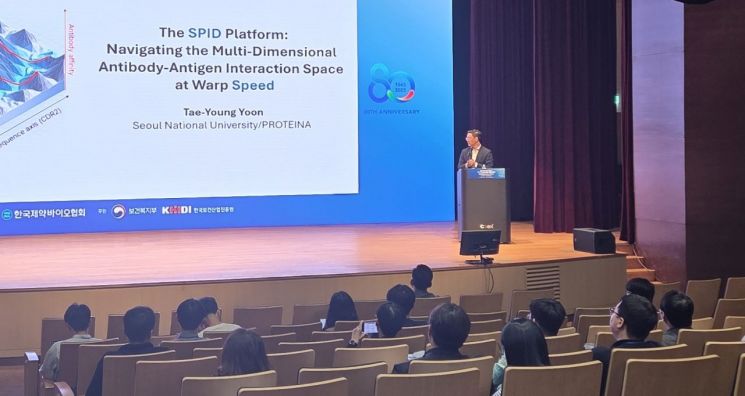 Professor Tae Young Yoon of the Department of Biotechnology at Seoul National University (CEO of Protina) is giving a lecture at the "AI Pharma Korea Conference 2025" hosted by the Korea Pharmaceutical and Bio-Pharma Manufacturers Association on the 25th at COEX in Gangnam-gu, Seoul. Photo by Donghoon Jung
Shin Hyunjin, director of the Mokam Life Science Research Institute, defined the essence of AI in drug development as "a tool to reduce labor and costs." It takes 10 to 15 years and investments ranging from hundreds of billions to trillions of won to bring a single new drug to market, with a success rate of less than 10%. The purpose of using AI is to shorten this process, even if only slightly. He simplified the role of AI into three functions: ▲ "prediction" of candidate properties, ▲ "optimization" of the best combination among multiple candidates, and ▲ "generation" of new sequences that do not exist in the world. He pointed out that AI is most effective in the early stages of drug discovery, before clinical trials, because clinical-stage data is often confined within pharmaceutical companies or hospitals, making it difficult for AI to learn from it.
At the same time, he pointed out the limitations facing Korea: the domestic market is small, and lack of collaboration makes large-scale investment difficult. The rapid progress of China in the AI drug development field is ultimately due to capital and a favorable regulatory environment. Shin emphasized, "A federated infrastructure is needed where hospitals, companies, and research institutes can safely share data," and suggested that "using a 'digital twin' model to run virtual clinical trials based on real patient data could accelerate development."
The presentations by both experts ultimately converged on the same conclusion. For AI to truly demonstrate its power in drug development, what is needed before sophisticated algorithms is high-quality data and a rapid experiment-validation loop. Professor Yoon predicted, "If a major company achieves a single success story, it will dispel market skepticism and open the floodgates," while Director Shin emphasized, "It is essential to relax capital and regulatory constraints to attract large-scale investment."
© The Asia Business Daily(www.asiae.co.kr). All rights reserved.


















