Establishing a Permanent Expenditure Efficiency System
The Ministry of Strategy and Finance has launched a comprehensive reform initiative to ensure the soundness and sustainability of the national fiscal system. This move aims to improve the long-term structure of fiscal management, as the financial burden of social insurance increases due to low birth rates and an aging population, and as fiscal expenditures rise in response to economic conditions.
On September 25, the Ministry held a kickoff meeting for the Fiscal Structure Innovation Task Force at the main conference room of the Korea Trade Insurance Corporation in Seoul. The meeting was presided over by Im Gigeun, the Second Vice Minister of Strategy and Finance, and attended by officials from major ministries such as the Ministry of Education, Ministry of Health and Welfare, and Ministry of Land, Infrastructure and Transport, as well as representatives from the Korea Development Institute, the Korea Institute of Public Finance, and private sector experts.
This Task Force serves as a pan-governmental forum for discussions on operating fiscal policy in a sustainable and strategic manner. The Second Vice Minister of Strategy and Finance oversees the Task Force, which is divided into five working groups: Expenditure Innovation, Tax System Innovation, Pension and Insurance Innovation, Fiscal Management Innovation, and Treasury Innovation. Each group includes participation from government ministries, research institutes, and private sector experts to enhance execution capabilities.
First, the Expenditure Innovation Group will establish a permanent expenditure efficiency system involving all ministries. Unlike previous efficiency efforts, which were limited to the budget formulation period, this system will conduct ongoing reviews starting from the pre-budget request stage. Each ministry will appoint a responsible official to identify and incorporate key tasks in advance, and the group will also explore improvements not only in discretionary spending but also in mandatory expenditure systems.
The Tax System Innovation Group will focus on strengthening the management of various tax exemptions and incentives. It will clarify the requirements for exemptions from preliminary feasibility studies and reinforce post-implementation evaluations to ensure that tax support leads to tangible outcomes.
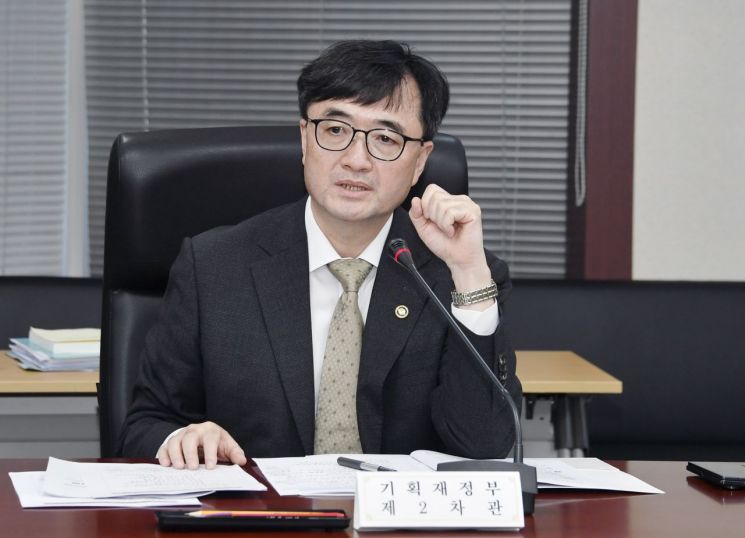 Im Gi-geun, Vice Minister of Strategy and Finance, is delivering opening remarks at the "Fiscal Structure Innovation Task Force Launch Meeting" held on the afternoon of the 25th at the Korea Trade Insurance Corporation in Jongno-gu, Seoul. (Photo by Ministry of Strategy and Finance)
The Pension and Insurance Innovation Group will develop measures to manage the finances of social insurance programs, which are expected to deteriorate due to declining birth rates and an aging population. Based on the long-term fiscal outlook announced in early September, the Ministry will support discussions in the National Assembly's Special Committee on Pension Reform and will consider various measures to enhance expenditure efficiency, such as preventing fraudulent claims in health and employment insurance and curbing excessive use.
The Fiscal Management Innovation Group will pursue institutional reforms to manage national finances with a focus on performance. It will integrate the evaluation systems for fiscal projects, which have previously been managed separately by each ministry, into a "spending restructuring and budget feedback platform," and will increase transparency by releasing evaluation results. Additionally, the group will consider improving the preliminary feasibility study system to reflect not only economic efficiency but also social value, and will discuss expanding private investment opportunities to new industries.
The Treasury Innovation Group will review systems for responding to tax revenue shortfalls and managing non-tax revenue. It will develop mechanisms to ensure fair and transparent responses in the event of revenue shortages and will discuss ways to integrate the management of non-tax revenue, which is currently handled separately by each ministry. Improving collection rates and recovering overdue receivables will also be considered.
Starting with this meeting, the government plans to finalize key tasks and a concrete implementation roadmap by the end of the year, and to reflect the results in the 2027 budget proposal and the 2026-2030 National Fiscal Management Plan.
At the meeting, Vice Minister Im emphasized, "For national finances to support economic recovery and growth, medium- to long-term sustainability is essential," adding, "Bold innovation that goes beyond established practices is crucial." He also stressed the importance of active participation from all ministries and private sector experts, calling for their cooperation.
© The Asia Business Daily(www.asiae.co.kr). All rights reserved.

















