High-Level Talks Establish Bridgehead for Global Cooperation
Mayor Kang Gi-jung Explores Ways to Apply 'AI Policy' in Gwangju
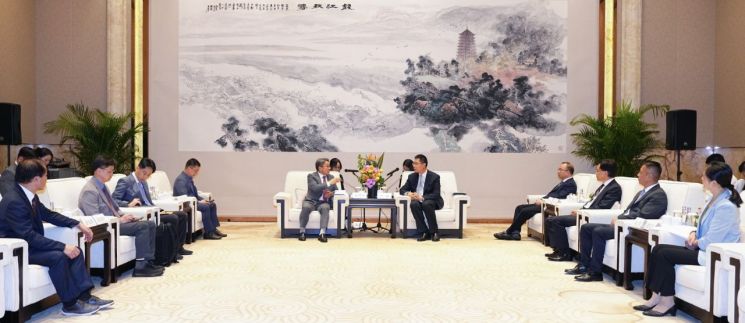 Kang Gijeong, mayor of Gwangju, held a meeting with Lu Shan, vice governor of Zhejiang Province, at the Intercontinental Hotel in Hangzhou, China, on the afternoon of the 24th to discuss exchange and cooperation plans on AI policies with Hangzhou City. Photo by Gwangju City
Gwangju, South Korea's "AI-centered city," has taken its first step toward friendly cooperation with Hangzhou, China's innovative AI city. The two cities have pledged strategic collaboration for the development of the AI industry, opening a new chapter in building a global artificial intelligence ecosystem.
On September 24, local time, Gwangju Mayor Kang Gi-jung met with Lu Shan, Vice Governor of Zhejiang Province, and other high-ranking officials at the InterContinental Hotel in Zhejiang Province, China, for in-depth discussions on China's advanced AI growth strategies. The meeting focused on the importance of an artificial intelligence industry ecosystem that integrates infrastructure, talent, and enterprises. Key topics included support for companies and nurturing talent by leveraging core AI infrastructure such as state-led supercomputing centers.
Mayor Kang expressed keen interest in Hangzhou's innovation system, emphasizing, "Hangzhou's system, which supports corporate challenges and growth in various ways, is an innovative model necessary to realize Gwangju's vision of 'AI for All'." He also unveiled Gwangju's plans for the second phase of its artificial intelligence project and the creation of a startup fund worth 1 trillion won, signaling his intention to further solidify the city's AI and startup innovation ecosystem.
Lu Shan, Vice Governor of Zhejiang Province, introduced the success stories of Hangzhou-based innovation companies such as Alibaba and DeepSeek, stating, "Korea's development experience will also serve as an important reference for shaping our shared future." He added, "We hope to contribute to pioneering the future of humanity through active exchanges and cooperation with Gwangju City."
Prior to his meeting with Vice Governor Lu Shan, Mayor Kang attended the welcome dinner for the "4th Hangzhou Global Digital Trade Expo," where he interacted with key guests from China, the United Arab Emirates, and other countries, further elevating Gwangju's status as an AI-centered city. At the event, he also met with Hangzhou Mayor Yao Gaoyuan to discuss friendly city cooperation plans aimed at revitalizing industrial and economic exchanges between the two cities. In response to Mayor Kang's proposal to activate exchanges of talent and companies between the leading AI cities of Korea and China, Mayor Yao replied that he would "consider it positively," and a friendly city agreement is expected to be signed following practical consultations.
Through this visit to Hangzhou, the city plans to actively benchmark Hangzhou's successful models for Gwangju's second-phase AI projects, such as the creation of AI InnoSpace. To date, Gwangju has invested 426.9 billion won to establish a solid foundation for its AI ecosystem, including operating the National AI Data Center, building a comprehensive talent development system spanning AI gifted high schools, academies, and graduate schools, and attracting more than 160 AI companies.
Since the launch of the eighth popularly elected administration, the city has raised 619.2 billion won in startup funds, moving toward the 1 trillion won goal, and has strengthened its reputation as a "demonstration city with a high startup success rate" by supporting 131 companies with proof-of-concept projects and fostering 15 G-Unicorn companies.
By establishing a cooperation channel with the Zhejiang provincial government in China, Gwangju has secured a bridgehead for global AI collaboration and plans to further advance its AI-centered city strategy in line with global standards as a result of this visit.
Meanwhile, Mayor Kang Gi-jung and the Gwangju delegation, who are on a four-day, three-night visit to China, will also participate in the "Hangzhou Global Digital Trade Expo" on September 25, local time, to learn about the latest AI technology trends and seek cooperation opportunities through meetings with the president of Zhejiang University and others.
© The Asia Business Daily(www.asiae.co.kr). All rights reserved.

















