Korea Federation of SMEs Releases 2025 Chuseok Funding Demand Survey for Small and Medium-Sized Enterprises
More than one out of every three small and medium-sized enterprises (SMEs) in South Korea are struggling with cash flow issues ahead of this year's Chuseok holiday.
The Korea Federation of SMEs announced the results of its "2025 SME Chuseok Funding Demand Survey" on September 25. The survey was conducted from September 8 to 12. Companies were selected based on sales volume (ranging from less than 1 billion KRW to more than 20 billion KRW) and number of employees (from fewer than 10 to more than 50), with 400 manufacturing and 400 non-manufacturing firms participating.
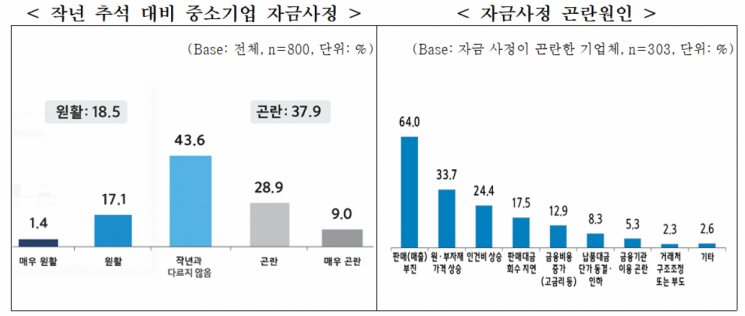
According to the survey, 37.9% of respondents said their cash flow situation for this Chuseok is more difficult compared to last year, which is higher than the 18.5% who said it was smooth. Meanwhile, 43.6% responded that there was no change from last year. The most frequently cited reasons for cash flow difficulties (multiple responses allowed) were "sluggish sales and revenue" (64.0%), followed by ▲ increases in raw material and component prices (33.7%), ▲ rising labor costs (24.4%), and ▲ delays in collecting sales payments (17.5%).
On average, companies responded that they need 197.8 million KRW in Chuseok funds this year, with an average shortfall of 47.7 million KRW compared to their needs. As for how they plan to cover the shortfall (multiple responses allowed), the most common answers were ▲ delaying payments (40.4%), ▲ early collection of delivery payments (30.8%), and ▲ borrowing from financial institutions (30.5%).
Regarding plans to pay Chuseok bonuses, 50.6% of companies said they plan to pay bonuses, 33.0% said they would not, and 16.4% have yet to decide. For those paying bonuses as a percentage, the average was 25.2% of base salary, while for those paying a fixed amount, the average was 783,000 KRW.
When asked about the ease of raising funds through banks and policy financial institutions compared to last year's Chuseok, 26.6% said it was "difficult," nearly double the 14.1% who said it was "smooth." Meanwhile, 59.3% said there was no change from last year. Regarding difficulties in raising funds from banks, 68.8% said they had no difficulties, while 31.3% said they did. The main challenges cited when raising funds from banks (multiple responses allowed) were ▲ insufficient loan limits (56.0%), ▲ screening focused on financial statements (42.0%), and ▲ high loan interest rates (39.2%).
As for additional days off for Chuseok, more than half of all companies (55.6%) said they have no extra days off beyond the Chuseok public holidays, with the average number of days off being 0.95-less than one day.
Chu Moongap, Head of Economic Policy at the Korea Federation of SMEs, stated, "This year, many SMEs continue to face tough cash flow conditions due to sluggish sales and the burden of financial costs. As a result, they are unable to secure a significant portion of the funds they need, increasing management pressures." He added, "In particular, since difficulties in using financial institutions-such as high interest rates and loan limits-persist, it is essential that the government's Chuseok livelihood stabilization measures, including the provision of 43 trillion KRW in holiday funds and the extension of loan and guarantee maturities, are implemented smoothly at the field level."
Chu further emphasized, "Resolving the funding difficulties of SMEs is directly linked to workers' bonuses and holiday conditions, so practical support from financial institutions and policy agencies is urgently needed."
© The Asia Business Daily(www.asiae.co.kr). All rights reserved.

















