Successful Trans-Pacific Crossing with Samsung Heavy Industries and Evergreen Container Ship
Real-Time Weather Analysis Enables Speed Optimization
"Demonstrates Shipping Supply Chain Stability... Fuel Efficiency Improved"
Samsung Heavy Industries has successfully completed a trans-Pacific demonstration voyage of its independently developed artificial intelligence (AI) autonomous navigation system, SAS (Samsung Autonomous Ship).
On the 25th, Samsung Heavy Industries announced that it had completed a demonstration by installing SAS on a 15,000 TEU container ship operated by Evergreen Taiwan. The vessel departed from the Port of Oakland in the United States on August 25 and arrived at the Port of Kaohsiung in Taiwan on September 6, covering a Pacific route of approximately 10,000 kilometers. During this voyage, SAS analyzed weather data every three hours and, according to route conditions, provided a total of 104 optimal navigation guides and performed 224 automatic controls. As a result, the ship arrived on schedule while reducing fuel consumption.
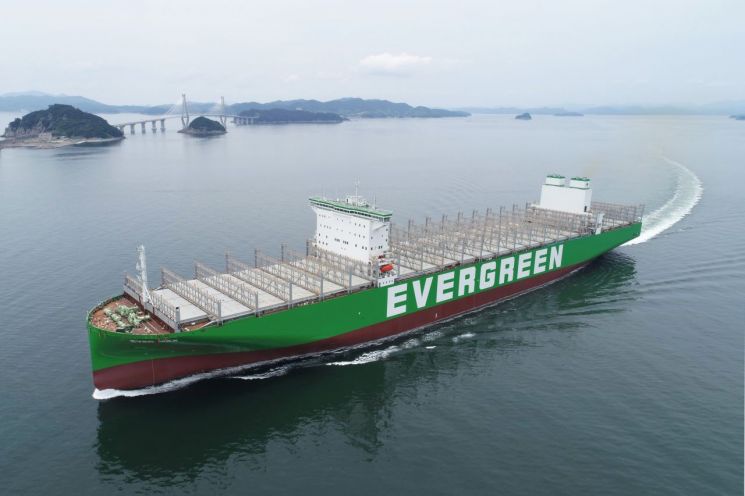 Samsung Heavy Industries announced on the 25th that it has completed a Pacific crossing demonstration by installing its artificial intelligence (AI) autonomous navigation system, SAS (Samsung Autonomous Ship), on a 15,000 TEU container ship belonging to Evergreen Taiwan. The photo shows the Evergreen 15,000 TEU container ship. Samsung Heavy Industries
 Photo by Samsung Heavy Industries
Securing punctuality in maritime transport is challenging due to variables such as adverse weather conditions. When vessels arrive late, it leads to increased logistics costs and supply chain disruptions, making weather-based speed control a highly sought-after technology in the shipping industry. This demonstration is considered to show that autonomous navigation can go beyond simple collision avoidance to provide tangible support for fuel savings and on-time operations.
Lee Dongyeon, Executive Vice President and Director of the Shipbuilding & Marine Research Institute at Samsung Heavy Industries, stated, "SAS has evolved beyond the collision avoidance assistance stage to maintaining economical speeds and ensuring timely arrivals. We believe it can contribute to the global shipping and logistics industry in terms of fuel efficiency and environmental sustainability."
SAS is an autonomous navigation solution that Samsung Heavy Industries began developing in 2019. By integrating radar and camera footage, it recognizes the surrounding environment and automatically controls the engine and rudder to avoid collisions. It is also equipped with AI-based perception capabilities that monitor the vessel's surroundings day and night without blind spots.
Samsung Heavy Industries plans to further expand its collaboration with Evergreen, moving beyond speed optimization to route optimization. Through this, the company aims to achieve measurable fuel savings and enhance its ability to comply with environmental regulations.
© The Asia Business Daily(www.asiae.co.kr). All rights reserved.

















